Why surprises temporarily blind us
March 11, 2010
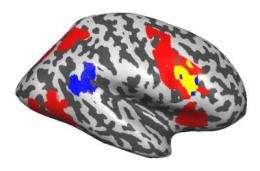
Brain regions that are active when an individual was actively searching for a target letter are shown in red; those that reacted to a surprise stimulus are shown in blue. The inferior frontal junction, shown in yellow, was involved in both processes and is believed to play a primary role in coordinating the two different types of attention. Credit: Christopher Asplund
Reading this story requires you to willfully pay attention to the sentences and to tune out nearby conversations, the radio and other distractions. But if a fire alarm sounded, your attention would be involuntarily snatched away from the story to the blaring sound.
New research from Vanderbilt University reveals for the first time how our brains coordinate these two types of attention and why we may be temporarily blinded by surprises.
The research was published March 7, 2010, in Nature Neuroscience.
"The simple example of having your reading interrupted by a fire alarm illustrates a fundamental aspect of attention: what ultimately reaches our awareness and guides our behavior depends on the interaction between goal-directed and stimulus-driven attention. For coherent behavior to emerge, you need these two forms of attention to be coordinated," René Marois, associate professor of psychology and co-author of the new study, said. "We found a brain area, the inferior frontal junction, that may play a primary role in coordinating these two forms of attention."
The researchers were also interested in what happens to us when our attention is captured by an unexpected event.
"We wanted to understand what caused limitations in our conscious perception when we are surprised," Christopher Asplund, a graduate student in the Department of Psychology and primary author of the new study, said. "We found that when shown a surprise stimulus, we are temporarily blinded to subsequent events."
In their study, the research team asked individuals to detect the letter "X" in a stream of letters appearing on a screen while their brain activity was being monitored using functional magnetic resonance imaging, or fMRI. Occasionally, an image of a face would unexpectedly interrupt the stream.
The surprise caused the subject to completely miss the "X" the first couple of times, despite the fact they were staring directly at the part of the screen on which it appeared. They were eventually able to identify it as successfully as when there was no surprise.
Using fMRI, the researchers found that the inferior frontal junction, a region of the lateral prefrontal cortex, was involved in both the original task and in the reaction to the surprise.
"What we think might be happening is that this brain area is coordinating different attention systems - it has a response both when you are controlling your attention and when you feel as though your attention is jerked away," Asplund said.
Surprise stimuli trigger what is known as the orienting response in which the heart rate increases, the nervous system is more aroused and we pay intense attention to a new item in our environment. Described by Pavlov in dogs, the orienting response allows one to determine if a new item is a good thing, such as food, or a threat, such as a predator, and to react accordingly.
"What we show is the dark side or negative impact of the orienting response. We found it blinds you to other events that can occur soon after the presentation of the surprise stimulus," Marois said.
The researchers hypothesize that we may be temporarily blinded by surprise because the surprise stimulus and subsequent response occupies so much of our processing ability.
"The idea is that we can't attend to everything at once," Asplund said. "It seems that the inferior frontal junction is involved in this limitation in attention."
The new research supports previous work by Marois' laboratory that found the interior frontal junction plays the role of an attentional bottleneck - limiting our ability to multitask and attend to many things at once.
"These new findings and our previous findings suggest that this area is centrally involved in the control of attention and may limit our attentional capacities," Marois said. "It is a very exciting convergence of findings across our studies. We're conducting studies now to demonstrate whether in fact disruption of activity in this brain region leads to loss of control of attention."
-
A real attention grabber
Dec 02, 2007 |
not rated yet |
0
-
Paying attention sets off symphony of cell synchronization
Dec 20, 2006 |
not rated yet |
0
-
Neural bottleneck found that thwarts multi-tasking
Jan 18, 2007 |
not rated yet |
0
-
Brain studies reveal the mechanisms of the voluntary control of visual attention
Jan 04, 2007 |
not rated yet |
0
-
Study: Training improves attention in kids
Sep 27, 2005 |
not rated yet |
0
-
Engineers build first sub-10-nm carbon nanotube transistor
Feb 01, 2012 |
4.9 / 5 (30) |
30
-
Something old, something new: Evolution and the structural divergence of duplicate genes
Jan 31, 2012 |
4.6 / 5 (7) |
1
-
The hidden nanoworld of ice crystals: Revealing the dynamic behavior of quasi-liquid layers
Jan 30, 2012 |
5 / 5 (3) |
1
-
Stock market network reveals investor clustering
Jan 27, 2012 |
3.9 / 5 (23) |
8
-
Of microchemistry and molecules: Electronic microfluidic device synthesizes biocompatible probes
Jan 26, 2012 |
5 / 5 (1) |
0
-
Is Everyday Technology Killing Us?
Feb 08, 2012
-
Exercise and weight loss
Feb 08, 2012
-
Why do we have head aches? Our brains can't feel anything.
Feb 07, 2012
-
"The end of diseases" by David Agus, interview from Daily Show with Jon Stewart
Feb 04, 2012
-
Oncolytic adenovirus
Feb 04, 2012
-
Nutrition label stuffs and diets
Feb 02, 2012
- More from Physics Forums - Medical Sciences
More news stories
FDA-approved drug rapidly clears amyloid from the brain, reverses Alzheimer's symptoms in mice
Neuroscientists at Case Western Reserve University School of Medicine have made a dramatic breakthrough in their efforts to find a cure for Alzheimer's disease. The researchers' findings, published in the journal Science, show t ...
Medicine & Health / Neuroscience
11 hours ago |
4.9 / 5 (32) |
14
|
Anyone can learn to be more inventive, cognitive researcher says
There will always be a wild and unpredictable quality to creativity and invention, says Anthony McCaffrey, a cognitive psychology researcher at the University of Massachusetts Amherst, because an "Aha moment" is rare and ...
Medicine & Health / Psychology & Psychiatry
7 hours ago |
4.8 / 5 (5) |
0
|
Cell biologists describes mechanism by which some people may be more susceptible to colon cancer
An international research team led by cell biologists at the University of California, Riverside has uncovered a new insight into colon cancer, the third leading cause of cancer-related deaths in the United ...
7 hours ago |
5 / 5 (2) |
0
|
Researchers weigh in on ethics of H5N1 research
(Medical Xpress) -- In a commentary on the biosecurity controversy surrounding publication of bird flu research details, a bioethicist and a vaccine expert at Johns Hopkins reaffirm that "all scientists have an affirmativ ...
9 hours ago |
not rated yet |
0
|
To perform with less effort, practice beyond perfection
Whether you are an athlete, a musician or a stroke patient learning to walk again, practice can make perfect, but more practice may make you more efficient, according to a surprising new University of Colorado Boulder study.
Medicine & Health / Neuroscience
10 hours ago |
4.5 / 5 (8) |
3
|
'Dark plasmons' transmit energy
Microscopic channels of gold nanoparticles have the ability to transmit electromagnetic energy that starts as light and propagates via "dark plasmons," according to researchers at Rice University.
Hydrogen from acidic water: Researchers develop potential low cost alternative to platinum for splitting water
A technique for creating a new molecule that structurally and chemically replicates the active part of the widely used industrial catalyst molybdenite has been developed by researchers with the Lawrence Berkeley ...
Ultraviolet protection molecule in plants yields its secrets
Lying around in the sun all day is hazardous not just for humans but also for plants, which have no means of escape. Ultraviolet (UV) radiation from the sun can damage proteins and DNA inside cells, leading ...
New method makes culture of complex tissue possible in any lab
Scientists at the University of California, San Diego have developed a new method for making scaffolds for culturing tissue in three-dimensional arrangements that mimic those in the body. This advance, published online in ...
Flexible paper robots
(PhysOrg.com) -- These inexpensive robots can stretch, bend and twist under control, and lift objects up to 120 times their own weight. Being soft, they can apply gentle and even pressure, and adapt to varied ...
Soraa LED light may dim 50-watt halogen rivals
(PhysOrg.com) -- Soraa, a Fremont, California company founded in 2008, this week launched its first product, a light that uses LEDS (light emitting diodes). The "Soraa LED MR16 lamp" is the "perfect" replacement ...
Mar 11, 2010
Rank: 5 / 5 (1)
Mar 11, 2010
Rank: not rated yet
Mar 11, 2010
Rank: 5 / 5 (1)