Scientists discover 600 million-year-old origins of vision
March 11, 2010
Scientists at UCSB discover 600 million-year-old origins of vision

Enlarge

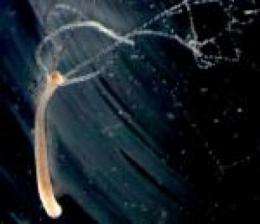
This is a hydra, an ancient sea creature that flourishes today. Credit: Todd Oakley, UCSB

By studying the hydra, a member of an ancient group of sea creatures that is still flourishing, scientists at UC Santa Barbara have made a discovery in understanding the origins of human vision. The finding is published in this week's issue of the Proceedings of the Royal Society B, a British journal of biology.

Hydra are simple animals that, along with , belong to the phylum cnidaria. Cnidarians first emerged 600 million years ago.

"We determined which genetic 'gateway,' or , in the hydra is involved in light sensitivity," said senior author Todd H. Oakley, assistant professor in UCSB's Department of Ecology, Evolution and Marine Biology. "This is the same gateway that is used in human vision."

Oakley explained that there are many genes involved in vision, and that there is an ion channel gene responsible for starting the neural impulse of vision. This gene controls the entrance and exit of ions; i.e., it acts as a gateway.

The gene, called opsin, is present in vision among vertebrate animals, and is responsible for a different way of seeing than that of animals like flies. The vision of insects emerged later than the visual machinery found in hydra and vertebrate animals.

"This work picks up on earlier studies of the in my lab, and continues to challenge the misunderstanding that evolution represents a ladder-like march of progress, with humans at the pinnacle," said Oakley. "Instead, it illustrates how all organisms -- humans included -- are a complex mix of ancient and new characteristics."

Provided by University of California - Santa Barbara (news : web)

4.4 /5 (20 votes)  

Rank 4.4 /5 (20 votes)
Related Stories
Relevant PhysicsForums posts
  • Pertubance in a model
    created2 hours ago
  • Cancer drugs and Alzheimer's, Oh my!
    created11 hours ago
  • Squishing cells
    created11 hours ago
  • Any books/articles for evolutionary stable strategy models in humans?
    created22 hours ago
  • Science behind the bore feeling?
    createdFeb 09, 2012
  • Homo Sapien vs. Chimpanzee - Divergence Timeline
    createdFeb 09, 2012
  • More from Physics Forums - Biology

More news stories

The power of estrogen -- male snakes attract other males

A new study has shown that boosting the estrogen levels of male garter snakes causes them to secrete the same pheromones that females use to attract suitors, and turned the males into just about the sexiest ...

Biology / Plants & Animals

created 57 minutes ago | popularity not rated yet | comments 0 | with audio podcast

Experts reveal how plants don't get sunburn

(PhysOrg.com) -- Experts at the University of Glasgow have discovered how plants survive the harmful rays of the sun.

Biology / Cell & Microbiology

created 44 minutes ago | popularity 5 / 5 (1) | comments 0 | with audio podcast

New drugs schedule makes horse racing a sure thing

What do Gai Waterhouse and Anthony Cummings have in common with Queen Elizabeth II?

Biology / Plants & Animals

created 56 minutes ago | popularity not rated yet | comments 0

Miami battling invasion of giant African snails

No one knows how they got there. But an invasion of African giant snails has southern Florida in a panic over potential crop damage, disease and general yuckiness surrounding the slimy gastropods.

Biology / Ecology

created 4 hours ago | popularity not rated yet | comments 2

Protein libraries in a snap

(PhysOrg.com) -- A Rice University undergraduate will depart with not only a degree but also a possible patent for his invention of an efficient way to create protein libraries, an important component of biomolecular ...

Biology / Cell & Microbiology

created 4 hours ago | popularity 5 / 5 (1) | comments 0 | with audio podcast


Team isolates nerve cells involved in storing long term memory and gene proteins associated with them

(Medical Xpress) -- A research team in Taiwan has succeeded in isolating two nerve cells in fruit fly brains that are believed to be the major players in allowing for the formation of long term memories. Furthermore, ...

Fool's gold may prove an unlikely alternative to overexploited catalytic materials

Catalytic materials, which lower the energy barriers for chemical reactions, are used in everything from the commercial production of chemicals to catalytic converters in car engines. However, with current catalytic materials ...

SLAC, Stanford team focuses on high-energy electrons to treat cancer

Accelerator physicists at SLAC and cancer specialists from Stanford are working on a new technology that could dramatically reduce the time needed for cancer radiation treatments. The team ran an initial experiment ...

News of plaque-clearing drug tops week of major advances against Alzheimer's disease

In the last eight days, scientists have delivered a powerful one-two punch in the fight to defeat Alzheimer's disease. At the same time, the White House and members of Congress are proposing increases in Alzheimer's research ...

Unpicking HIV’s invisibility cloak

Drug researchers hunting for alternative ways to treat human immunodeficiency virus (HIV) infections may soon have a novel target—its camouflage coat. HIV hides inside a cloak unusually rich in a sugar ...

What lies beneath: Mapping hidden nanostructures

The ability to diagnose and predict the properties of materials is vital, particularly in the expanding field of nanotechnology. Electron and atom-probe microscopy can categorize atoms in thin sheets of material, ...