Cassini Data Show Ice and Rock Mixture Inside Titan
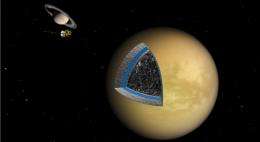
(PhysOrg.com) -- By precisely tracking NASA's Cassini spacecraft on its low swoops over Saturn's moon Titan, scientists have determined the distribution of materials in the moon's interior. The subtle gravitational tugs they measured suggest the interior has been too cold and sluggish to split completely into separate layers of ice and rock.
The finding, to be published in the March 12 issue of the journal Science, shows how Titan evolved in a different fashion from inner planets such as Earth, or icy moons such as Jupiter's Ganymede, whose interiors have split into distinctive layers.
"These results are fundamental to understanding the history of moons of the outer solar system," said Cassini Project Scientist Bob Pappalardo, commenting on his colleagues' research. Pappalardo is with NASA's Jet Propulsion Laboratory in Pasadena, Calif. "We can now better understand Titan's place among the range of icy satellites in our solar system."
Scientists have known that Titan, Saturn's largest moon, is about half ice and half rock, but they needed the gravity data to figure out how the materials were distributed. It turns out Titan's interior is a sorbet of ice studded with rocks that probably never heated up beyond a relatively lukewarm temperature. Only in the outermost 500 kilometers (300 miles) is Titan's ice devoid of any rock, while ice and rock are mixed to various extents at greater depth.
"To avoid separating the ice and the rock, you must avoid heating the ice too much," said David J. Stevenson, one of the paper's co-authors and a professor of planetary science at the California Institute of Technology in Pasadena. "This means that Titan was built rather slowly for a moon, in perhaps around a million years or so, back soon after the formation of the solar system."
This incomplete separation of ice and rock makes Titan less like Jupiter's moon Ganymede, where ice and rock have fully separated, and perhaps more like another Jovian moon, Callisto, which is believed to have a mixed ice and rock interior. Though the moons are all about the same size, they clearly have diverse histories.
The Cassini measurements help construct a gravity map, which may help explain why Titan has a stunted topography, since interior ice must be warm enough to flow slowly in response to the weight of heavy geologic structures, such as mountains.
Creating the gravity map required tracking minute changes in Cassini's speed along a line of sight from Earth to the spacecraft as it flew four close flybys of Titan between February 2006 and July 2008. The spacecraft took paths between about 1,300 to 1,900 kilometers (800 to 1,200 miles) above Titan.
"The ripples of Titan's gravity gently push and pull Cassini along its orbit as it passes by the moon and all these changes were accurately recorded by the ground antennas of the Deep Space Network within 5 thousandths of a millimeter per second [0.2 thousandths of an inch per second] even as the spacecraft was over a billion kilometers [more than 600 million miles] away," said Luciano Iess, a Cassini radio science team member at Sapienza University of Rome in Italy, and the paper's lead author. "It was a tricky experiment."
The results don't speak to whether Titan has an ocean beneath the surface, but scientists say this hypothesis is very plausible and they intend to keep investigating. Detecting tides induced by Saturn, a goal of the radio science team, would provide the clearest evidence for such a hidden water layer.
A Cassini interdisciplinary investigator, Jonathan Lunine, said of his colleagues' findings, "Additional flybys may tell us whether the crust is thick or thin today." Lunine is with the University of Rome, Tor Vergata, Italy, and the University of Arizona, Tucson. "With that information we may have a better understanding of how methane, the ephemeral working fluid of Titan's rivers, lakes and clouds, has been resupplied over geologic time. Like the history of water on Earth, this is fundamental to a deep picture of the nature of Titan through time."
Provided by JPL/NASA


