Did the Chilean Quake Shift Earth's Axis?
March 11, 2010 by Dr. Tony Phillips
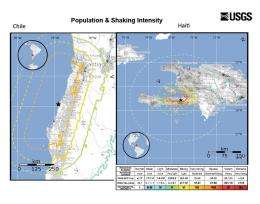
A USGS map of the Chilean quake.
Pictures of widespread devastation leave no doubt: Last month's 8.8 magnitude earthquake in coastal Chile was extremely strong. Indeed, say NASA scientists, it might have shifted the axis of Earth itself.
"According to our calculations, the quake moved Earth's figure axis by about 3 inches (8 cm)," says geophysicist Richard Gross of the Jet Propulsion Laboratory in Pasadena, California.
If the Earth tilted over 3 inches, you probably think you would have noticed. But that's not how the "figure axis" works. "The figure axis defines not how Earth is tilted, but rather how it is balanced," says Gross.
Consider the following:
Earth is not a perfect sphere. Continents and oceans are distributed unevenly around the planet. There's more land in the north, more water in the south, a great ocean in the west, and so on. As a result of these asymmetries, Earth slowly wobbles as it spins. The figure axis is Earth's axis of mass balance, and the spin axis wobbles around it.
"The Chilean quake shifted enough material to change the mass balance of our entire planet," Gross says.
A shifting figure axis is nothing new. On its own, the figure axis moves about 10 centimeters per year as a result of "Ice Age rebound." After the last great glacial period some 11,000 years ago, many heavy ice sheets disappeared. This unloaded the crust and mantle of the Earth, allowing the planet to relax or "rebound" back into a more spherical shape. The rebounding process is still underway and so the figure axis naturally moves.
On Feb. 27, 2010, the Chilean quake may have moved the figure axis as much in a matter of minutes as it normally moves in a whole year. It was a truly seismic shift—no pun intended.
So far, however, it's all calculation and speculation. "We haven't actually measured the shift," says Gross. "But I intend to give it a try."
The key is GPS1. "Using a global network of GPS receivers, we can monitor the rotation of Earth with high precision," he says. "Changes in Earth's spin and the orientation of Earth's axes affect [the phase and timing of] signals we get from the satellites in Earth orbit."
GPS is already used to monitor seasonal changes in Earth's spin. It turns out that tides, winds, ocean currents, and circulation patterns in Earth's molten core modulate Earth's rotation on a regular basis. For instance, a typical day in January is about 1 millisecond longer than a typical day in June. The roughly six-month variation is driven mainly by seasonal winds; there are also changes on time scales of weeks, years, decades and centuries.
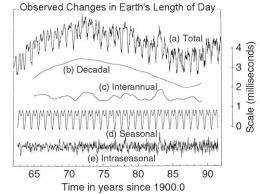
Observed changes in Earth's length of day caused by tides, winds, ocean currents and other factors. From Treatise on Geophysics, 2007, section 3.09, "Earth Rotation Variations--Long Period" by Richard Gross.
Earthquakes throw a "spike" into GPS signals, which Gross believes he can find."I have to take the GPS Earth rotation measurements and subtract the effects of tides, winds and ocean currents," he explains. "Then the earthquake should stand out."
Recent news reports have focused on Earth's length of day, noting that the Chilean earthquake might have shortened days by as much as 1.26 microseconds out of 24 hours. That's true. But it's also negligible compared to the normal effect of wind and tides, which can lengthen or shorten days a thousand times more than earthquakes can.
The real news, as Gross sees it, is the possible shift in Earth's figure axis. He has a very "JPL perspective" on the issue: "The antennas we use to track spacecraft en route to Mars and elsewhere are located on Earth. If our tracking platform shifts, we need to know about it."
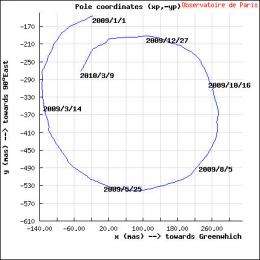
The normal wobble of Earth's axis since Jan. 2009 as reported by the International Earth Rotation Service. The grid is scaled in milliarcseconds (mas); 1 mas = 1/3,600,000 deg.
No one has ever measured a shift in Earth's axis due to an earthquake before. Back in 2004, Gross looked for a shift from the magnitude 9.1 earthquake in Sumatra, but failed to find a signal. The Sumatra quake was less effective in altering Earth's figure axis because of its location near the equator and the orientation of the underlying fault. The Chilean quake, albeit weaker, may have produced a bigger shift.The stage is set for discovery. "Computing power is at an all-time high. Our models of tides, winds and ocean currents have never been better. And the orientation of the Chilean fault favors a stronger signal."
In a few months Gross hopes to have the answer. Stay tuned.
Source: Science@NASA, by Dr. Tony Phillips
-
Chilean Quake May Have Shortened Earth Days
Mar 02, 2010 |
not rated yet |
0
-
Two More Earth's Chandler Wobble Jumps Revealed, Last in 2005
Sep 02, 2009 |
not rated yet |
0
-
Probing Question: Why does the Earth rotate?
Aug 06, 2007 |
not rated yet |
0
-
Warming oceans may diminish length of day
May 07, 2007 |
not rated yet |
0
-
Long debate ended over cause, demise of ice ages -- may also help predict future
Aug 06, 2009 |
not rated yet |
0
-
Engineers build first sub-10-nm carbon nanotube transistor
Feb 01, 2012 |
4.9 / 5 (31) |
30
-
Something old, something new: Evolution and the structural divergence of duplicate genes
Jan 31, 2012 |
4.6 / 5 (7) |
1
-
The hidden nanoworld of ice crystals: Revealing the dynamic behavior of quasi-liquid layers
Jan 30, 2012 |
5 / 5 (3) |
1
-
Stock market network reveals investor clustering
Jan 27, 2012 |
3.9 / 5 (23) |
8
-
Of microchemistry and molecules: Electronic microfluidic device synthesizes biocompatible probes
Jan 26, 2012 |
5 / 5 (1) |
0
-
Discrepancy between oxygen and carbon-dioxide levels
Feb 09, 2012
-
where gems are found in the world
Feb 09, 2012
-
Wind Waves in Reservoir ~ Wind run-up and Wind set-up
Feb 08, 2012
-
Balance of oxygen in the atmosphere
Feb 01, 2012
-
The case for a methanol-based economy
Jan 30, 2012
-
Weather in a rotating cylinder
Jan 25, 2012
- More from Physics Forums - Earth
More news stories
Humans may have helped the decline of African rainforests 3000 years ago
(PhysOrg.com) -- Large areas of rainforests in Central Africa mysteriously disappeared over three thousand years ago, to be replaced by savannas. The prevailing theory has been that the cause was a change ...
Could Venus be shifting gear?
(PhysOrg.com) -- ESAs Venus Express spacecraft has discovered that our cloud-covered neighbour spins a little slower than previously measured. Peering through the dense atmosphere in the infrared, the ...
Space & Earth / Space Exploration
19 hours ago |
5 / 5 (7) |
8
|
NASA budget will axe Mars deal with Europe: scientists
US President Barack Obama's budget proposal to be submitted next week for 2013 will cut NASA's budget by 20 percent and eliminate a major partnership with Europe on Mars exploration, scientists said Thursday.
Space & Earth / Space Exploration
22 hours ago |
5 / 5 (2) |
19
Mars Science Laboratory computer issue resolved
(PhysOrg.com) -- Engineers have found the root cause of a computer reset that occurred two months ago on NASA's Mars Science Laboratory and have determined how to correct it.
Space & Earth / Space Exploration
20 hours ago |
4.7 / 5 (6) |
4
|
Two new moons for Jupiter
Advances in technology have lead to the discovery of new planets outside of our Solar System, and now even new moons in our own backyard.
Space & Earth / Space Exploration
19 hours ago |
4 / 5 (1) |
7
Anonymous knocks CIA website offline (Update)
The website of the Central Intelligence Agency was inaccessible on Friday after the hacker group Anonymous claimed to have knocked it offline.
New error-correcting codes guarantee the fastest possible rate of data transmission
Error-correcting codes are one of the triumphs of the digital age. Theyre a way of encoding information so that it can be transmitted across a communication channel such as an optical fiber o ...
New power source discovered
(PhysOrg.com) -- Researchers at the Massachusetts Institute of Technology (MIT) and RMIT University have made a breakthrough in energy storage and power generation.
Small modular reactor design could be a 'SUPERSTAR'
(PhysOrg.com) -- Though most of today's nuclear reactors are cooled by water, we've long known that there are alternatives; in fact, the world's first nuclear-powered electricity in 1951 came from a reactor ...
The power of estrogen -- male snakes attract other males
A new study has shown that boosting the estrogen levels of male garter snakes causes them to secrete the same pheromones that females use to attract suitors, and turned the males into just about the sexiest ...
Google users warned of threat to smartphone wallets
Users of Google smartphone wallets were being warned on Friday that there is a way to crack pass codes intended to thwart thieves from going on illicit shopping sprees.


Mar 12, 2010
Rank: not rated yet
Mar 12, 2010
Rank: not rated yet
Which reminds me, as a child I once was at an airport in Lapland, and there was this brass line across the lounge floor, with the text Arctic Circle. I wondered whether that was just BS, since I'd expect the circle to move every year.
The latter graph, above, proves the case.