New charging method could greatly reduce battery recharge time
March 11, 2010 by Lisa Zyga
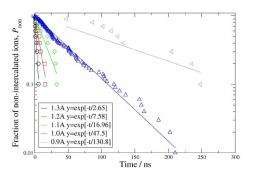
This figure shows the fraction of non-intercalated lithium ions per time, with the different colors representing different amplitudes of the applied oscillating field (A = 5 kCal/mol). The denominator in the exponential is the average intercalation time in nanoseconds, showing that a larger amplitude field speeds up ion intercalation. Credit: Hamad, et al.
(PhysOrg.com) -- Part of the headache of having to constantly recharge batteries is not just how often they need to be charged, but also the time it takes to charge them. In a new study, researchers have proposed a charging method that could greatly reduce the charging time of lithium-ion batteries, which are used in everything from electronic devices to electric vehicles. The new method uses an additional oscillating electric field (besides the charging field) that should be capable of charging a lithium-ion battery in a fraction of the time compared with traditional methods.
Researchers Ibrahim Abou Hamad from Mississippi State University and coauthors have developed the new charging method thanks to revolutionary developments in molecular dynamics simulations. In their study, the researchers simulated the lithium-ion battery-charging process by simulating the intercalation (i.e. “insertion”) of lithium ions into the battery’s graphite anode. Although intercalation is just one part of the charging process (along with diffusion), it dominates the charging time.
In the charging process, lithium ions first diffuse within the battery’s electrolyte until they reach the graphite anode. At this interface, ions must overcome an energy barrier in order to be intercalated into the anode.
In their simulations, Hamad and his team found that an additional oscillating electric field can lower this energy barrier, enabling lithium ions to intercalate more quickly into the anode. The oscillating field also increases the diffusion rate, which helps further reduce the overall charging time, albeit to a lesser extent.
Specifically, when the scientists applied an oscillating square-wave field with a frequency of 25 GHz and an amplitude of 5 kCal/mol to the graphite sheets in the anode, the lithium ions intercalated into the graphite sheets within an average time of about 50 nanoseconds. By changing the amplitude of the oscillating wave, the researchers found that they could further improve charging time by lowering the energy barrier and speeding up intercalation. Their simulations showed that the dependence of the intercalation time on the amplitude is exponential, meaning that a small increase in amplitude leads to a large increase the intercalation speed, which offers the potential for very fast charging times.
In the future, the researchers plan to further investigate the new method, including analyzing how changing the frequency of the oscillating field effects the charging time. They noted that the new method might provide an increase in battery power densities, as well.
More information: Ibrahim Abou Hamad, M. A. Novotny, D. Wipf, and P. A. Rikvold. “A new battery-charging method suggested by molecular dynamics simulations.” Available at arxiv.org. Doi: 10.1039/b920970k.
via: Technology Review
© 2010 PhysOrg.com
-
Increasing Electric Car Battery Performance
Sep 23, 2009 |
not rated yet |
0
-
Nanoball Batteries Could Charge Electric Cars in 5 Minutes
Mar 12, 2009 |
not rated yet |
0
-
Scientists Working Toward Better Batteries
Mar 09, 2006 |
not rated yet |
0
-
'Core-Shell' Silicon Nanowires May Improve Lithium-Ion Batteries
Jan 20, 2009 |
not rated yet |
0
-
Tin-sulfur-lithium-ion battery as alternative to conventional lithium batteries
Mar 11, 2010 |
not rated yet |
0
-
Engineers build first sub-10-nm carbon nanotube transistor
Feb 01, 2012 |
4.9 / 5 (29) |
30
-
Something old, something new: Evolution and the structural divergence of duplicate genes
Jan 31, 2012 |
4.6 / 5 (7) |
1
-
The hidden nanoworld of ice crystals: Revealing the dynamic behavior of quasi-liquid layers
Jan 30, 2012 |
5 / 5 (3) |
1
-
Stock market network reveals investor clustering
Jan 27, 2012 |
4 / 5 (22) |
8
-
Of microchemistry and molecules: Electronic microfluidic device synthesizes biocompatible probes
Jan 26, 2012 |
5 / 5 (1) |
0
-
How is zeno paradox of motion solved
1 hour ago
-
Good books for studying physics on own
2 hours ago
-
Kinetic energy and crumple zones
4 hours ago
-
Finding the E field with a changing p???
7 hours ago
-
All matter being liquid in 10^65 years if proton decay doesn't occur.
8 hours ago
-
The acceleration of an Elephant and a Paper Clip
8 hours ago
- More from Physics Forums - General Physics
More news stories
Hints of the Higgs - papers are submitted
Back in December 2011, the ATLAS and CMS experiments at CERN presented some exciting results that provided tantalising hints of the Higgs boson.
18 minutes ago |
not rated yet |
0
Physicists 'record' magnetic breakthrough
An international team of scientists has demonstrated a revolutionary new way of magnetic recording which will allow information to be processed hundreds of times faster than by current hard drive technology.
16 hours ago |
4.4 / 5 (30) |
13
|
Diamond light, brighter than the sun
Its the size of five football pitches and generates light 10 billion times brighter than the sun. As the Diamond Light Source celebrates its tenth anniversary this year, Penny Bailey visits one of the ...
19 hours ago |
4.3 / 5 (6) |
14
|
With single laser pulses on single molecules
(PhysOrg.com) -- Physicists at MPQ (Max Planck Institute) succeed in resolving the internal dynamics of individual molecules using UV femtosecond laser pulses.
20 hours ago |
5 / 5 (1) |
1
|
Searching for a solid that flows like a liquid
(PhysOrg.com) -- A series of neutron scattering experiments at Oak Ridge National Laboratory and other research centers is exploring the key question about a long-sought quantum state of matter called supersolidity: ...
Feb 03, 2012 |
4.3 / 5 (7) |
17
|
Scared of a younger rival? Not for some male songbirds
When mature male white-crowned sparrows duel to win a mate or a nesting territory, a young bird just doesn't get much respect.
Tiny primate 'talks' in ultrasound
One of the world's smallest primates, the Philippine tarsier, communicates in a range of ultrasound inaudible to predator and prey alike, according to a study published on Wednesday.
Playing school sports affects youths' smoking
Young people's choices about using drugs and alcohol are influenced by peersnot only close friends, but also sports teammates. A new study of middle schoolers and their social networks has found that teammates' smoking ...
New study: Adolescents suffering from depression more likely to be bullied
A new study provides evidence that adolescents who suffer from depression are more likely to develop difficulty in peer relationships including being bullied at school.
Preventing bacteria from falling in with the wrong crowd could help stop gum disease
Stripping some mouth bacteria of their access key to gangs of other pathogenic oral bacteria could help prevent gum disease and tooth loss. The study, published in the journal Microbiology suggests that t ...
New study sheds light on genetics of rice metabolism
A large-scale study analyzing metabolic compounds in rice grains conducted by researchers at the RIKEN Plant Science Center (PSC) and their collaborators has identified 131 rice metabolites and clarified the ...
Mar 11, 2010
Rank: 4 / 5 (1)
Mar 12, 2010
Rank: 4 / 5 (1)
Mar 12, 2010
Rank: 3 / 5 (1)
But maybe even lower frequencies could work in sufficient way. After all, the charging with AC component is used widely, as it decreases the tendency to formation of dendrites in certain batteries.
Mar 12, 2010
Rank: 3 / 5 (1)
Mar 12, 2010
Rank: 5 / 5 (2)
Mar 12, 2010
Rank: 3.7 / 5 (3)
Mar 12, 2010
Rank: 3.5 / 5 (4)
Applying 25 GHz Ac has probably only one real effect - it is heating the battery. That is why it reduced impedance and increases charging rate. They should measure the battery impedance and compensate it for temperature and they will see that there is no difference if you heat it with 25 GHz AC or just with a thermal chamber.
Now, heating the battery (while decreasing impedance and
therefore increasing charging rate) is not without consequences. It is well known that it accelerates battery degradation. For example cycle life at 25C is 3 times longer than that at 60C. Heating during charge is
specially harmful, that is why new Japanese charging standard specifically requires to reduce charging rate at higher temperatures.
Regards,
Yevgen
Mar 12, 2010
Rank: 1 / 5 (1)
Why? Super capacitors have their own problems, not least of which is low capacity, and the ability to discharge instantly when shorted (the technical term is the kaboom factor). Note that the kaboom factor goes up with the capacity.
Mar 13, 2010
Rank: not rated yet
Mar 13, 2010
Rank: not rated yet
http://www.youtub..._TBzD49Y
Mar 13, 2010
Rank: not rated yet
Supercapacitor: low power density; able to accept (and donate) energy quickly; voltage is dependent on energy stored.
Battery: high power density (about a factor of ten higher per unit weight than supercapacitors); able to accept (and donate) energy slowly; voltage stays roughly the same until battery is nearly empty.
Mar 14, 2010
Rank: not rated yet
Mar 18, 2010
Rank: not rated yet
Mar 18, 2010
Rank: not rated yet
and its still true -- i felt a couple earlier poster missed the point that u STILL have to charge the capacitor and that is 4*RC so the bigger the capaitor the longer it takes to charge to close to full capacity -- I didn't feel i needed to explain further - but since it was POINTLESS VERBAIGE I decided to clarify for the psyorg moderator because they didn't understand that the article is about short charge times in a battery and previous posts could inspire unique responces.