Chopper Crash Test a Smash Hit (w/ Video)
March 11, 2010 by Kathy Barnstorff
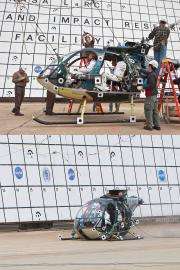
The MD-500 before and after the drop test. Credit: NASA/Sean Smith
The second crash test of a small lightweight helicopter at NASA's Langley Research Center in Hampton, Va., was a smashing success, literally -- just as engineers had predicted.
"Three, two, one, release," said the technician on the loudspeaker at the Landing and Impact Research Facility. With that countdown the helicopter smacked hard into the concrete. Its skid gear collapsed, its windscreen cracked open and its occupants lurched forward violently, suffering potentially spine-crushing injuries according to internal data recorders. The crash test was all in the name of research to try to make helicopters safer.
"The goal of any research program that has an element of impact dynamics is to develop an understanding of the crash response of the vehicle," said Karen Jackson, an aerospace engineer who oversaw the test. "Once we understand that response we can look at ways to improve the crash performance."
This video is not supported by your browser at this time.
In December 2009 researchers dropped the same MD-500 at a similar angle from the same height of 35 feet (10.7 m). Inside were the same instruments that collected 160 channels of data and the same four crash test dummies. Three of the dummies were full bodies and one was a special torso model equipped with simulated internal organs. Technicians set up the same cameras to record the impact from inside and outside the helicopter.The test conditions on both days were the same too, simulating what would be a relatively severe but survivable helicopter crash. The flight path angle was about 33 degrees and the combined forward and vertical speeds were about 48 feet per second or 33 miles per hour (53.1 kph).
In the first test the MD-500 skidded to a stop, with very little damage to the helicopter or its silent occupants, because its underside was outfitted with an expandable honeycomb cushion called a deployable energy absorber.
"It's made of Kevlar and has a unique flexible hinge design that allows the honeycomb to be packaged and remain flat until needed," said Sotiris Kellas, the Langley engineer who created the idea as a way to cushion the next generation of astronaut-carrying space capsules, but realized it could be used in other ways.
The more recent drop on March 10, 2010 involved just the helicopter. No new technology was attached. That was the point. Engineers wanted to determine exactly how efficient the deployable energy absorber had been in the earlier test and how much it might help reduce occupant injuries. So they dropped the same helicopter in the same way and measured and recorded the same conditions with the same instruments.
"We were fortunate enough that the helicopter survived so well the first time that we could use it again," said engineer Martin Annett.
There will be no third crash test for this helicopter. It was too damaged. Researchers say the "g" forces the MD-500 experienced more than tripled those recorded in the previous test. But that doesn't mean the research is over. Engineers have gigabytes of data to analyze to confirm exactly what impact the new honeycomb cushion technology might have for helicopters in the future.
The drop tests were conducted by the Subsonic Rotary Wing Project of NASA's Fundamental Aeronautics Program, and funded by the agency's Aeronautics Research Mission Directorate in Washington.
-
Engineers to create parts of virtual crash test dummy
Dec 11, 2008 |
not rated yet |
0
-
In Brief: Iridium helps helicopter tracking
Apr 17, 2006 |
not rated yet |
0
-
Helicopter flight trials for EGNOS
Jul 18, 2007 |
not rated yet |
0
-
Micro flying robots can fly more effectively than flies
Aug 01, 2009 |
not rated yet |
0
-
Next-Generation Space Vehicle Tested in Pacific Ocean Drop
Aug 09, 2005 |
not rated yet |
0
-
Engineers build first sub-10-nm carbon nanotube transistor
Feb 01, 2012 |
4.9 / 5 (31) |
30
-
Something old, something new: Evolution and the structural divergence of duplicate genes
Jan 31, 2012 |
4.6 / 5 (7) |
1
-
The hidden nanoworld of ice crystals: Revealing the dynamic behavior of quasi-liquid layers
Jan 30, 2012 |
5 / 5 (3) |
1
-
Stock market network reveals investor clustering
Jan 27, 2012 |
3.9 / 5 (23) |
8
-
Of microchemistry and molecules: Electronic microfluidic device synthesizes biocompatible probes
Jan 26, 2012 |
5 / 5 (1) |
0
-
Scale of the Universe
5 hours ago
-
Titan's lack of impact craters
Feb 09, 2012
-
Real pictures of black hole eating a star?
Feb 08, 2012
-
Hypothetical way to travel faster than light, but not technically exceed lightspeed
Feb 06, 2012
-
How do scientists monitor the Sun's activity?
Feb 05, 2012
-
Search patterns in observational studies
Feb 05, 2012
- More from Physics Forums - General Astronomy
More news stories
Humans may have helped the decline of African rainforests 3000 years ago
(PhysOrg.com) -- Large areas of rainforests in Central Africa mysteriously disappeared over three thousand years ago, to be replaced by savannas. The prevailing theory has been that the cause was a change ...
NASA sees wide-eyed cyclone Jasmine
Cyclone Jasmine's eye has opened wider on NASA satellite imagery, as it moves through the Southern Pacific Ocean.
Space & Earth / Earth Sciences
4 hours ago |
2 / 5 (1) |
1
Could Venus be shifting gear?
(PhysOrg.com) -- ESAs Venus Express spacecraft has discovered that our cloud-covered neighbour spins a little slower than previously measured. Peering through the dense atmosphere in the infrared, the ...
Space & Earth / Space Exploration
12 hours ago |
5 / 5 (7) |
7
|
NASA sees Giovanna reach cyclone strength, threaten Madagascar
Tropical Storm 12S built up steam and became a cyclone on February 10, 2012 as NASA's Terra satellite passed overhead. Residents of east-central Madagascar should prepare for this cyclone to make landfall ...
Space & Earth / Earth Sciences
4 hours ago |
not rated yet |
0
Mars Science Laboratory computer issue resolved
(PhysOrg.com) -- Engineers have found the root cause of a computer reset that occurred two months ago on NASA's Mars Science Laboratory and have determined how to correct it.
Space & Earth / Space Exploration
13 hours ago |
4.7 / 5 (6) |
3
|
Google users warned of threat to smartphone wallets
Users of Google smartphone wallets were being warned on Friday that there is a way to crack pass codes intended to thwart thieves from going on illicit shopping sprees.
Anonymous knocks CIA website offline (Update)
The website of the Central Intelligence Agency was inaccessible on Friday after the hacker group Anonymous claimed to have knocked it offline.
Complex wiring of the nervous system may rely on a just a handful of genes and proteins
Researchers at the Salk Institute have discovered a startling feature of early brain development that helps to explain how complex neuron wiring patterns are programmed using just a handful of critical genes. ...
New error-correcting codes guarantee the fastest possible rate of data transmission
Error-correcting codes are one of the triumphs of the digital age. Theyre a way of encoding information so that it can be transmitted across a communication channel such as an optical fiber o ...
The power of estrogen -- male snakes attract other males
A new study has shown that boosting the estrogen levels of male garter snakes causes them to secrete the same pheromones that females use to attract suitors, and turned the males into just about the sexiest ...
Putting the squeeze on planets outside our solar system
(PhysOrg.com) -- Using high-powered lasers, scientists at Lawrence Livermore National Laboratory and collaborators discovered that molten magnesium silicate undergoes a phase change in the liquid state, abruptly ...
Mar 11, 2010
Rank: not rated yet
Mar 11, 2010
Rank: 5 / 5 (1)
In the first test, the helicopter was "outfitted with an expandable honeycomb cushion called a deployable energy absorber". Presumably, the presence of this caused the acceleration (and force, according to F=ma) experienced by the occupants to be less abrupt. This is possible if the time period during which acceleration occurs is longer, as could be expected to happen with the cushion in place.
Upon impact after falling, it is common for the force experienced to be orders of magnitude greater than a "g" force of 1. If the object was in freefall for longer than it takes to come to a stop, then it's not hard to imagine why.
Mar 12, 2010
Rank: not rated yet
Ah, I missed the part where the honeycomb was not attached. Thanks.
Mar 12, 2010
Rank: not rated yet
Just havnt heard about the reasons.
I think the honeycomb was still attached it was just already collapsed by previous test.
Mar 12, 2010
Rank: not rated yet