Phylogenetic analysis of Mexican cave scorpions suggests adaptation to caves is reversable
March 12, 2010
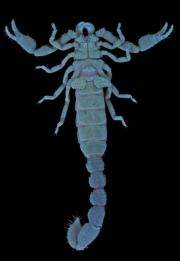
Typhochactas mitchelli is among the smallest known scorpions and part of the Typhlochactidae family of cave scorpions, endemic to Mexico. Like all scorpions, it fluoresces in long-wave ultraviolet light as this image of its ventral side highlights. Credit: V. Vignoli
Blind scorpions that live in the stygian depths of caves are throwing light on a long-held assumption that specialized adaptations are irreversible evolutionary dead-ends. According to a new phylogenetic analysis of the family Typhlochactidae, scorpions currently living closer to the surface (under stones and in leaf litter) evolved independently on more than one occasion from ancestors adapted to life further below the surface (in caves). The research, currently available in an early online edition, will be published in the April issue of Cladistics.
"Our research shows that the evolution of troglobites, or animals adapted for life in caves, is reversible," says Lorenzo Prendini, Associate Curator in the Division of Invertebrate Zoology at the American Museum of Natural History. "Three more generalized scorpion species living closer to the surface evolved from specialized ancestors living in caves deep below the surface."
Scorpions are predatory, venomous, nocturnal arachnids that are related to spiders, mites, and other arthropods. About 2,000 species are distributed throughout the world, but only 23 species found in ten different families are adapted to a permanent life in caves. These are the specialized troglobites.
This study concentrates on the family Typhlochactidae that includes nine species of scorpions endemic to the karstic regions of eastern Mexico. These species were initially grouped together by Robert Mitchell in 1971 but were elevated to the rank of family for the first time last year, based on morphological data published by Prendini and Valerio Vignoli of the Department of Evolutionary Biology, University of Siena, Italy, in the Bulletin of the American Museum of Natural History.
Prendini, Vignoli, and Oscar F. Francke of the Departmento de Zoologia, Instituto de Biología at the Universidad Nacional Autónoma de México, Mexico City, also created a new genus, Stygochactas, for one species in the family and described a new surface-living species, Typhlochactas sissomi, in a separate American Museum Novitates paper.
All species in the family have adapted to the dark with features such as loss of eyes and reduced pigmentation. The family contains the most specialized troglobite scorpion, Sotanochactas elliotti, one of the world's smallest scorpions, Typhlochactas mitchelli, and the scorpion found at the greatest depth (nearly 1 km below the surface), Alacran tartarus. Three of the species (including T. mitchelli) live closer to the surface and are more generalized morphologically than the other six, making this family an excellent model with which to test and falsify Cope's Law of the unspecialized (novel evolutionary traits tend to originate from a generalized member of an ancestral taxon) and Dollo's Law of evolutionary irreversibility (specialized evolutionary traits are unlikely to reverse).
For the current research paper, Prendini and colleagues gathered data for 195 morphological characteristics, including a detailed mapping of the positions of all trichobothria (sensory setae) on the pedipalps, among the species of Typhlochactidae. The resulting phylogenetic tree shows that adaptation to life in caves has reversed among this group of scorpions: two of the less specialized, surface-living species, T. mitchelli and T. sylvestris, share a common ancestor with a much more cave-adapted species, and a similar pattern was found for the third less specialized, surface-living species, T. sissomi.
"Scorpions have been around for 450 million years, and their biology is obviously flexible," says Prendini. "This unique group of eyeless Mexican scorpions may have started re-colonizing niches closer to the surface from the deep caves of Mexico after their surface-living ancestors were wiped out by the nearby Chicxuluxb impact along with non-avian dinosaurs, ammonites, and other species."
Provided by American Museum of Natural History
-
Microscopic morphology adds to the scorpion family tree
Jan 12, 2009 |
not rated yet |
0
-
Genetic analysis reveals secrets of scorpion venom
Jul 01, 2009 |
not rated yet |
0
-
Researchers go underground to reveal 850 new species
Sep 28, 2009 |
not rated yet |
0
-
Researchers chirping over discovery of new cricket genus
May 06, 2006 |
not rated yet |
0
-
Revealing the evolutionary history of threatened sea turtles
Oct 15, 2008 |
not rated yet |
0
-
Engineers build first sub-10-nm carbon nanotube transistor
Feb 01, 2012 |
4.9 / 5 (31) |
30
-
Something old, something new: Evolution and the structural divergence of duplicate genes
Jan 31, 2012 |
4.6 / 5 (7) |
1
-
The hidden nanoworld of ice crystals: Revealing the dynamic behavior of quasi-liquid layers
Jan 30, 2012 |
5 / 5 (3) |
1
-
Stock market network reveals investor clustering
Jan 27, 2012 |
3.9 / 5 (23) |
8
-
Of microchemistry and molecules: Electronic microfluidic device synthesizes biocompatible probes
Jan 26, 2012 |
5 / 5 (1) |
0
-
Mitosis
2 hours ago
-
Stem cell question.
3 hours ago
-
Protease cleavage
10 hours ago
-
Pertubance in a model
16 hours ago
-
Cancer drugs and Alzheimer's, Oh my!
Feb 09, 2012
-
Squishing cells
Feb 09, 2012
- More from Physics Forums - Biology
More news stories
The power of estrogen -- male snakes attract other males
A new study has shown that boosting the estrogen levels of male garter snakes causes them to secrete the same pheromones that females use to attract suitors, and turned the males into just about the sexiest ...
14 hours ago |
4.8 / 5 (6) |
1
|
Grass to gas: Researchers' genome map speeds biofuel development
Researchers at the University of Georgia have taken a major step in the ongoing effort to find sources of cleaner, renewable energy by mapping the genomes of two originator cells of Miscanthus x giganteus, a large perenn ...
11 hours ago |
3.8 / 5 (5) |
0
|
Experts reveal how plants don't get sunburn
(PhysOrg.com) -- Experts at the University of Glasgow have discovered how plants survive the harmful rays of the sun.
14 hours ago |
4.8 / 5 (5) |
0
|
Miami battling invasion of giant African snails
No one knows how they got there. But an invasion of African giant snails has southern Florida in a panic over potential crop damage, disease and general yuckiness surrounding the slimy gastropods.
18 hours ago |
4 / 5 (1) |
4
Protein libraries in a snap
(PhysOrg.com) -- A Rice University undergraduate will depart with not only a degree but also a possible patent for his invention of an efficient way to create protein libraries, an important component of biomolecular ...
18 hours ago |
4.8 / 5 (4) |
0
|
Google users warned of threat to smartphone wallets
Users of Google smartphone wallets were being warned on Friday that there is a way to crack pass codes intended to thwart thieves from going on illicit shopping sprees.
Anonymous knocks CIA website offline (Update)
The website of the Central Intelligence Agency was inaccessible on Friday after the hacker group Anonymous claimed to have knocked it offline.
New error-correcting codes guarantee the fastest possible rate of data transmission
Error-correcting codes are one of the triumphs of the digital age. Theyre a way of encoding information so that it can be transmitted across a communication channel such as an optical fiber o ...
Humans may have helped the decline of African rainforests 3000 years ago
(PhysOrg.com) -- Large areas of rainforests in Central Africa mysteriously disappeared over three thousand years ago, to be replaced by savannas. The prevailing theory has been that the cause was a change ...
New power source discovered
(PhysOrg.com) -- Researchers at the Massachusetts Institute of Technology (MIT) and RMIT University have made a breakthrough in energy storage and power generation.
Complex wiring of the nervous system may rely on a just a handful of genes and proteins
Researchers at the Salk Institute have discovered a startling feature of early brain development that helps to explain how complex neuron wiring patterns are programmed using just a handful of critical genes. ...
Mar 12, 2010
Rank: 4 / 5 (1)
The fact that it had those properties before can only make it easier/faster to adapt/evolve to it again.
The word reversible is maybe bad choosen since you obviously do not evolve to the past but to a new future where you have been before.
Mar 12, 2010
Rank: 1 / 5 (1)