New defenses deployed against plant diseases
March 14, 2010
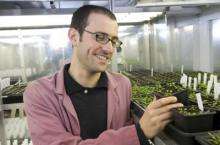
This is Dr. Cyril Zipfel of Norwich BioScience Institutes. Credit: Sainsbury Laboratory
An international team led by scientists at the Sainsbury Laboratory in Norwich, UK, have transferred broad spectrum resistance against some important plant diseases across different plant families. This breakthrough provides a new way to produce crops with sustainable resistance to economically important diseases.
Food insecurity is driving the search for ways to increase the amount of food we grow, whilst at the same time reducing unsustainable agricultural inputs. One way to do this is to increase the innate ability of crops to fight off disease-causing pathogens. Increased disease resistance would reduce yield losses as well as reduce the need for pesticide spraying.
Breeding programs for resistance generally rely on single resistance genes that recognise molecules specific to particular strain of pathogens. Hence this kind of resistance rarely confers broad-spectrum resistance and is often rapidly overcome by the pathogen evolving to avoid recognition by the plant.
However, plants have another defence system, based on pattern recognition receptors (PRRs). PRRs recognise molecules that are essential for pathogen survival. These molecules are less likely to mutate without harming the pathogen's survival, making resistance to them more durable in the field. These essential molecules are common to many different microbes, meaning that if a plant recognises and can defend itself against one of these molecular patterns, it is likely to be resistant against a broad range of other pathogens.
Very few of these PRRs have been identified to date. Dr Cyril Zipfel and his group at the Sainsbury Laboratory in Norwich, UK, took a Brassica-specific PRR that recognises bacteria, and transformed it into the Solanaceae plants Nicotania benthaminia and tomato.
"We hypothesised that adding new recognition receptors to the host arsenal could lead to enhanced resistance," said Dr Zipfel.
Under controlled laboratory conditions, they tested these transformed plants against a variety of different plant pathogens, and found drastically enhanced resistance against many different bacteria, including some of great importance to modern agriculture such as Rastonia solanaceraum, the causal agent of bacterial wilt and a select agent in the United States under the Agricultural Bioterrorism Protection Act of 2002.
"The strength of this resistance is because it has come from a different plant family, which the pathogen has not had any chance to adapt to. Through genetic modification, we can now transfer this resistance across plant species boundaries in a way traditional breeding cannot," said Dr Zipfel.
Published in the journal Nature Biotechnology, the finding, that plant recognition receptors can be successfully transferred from one plant family to another provides a new biotechnological solution to engineering disease resistance. The Zipfel group is currently extending this work to other crops including potato, apple, cassava and banana that all suffer from important bacterial diseases, particularly in the developing world.
"A guiding principle in plant pathology is that most plants tend to be resistant to most pathogens. Cyril's work indicates that transfer of genes that contribute to this basic innate immunity from one plant to another can enhance pathogen resistance," commented Professor Sophien Kamoun, Head of the Sainsbury Laboratory. "The implications for engineering crop plants with enhanced resistance to infectious diseases are very promising."
This research was funded by the Gatsby Charitable Foundation and the Two Blades Foundation, who have patented the technology on behalf of the inventors, and involved research groups from INRA/CNRS in France, the University of California, Berkeley and Wageningen University in the Netherlands.
More information: Inter-family transfer of a plant pattern recognition receptor confers broad-spectrum bacterial resistance, will be published online by Nature Biotechnology on 14th March 2010. doi:10.1038/nbt.1613
Provided by Norwich BioScience Institutes
-
Tomato stands firm in face of fungus
May 09, 2008 |
not rated yet |
0
-
Researcher looks for answers about unique disease-resistant gene
Sep 14, 2009 |
not rated yet |
0
-
Genes identified to protect brassicas from damaging disease
Nov 01, 2007 |
not rated yet |
0
-
Rice Protein Identified that Moderates Resistance to Infectious Disease
Sep 23, 2008 |
not rated yet |
0
-
Tomato pathogen genome may offer clues about bacterial evolution
Apr 14, 2008 |
not rated yet |
0
-
Engineers build first sub-10-nm carbon nanotube transistor
Feb 01, 2012 |
4.9 / 5 (30) |
30
-
Something old, something new: Evolution and the structural divergence of duplicate genes
Jan 31, 2012 |
4.6 / 5 (7) |
1
-
The hidden nanoworld of ice crystals: Revealing the dynamic behavior of quasi-liquid layers
Jan 30, 2012 |
5 / 5 (3) |
1
-
Stock market network reveals investor clustering
Jan 27, 2012 |
3.9 / 5 (23) |
8
-
Of microchemistry and molecules: Electronic microfluidic device synthesizes biocompatible probes
Jan 26, 2012 |
5 / 5 (1) |
0
-
Pertubance in a model
2 hours ago
-
Cancer drugs and Alzheimer's, Oh my!
10 hours ago
-
Squishing cells
11 hours ago
-
Any books/articles for evolutionary stable strategy models in humans?
22 hours ago
-
Science behind the bore feeling?
Feb 09, 2012
-
Homo Sapien vs. Chimpanzee - Divergence Timeline
Feb 09, 2012
- More from Physics Forums - Biology
More news stories
The power of estrogen -- male snakes attract other males
A new study has shown that boosting the estrogen levels of male garter snakes causes them to secrete the same pheromones that females use to attract suitors, and turned the males into just about the sexiest ...
27 minutes ago |
not rated yet |
0
|
Experts reveal how plants don't get sunburn
(PhysOrg.com) -- Experts at the University of Glasgow have discovered how plants survive the harmful rays of the sun.
14 minutes ago |
not rated yet |
0
|
New drugs schedule makes horse racing a sure thing
What do Gai Waterhouse and Anthony Cummings have in common with Queen Elizabeth II?
26 minutes ago |
not rated yet |
0
Miami battling invasion of giant African snails
No one knows how they got there. But an invasion of African giant snails has southern Florida in a panic over potential crop damage, disease and general yuckiness surrounding the slimy gastropods.
4 hours ago |
not rated yet |
2
Protein libraries in a snap
(PhysOrg.com) -- A Rice University undergraduate will depart with not only a degree but also a possible patent for his invention of an efficient way to create protein libraries, an important component of biomolecular ...
3 hours ago |
5 / 5 (1) |
0
|
Could Venus be shifting gear?
(PhysOrg.com) -- ESAs Venus Express spacecraft has discovered that our cloud-covered neighbour spins a little slower than previously measured. Peering through the dense atmosphere in the infrared, the ...
Team isolates nerve cells involved in storing long term memory and gene proteins associated with them
(Medical Xpress) -- A research team in Taiwan has succeeded in isolating two nerve cells in fruit fly brains that are believed to be the major players in allowing for the formation of long term memories. Furthermore, ...
Fool's gold may prove an unlikely alternative to overexploited catalytic materials
Catalytic materials, which lower the energy barriers for chemical reactions, are used in everything from the commercial production of chemicals to catalytic converters in car engines. However, with current catalytic materials ...
Measurements from high-energy collisions lead to better understanding of why meson particles disappear
For several years, physicists at the Relativistic Heavy Ion Collider (RHIC) at Brookhaven National Laboratory (BNL), USA, have studied an unusual state of matter called the quarkgluon plasma, which they ...
What does a nebula sound like?
What do things sound like out in the cosmos? Of course, sound waves cant travel through the vacuum of space; however, electromagnetic waves can. These electromagnetic waves can be recorded by devices called spectrographs ...
Two new moons for Jupiter
Advances in technology have lead to the discovery of new planets outside of our Solar System, and now even new moons in our own backyard.