New microscopy technique offers close-up, real-time view of cellular phenomena
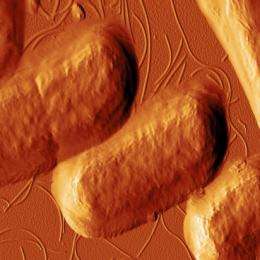
For two decades, scientists have been pursuing a potential new way to treat bacterial infections, using naturally occurring proteins known as antimicrobial peptides (AMPs). Now, MIT scientists have recorded the first microscopic images showing the deadly effects of AMPs, most of which kill by poking holes in bacterial cell membranes.
Researchers led by MIT Professor Angela Belcher modified an existing, extremely sensitive technique known as high-speed atomic force microscopy (AFM) to allow them to image the bacteria in real time. Their method, described in the March 14 online edition of Nature Nanotechnology, represents the first way to study living cells using high-resolution images recorded in rapid succession.
Using this type of high-speed AFM could allow scientists to study how cells respond to other drugs and to viral infection, says Belcher, the Germeshausen Professor of Materials Science and Engineering and Biological Engineering and a member of the Koch Institute for Integrative Cancer Research at MIT.
It could also be useful in studying cell death in mammalian cells, such as the nerve cell death that occurs in Alzheimer’s patients, says Paul Hansma, a physics professor at the University of California at Santa Barbara who has been developing AFM technology for 20 years. “This paper is a highly significant advance in the state-of-the-art imaging of cellular processes,” says Hansma, who was not involved in the research.
High speed
Atomic force microscopy, invented in 1986, is widely used to image nanoscale materials. Its resolution (about 5 nanometers) is comparable to that of electron microscopy, but unlike electron microscopy, it does not require a vacuum and thus can be used with living samples. However, traditional AFM requires several minutes to produce one image, so it cannot record a sequence of rapidly occurring events.
In recent years, scientists have developed high-speed AFM techniques, but haven’t optimized them for living cells. That’s what the MIT team set out to do, building on the experience of lead author Georg Fantner, a postdoctoral associate in Belcher’s lab who had worked on high-speed AFM at the University of California at Santa Barbara.
Atomic force microscopy makes use of a cantilever equipped with a probe tip that “feels” the surface of a sample. Forces between the tip and the sample can be measured as the probe moves across the sample, revealing the shape of the surface. The MIT team used a cantilever about 1,000 times smaller than those normally used for AFM, which enabled them to increase the imaging speed without harming the bacteria.
The measurements are performed in a liquid environment, another critical factor in keeping the bacteria alive.
With the new setup, the team was able to take images every 13 seconds over a period of several minutes following treatment with an AMP known as CM15. They found that AMP-induced cell death appears to be a two-step process: a short incubation period followed by a rapid “execution.” They were surprised to see that the onset of the incubation period varied from 13 to 80 seconds.
“Not all of the cells started dying at the exact same time, even though they were genetically identical and were exposed to the peptide at the same time,” says Roberto Barbero, a graduate student in biological engineering and an author of the paper.
Most AMPs act by puncturing bacterial cell membranes, which destroys the delicate equilibrium between the bacterium and its environment. Others appear to target machinery inside the cell. There has been a great deal of interest in developing AMPs as drugs that could supplement or replace traditional antibiotics, but none have been approved yet.
Until a few years ago, it was thought that bacteria could not become resistant to AMPS, but recent studies have shown that they can. The new MIT work could help researchers understand how that resistance develops.
More information: "Kinetics of antimicrobial peptide activity measured on individual bacterial cells using high-speed atomic force microscopy," Georg Fantner, Roberto Barbero, David Gray and Angela Belcher." Nature Nanotechology, March 14, 2010.
Provided by Massachusetts Institute of Technology


