Scientists reveal how snakes 'see' at night
March 15, 2010 by Marlowe Hood
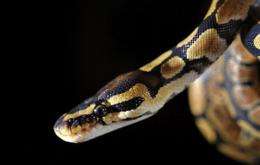
Scientists revealed Sunday for the first time how some snakes can detect the faint body heat exuded by a mouse a metre (three feet) away with enough precision and speed to hunt in the dark.
It has been known for decades that rattlesnakes, boas and pythons have so-called pit organs between the eye and the nostril that can sense even tiny amounts of infrared radiation -- heat -- in their surroundings.
Among pit vipers, the western diamondback rattlesnake, native to northern Mexico and southwestern United States, is in a class of its own, its heat-seeking ability up to 10 times keener than any of its cousins.
Even with tiny patches covering its eyes, the snake has shown the ability to track and kill prey blindfolded.
But exactly how these reptiles detect and convert infrared signals into nerve impulses has remained a mystery, and the subject of sharp debate.
One candidate was the photochemical process underlying vision, whereby the eye sees electromagnetic radiation -- visible light for humans -- in the form of photons that activate receptor cells, which in turn convert the energy into a biochemical signal to the brain.
Some fish, for example, can see into the infrared wavelength of the electromagnetic spectrum.
But David Julius, a molecular biologist at the University of California in San Francisco, demonstrated in laboratory experiments that a different neurological pathway was at work for the serpentine "sixth sense."
"In this case, the infrared radiation is actually detected inside the pit organ as heat," Julius said in a phone interview. "We found the molecule responsible."
A very thin membrane inside the pit organ -- essentially a hollow, bony cavity -- warms up as the radiation enters through an opening in the skin, he explained.
Because the membrane is in a hollow space, it is exquisitely sensitive to changes in temperature.
"The heated tissue then imparts a signal to nerve fibres to activate the receptors we have identified," known as TRPA1 channels.
The neurochemical pathway involved suggests that snakes feel heat rather than see it.
"The molecule we found belongs to a family of receptors related to pain pathways in mammals," Julius said.
In humans, the equivalent mechanism is called the "wasabi receptor" because it allows our sensory nervous system to detect irritants -- such as the Japanese condiment -- that belong to the mustard family.
It is not, however, activated by heat.
The discovery, published in Nature, may also shed light on how snakes, which have been slithering across the planet for more than 100 million years, evolved.
"Studying change in sensory molecules is an interesting way to look at evolution because as animals inhabit different niches, smell and taste different things, hunt different animals, their sensory systems have to adapt," Julius said.
The findings also suggest that the forces of natural selection yielded the same remarkable heat-seeking mechanism in reptiles on separate occasions.
Unlike boas and pythons, which also have pit organs, vipers -- including rattlesnakes -- are relatively recent arrivals, in evolutionary terms, and thus must have developed the same capacity independently.
"It is amazing to think that random mutation could have come up with the same kind of solution more than once," Julius said.
(c) 2010 AFP
-
Researchers discover paradox about general anesthesia: It can increase post-surgical pain
Jun 24, 2008 |
not rated yet |
0
-
Squirrels use snake scent
Dec 19, 2007 |
not rated yet |
0
-
Researchers discover key to body's ability to detect subtle temperature changes
Feb 26, 2007 |
not rated yet |
0
-
Heat halts pain inside the body
Jul 05, 2006 |
not rated yet |
0
-
Burmese pythons slithering their way north?
Jun 24, 2009 |
not rated yet |
0
-
Engineers build first sub-10-nm carbon nanotube transistor
Feb 01, 2012 |
4.9 / 5 (31) |
30
-
Something old, something new: Evolution and the structural divergence of duplicate genes
Jan 31, 2012 |
4.6 / 5 (7) |
1
-
The hidden nanoworld of ice crystals: Revealing the dynamic behavior of quasi-liquid layers
Jan 30, 2012 |
5 / 5 (3) |
1
-
Stock market network reveals investor clustering
Jan 27, 2012 |
3.9 / 5 (23) |
8
-
Of microchemistry and molecules: Electronic microfluidic device synthesizes biocompatible probes
Jan 26, 2012 |
5 / 5 (1) |
0
-
Pertubance in a model
7 hours ago
-
Cancer drugs and Alzheimer's, Oh my!
15 hours ago
-
Squishing cells
15 hours ago
-
Any books/articles for evolutionary stable strategy models in humans?
Feb 09, 2012
-
Science behind the bore feeling?
Feb 09, 2012
-
Homo Sapien vs. Chimpanzee - Divergence Timeline
Feb 09, 2012
- More from Physics Forums - Biology
More news stories
The power of estrogen -- male snakes attract other males
A new study has shown that boosting the estrogen levels of male garter snakes causes them to secrete the same pheromones that females use to attract suitors, and turned the males into just about the sexiest ...
5 hours ago |
not rated yet |
0
|
Experts reveal how plants don't get sunburn
(PhysOrg.com) -- Experts at the University of Glasgow have discovered how plants survive the harmful rays of the sun.
5 hours ago |
5 / 5 (2) |
0
|
Grass to gas: Researchers' genome map speeds biofuel development
Researchers at the University of Georgia have taken a major step in the ongoing effort to find sources of cleaner, renewable energy by mapping the genomes of two originator cells of Miscanthus x giganteus, a large perenn ...
2 hours ago |
5 / 5 (2) |
0
|
Protein libraries in a snap
(PhysOrg.com) -- A Rice University undergraduate will depart with not only a degree but also a possible patent for his invention of an efficient way to create protein libraries, an important component of biomolecular ...
8 hours ago |
5 / 5 (2) |
0
|
Miami battling invasion of giant African snails
No one knows how they got there. But an invasion of African giant snails has southern Florida in a panic over potential crop damage, disease and general yuckiness surrounding the slimy gastropods.
9 hours ago |
not rated yet |
2
Human cognitive performance suffers following natural disasters, researchers find
Not surprisingly, victims of a natural disaster can experience stress and anxiety, but a new study indicates that it might also cause them to make more errors - some serious - in their daily lives. In their upcoming Human Fa ...
"Twisted Metal" gamers get shot at real gunplay
Fans of "Twisted Metal" will get to welcome a long-awaited sequel of the car-battle videogame with a real-world bang by blasting an ice cream truck to bits with a machine gun.
Putting the squeeze on planets outside our solar system
(PhysOrg.com) -- Using high-powered lasers, scientists at Lawrence Livermore National Laboratory and collaborators discovered that molten magnesium silicate undergoes a phase change in the liquid state, abruptly ...
Both maternal and paternal age linked to autism
Older maternal and paternal age are jointly associated with having a child with autism, according to a recently published study led by researchers at The University of Texas Health Science Center at Houston (UTHealth).
New error-correcting codes guarantee the fastest possible rate of data transmission
Error-correcting codes are one of the triumphs of the digital age. Theyre a way of encoding information so that it can be transmitted across a communication channel such as an optical fiber o ...
Curry spice component may help slow prostate tumor growth
Curcumin, an active component of the Indian curry spice turmeric, may help slow down tumor growth in castration-resistant prostate cancer patients on androgen deprivation therapy (ADT), a study from researchers ...