Japan auto, power giants target global electric car standard
March 15, 2010
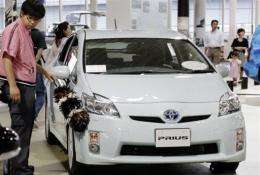
File photo shows a worker dusting a Japanese auto giant Toyota Motor's hybrid Prius at the company's showroom in Tokyo. Four Japanese auto giants and the country's largest power company joined forces to set up a common system to recharge electric cars, with the aim of creating a global standard.
Four Japanese auto giants and the country's largest power company joined forces Monday to set up a common system to recharge electric cars, with the aim of creating a global standard.
The growth of the electric vehicle sector has been hampered by the chicken-or-egg question of what should come first: zero-emission cars or the networks of recharging stations to keep them on the road.
Toyota, Nissan, Mitsubishi Motors and Fuji Heavy Industries have linked up with Tokyo Electric Power Company (TEPCO) as the organising members of the new grouping called "CHAdeMO".
The name is derived from a combination of the words "Charge" and "Move" and a pun on a popular Japanese phrase.
In total 158 companies and government bodies are members, including 20 foreign firms, among them Bosch, Peugeot SA and Enel SpA.
Standardizing charging infrastructure is vital to making electric vehicles popular, TEPCO chairman Tsunehisa Katsumata said.
"We need to make this protocol a standard protocol outside of Japan," he told a gathering in a Tokyo hotel.
Zero-emission cars are gaining traction globally as concern has grown over pollution from the exhaust pipes of conventional petrol cars and its impact on the environment.
Mitsubishi Motors last year rolled out the i-MiEV and Fuji Heavy the Subaru Plug-in Stella, both in Japan. Nissan is set to launch the world's first mass market electric vehicle, the Leaf, later this year.
Toyota, which has focused on hybrids, has promised to launch its own version by 2012. It has already begun leasing a plug-in hybrid electric vehicle since late last year, one year earlier than initially planned.
Electric cars still face key hurdles such as costly batteries and the lack of conveniently-located recharging points, which limits their operating radius.
Standardisation would require all makers to agree on the kind of outlet and the voltage, which currently differ among firms.
"It's like establishing a common operation manual or a code that allows the charging machine to work across a broad range of electric vehicles," said Takafumi Anegawa, electric vehicle manager at TEPCO.
The Japanese government is throwing its support behind the move, and has earmarked 12.4 billion yen (13.7 million dollars) in the budget for fiscal 2010 starting in April to develop a recharging grid.
Some officials pointed at hurdles in creating a global standard.
"It will be a big and difficult challenge for the entire world to reach the same method" in charging EVs, Toyota managing officer Koei Saga said. "In the end, we may just need to adhere to the methods in each country."
(c) 2010 AFP
-
Japan electric car makers, utility plan battery-charge stations
Aug 05, 2009 |
not rated yet |
0
-
Toyota to release solar charger for electric vehicles
Oct 27, 2009 |
not rated yet |
0
-
Toyota aims to roll out plug-in Prius in two years
Dec 14, 2009 |
not rated yet |
0
-
Nissan's 'Leaf' to challenge Toyota's Prius (Update)
Aug 06, 2009 |
not rated yet |
0
-
Electric cars rolling out
Dec 16, 2009 |
not rated yet |
0
-
Engineers build first sub-10-nm carbon nanotube transistor
Feb 01, 2012 |
4.9 / 5 (30) |
30
-
Something old, something new: Evolution and the structural divergence of duplicate genes
Jan 31, 2012 |
4.6 / 5 (7) |
1
-
The hidden nanoworld of ice crystals: Revealing the dynamic behavior of quasi-liquid layers
Jan 30, 2012 |
5 / 5 (3) |
1
-
Stock market network reveals investor clustering
Jan 27, 2012 |
3.9 / 5 (23) |
8
-
Of microchemistry and molecules: Electronic microfluidic device synthesizes biocompatible probes
Jan 26, 2012 |
5 / 5 (1) |
0
-
feed hold button on CNC lathe
19 hours ago
-
Mechanics of Solids ( Final exam question) please help!
21 hours ago
-
RFAC in Fortran
Feb 09, 2012
-
dynamics 2/32
Feb 08, 2012
-
dynamics
Feb 08, 2012
-
Vibration Absorbtion Problem
Feb 08, 2012
- More from Physics Forums - General Engineering
More news stories
Soraa LED light may dim 50-watt halogen rivals
(PhysOrg.com) -- Soraa, a Fremont, California company founded in 2008, this week launched its first product, a light that uses LEDS (light emitting diodes). The "Soraa LED MR16 lamp" is the "perfect" replacement ...
Samsung can continue selling Galaxy tabs in Germany: court
South Korea's Samsung Electronics can continue to sell its Galaxy Tab 10.1N tablet computer in Germany, a German court ruled Thursday, rejecting a bid by arch-rival Apple to have them banned.
18 hours ago |
3.7 / 5 (3) |
3
First Google hire leaving for online academy
The first person hired by Google's founders is leaving the Internet giant to devote himself to an innovative online education website called Khan Academy.
8 hours ago |
5 / 5 (1) |
0
Google launches Chrome browser for Android smartphones
With more and more people connecting to the Internet through a phone or a tablet instead of a PC, Google Inc. is bringing its fast-growing browser, Chrome, to the newest Android-powered mobile devices.
16 hours ago |
5 / 5 (4) |
0
FBI file: Steve Jobs was considered for govt post
(AP) -- FBI background interviews of some people who knew Apple co-founder Steve Jobs reveal a man driven by power and alienating some of the people who worked with him.
8 hours ago |
3.3 / 5 (7) |
0
'Dark plasmons' transmit energy
Microscopic channels of gold nanoparticles have the ability to transmit electromagnetic energy that starts as light and propagates via "dark plasmons," according to researchers at Rice University.
FDA-approved drug rapidly clears amyloid from the brain, reverses Alzheimer's symptoms in mice
Neuroscientists at Case Western Reserve University School of Medicine have made a dramatic breakthrough in their efforts to find a cure for Alzheimer's disease. The researchers' findings, published in the journal Science, show t ...
Hydrogen from acidic water: Researchers develop potential low cost alternative to platinum for splitting water
A technique for creating a new molecule that structurally and chemically replicates the active part of the widely used industrial catalyst molybdenite has been developed by researchers with the Lawrence Berkeley ...
Ultraviolet protection molecule in plants yields its secrets
Lying around in the sun all day is hazardous not just for humans but also for plants, which have no means of escape. Ultraviolet (UV) radiation from the sun can damage proteins and DNA inside cells, leading ...
Anyone can learn to be more inventive, cognitive researcher says
There will always be a wild and unpredictable quality to creativity and invention, says Anthony McCaffrey, a cognitive psychology researcher at the University of Massachusetts Amherst, because an "Aha moment" is rare and ...
Flexible paper robots
(PhysOrg.com) -- These inexpensive robots can stretch, bend and twist under control, and lift objects up to 120 times their own weight. Being soft, they can apply gentle and even pressure, and adapt to varied ...
Mar 15, 2010
Rank: not rated yet
this also isn't like a cell phone (which still has no standard but should) because cell phones at this point are all more or less comparable in battery life (or they ought to be)
car batteries technology has a long long way to go. along with the difference in batteries and capacitor , there must also be a difference in charging. it's too early to adopt a standard.
Mar 15, 2010
Rank: not rated yet
Mar 16, 2010
Rank: not rated yet
the standard should be for all car manufacturers to publicize and make open source the code that they use in their vehicles. this is the biggest no brainer for any 'standards' in the electric car industry.
the same should apply to 'smart grid' technology.
but alas, neither of these standards can ever be enforced without government force. and alas, government has no balls. but they are always happy to give out free money and create a bubble
Mar 16, 2010
Rank: not rated yet
THEN, 3-4 years from now after real life experience over that period all manufacturers must come together, along with the proven 3-4 years of real life usage to see what standard works best.
Then the manufacturers can discuss the benefits and negatives of their standard and decide upon which standard will be used based on the results.
Then Standardization will make sense.