Robot teaches stroke survivors
March 15, 2010
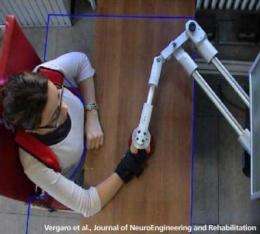
The arm is being used by a patient. Credit: Vergaro et al., Journal of NeuroEngineering and Rehabilitation
Shaking hands with a robotic arm could be a new way to help stroke patients learn to use their arms again. Researchers writing in BioMed Central's open access Journal of NeuroEngineering and Rehabilitation report a pilot trial of the 'Braccio di Ferro' (Iron arm) robot in 10 patients.
Elena Vergaro, from the University of Genoa, Italy, worked with a team of researchers from the Italian Institute of Technology, Genoa, to develop the robotic aid. She said, "Our preliminary results from this small group of patients suggest that the scheme is robust and promotes a statistically significant improvement in performance. Future large-scale controlled clinical trials should confirm that robot-assisted physiotherapy can allow functional achievements in activities of daily life".
The researcher's robot assists patients as they attempt to guide its 'hand' in a figure-of-eight motion above a desk, pulling in the correct direction and resisting incorrect movements to a minutely controlled degree. This interactive assistance allows for alternating levels of help, encouraging patients to re-learn how to use their arms.
Vergaro said, "Stroke survivors perform arm movements in abnormal ways, for example by elevating the shoulder in order to lift the arm, or leaning forward with the torso instead of extending the elbow. Use of such incorrect patterns may limit their ability to achieve higher levels of movement ability, and may lead to repetitive use injuries. By demonstrating the correct movements, a robot can help the motor system of the subject learn to replicate the desired trajectory by experience".
More information: Self-adaptive robot training of stroke survivors for continuous tracking movements, Elena Vergaro, Maura Casadio, Valentina Squeri, Psiche Giannoni, Pietro Morasso and Vittorio Sanguineti, Journal of NeuroEngineering and Rehabilitation 2010, 7:13, doi:10.1186/1743-0003-7-13
-
Stroke survivors can improve functioning of paralyzed arm years after stroke
Feb 26, 2010 |
not rated yet |
0
-
Robotic therapy helps restore hand use after stroke
Feb 08, 2007 |
not rated yet |
0
-
New surgical technique shows promise for improving function of artificial arms
Feb 10, 2009 |
not rated yet |
0
-
Robotic joystick reveals how brain controls movement
May 23, 2006 |
not rated yet |
0
-
Muscle 'synergies' may be key to stroke treatment
Oct 20, 2009 |
not rated yet |
0
-
Engineers build first sub-10-nm carbon nanotube transistor
Feb 01, 2012 |
4.9 / 5 (31) |
30
-
Something old, something new: Evolution and the structural divergence of duplicate genes
Jan 31, 2012 |
4.6 / 5 (7) |
1
-
The hidden nanoworld of ice crystals: Revealing the dynamic behavior of quasi-liquid layers
Jan 30, 2012 |
5 / 5 (3) |
1
-
Stock market network reveals investor clustering
Jan 27, 2012 |
3.9 / 5 (23) |
8
-
Of microchemistry and molecules: Electronic microfluidic device synthesizes biocompatible probes
Jan 26, 2012 |
5 / 5 (1) |
0
-
Classical and Quantum Mechanics via Lie algebras
Apr 15, 2011
- More from Physics Forums - Independent Research
More news stories
Complex wiring of the nervous system may rely on a just a handful of genes and proteins
Researchers at the Salk Institute have discovered a startling feature of early brain development that helps to explain how complex neuron wiring patterns are programmed using just a handful of critical genes. ...
6 hours ago |
4.9 / 5 (9) |
0
|
Both maternal and paternal age linked to autism
Older maternal and paternal age are jointly associated with having a child with autism, according to a recently published study led by researchers at The University of Texas Health Science Center at Houston (UTHealth).
Medicine & Health / Psychology & Psychiatry
10 hours ago |
4 / 5 (2) |
0
|
New understanding of DNA repair could eventually lead to cancer therapy
A research group in the Faculty of Medicine & Dentistry at the University of Alberta is hoping its latest discovery could one day be used to develop new therapies that target certain types of cancers.
10 hours ago |
4.8 / 5 (4) |
0
|
Curry spice component may help slow prostate tumor growth
Curcumin, an active component of the Indian curry spice turmeric, may help slow down tumor growth in castration-resistant prostate cancer patients on androgen deprivation therapy (ADT), a study from researchers ...
11 hours ago |
4.4 / 5 (8) |
0
|
Human cognitive performance suffers following natural disasters, researchers find
Not surprisingly, victims of a natural disaster can experience stress and anxiety, but a new study indicates that it might also cause them to make more errors - some serious - in their daily lives. In their upcoming Human Fa ...
Medicine & Health / Psychology & Psychiatry
7 hours ago |
4 / 5 (1) |
0
Google users warned of threat to smartphone wallets
Users of Google smartphone wallets were being warned on Friday that there is a way to crack pass codes intended to thwart thieves from going on illicit shopping sprees.
Anonymous knocks CIA website offline (Update)
The website of the Central Intelligence Agency was inaccessible on Friday after the hacker group Anonymous claimed to have knocked it offline.
New error-correcting codes guarantee the fastest possible rate of data transmission
Error-correcting codes are one of the triumphs of the digital age. Theyre a way of encoding information so that it can be transmitted across a communication channel such as an optical fiber o ...
The power of estrogen -- male snakes attract other males
A new study has shown that boosting the estrogen levels of male garter snakes causes them to secrete the same pheromones that females use to attract suitors, and turned the males into just about the sexiest ...
Humans may have helped the decline of African rainforests 3000 years ago
(PhysOrg.com) -- Large areas of rainforests in Central Africa mysteriously disappeared over three thousand years ago, to be replaced by savannas. The prevailing theory has been that the cause was a change ...
New power source discovered
(PhysOrg.com) -- Researchers at the Massachusetts Institute of Technology (MIT) and RMIT University have made a breakthrough in energy storage and power generation.