A magical way to move kids
March 15, 2010
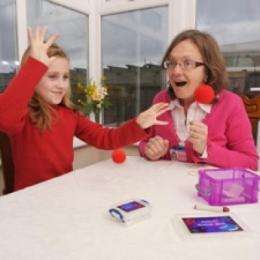
Dr. Dido Green uses magic to help a young patient regain movement in her left arm. Credit: Guy's and St. Thomas' Hospital Charity
It's often hard to motivate youngsters with physical disabilities. But a new approach from a Tel Aviv University researcher bridges the worlds of behavior and science to help kids with paralysis and motor dysfunction improve their physical skills and inner confidence -- using a trick up her sleeve called "magic."
Dr. Dido Green of Tel Aviv University's School of Health Professionals developed an innovative yet remarkably simple series of therapeutic exercises for children and young adults based on sleight-of-hand tricks used by professional magicians. Dr. Green and her magicians used sponge balls, elastics and paper clips to teach the children how to perform the challenging, fun and engaging exercises.
She started her foundational research at the Evelina Children's Hospital funded by the Guy's and St. Thomas' Hospital Charity, Performing Arts Programme in London.
Making physical therapy fun
"Children with motor disorders like hemiplegia -- or paralysis on one side of the body -- perform routine exercises with their hands and wrists to be able to carry out basic functions such as opening a door, doing up their zipper, or closing buttons," explains Dr. Green, an occupational therapist with a masters degree in clinical neuroscience and a Ph.D. in psychomotor development of children. "Not only did the kids get a kick out of the magic tricks, they loved doing the exercises every day."
Dr. Green hopes to create summer "magic camps" for disabled children in both the U.K. and Israel, and will further investigate the benefits of magic for improving motor development of children with disabilities.
Her initial research, now in the process of publication in a peer-reviewed journal, looked at a sample of nine children. "We had a hunch that learning magic tricks could do wonders for kids' movement problems, but we wanted to see if the kids would actually practice them," says Dr. Green.
The children practiced ten minutes a day over four to six weeks, resulting in a significant and measurable change in motor skills. "It was a big enough effect to make us want to marry the concept of magic with more specific treatment regimes important for motor learning," says Dr. Green.
In the next part of the study, Dr. Green will bridge the worlds of behavioral therapy with science. She plans not only to give a large group of U.K. and Israeli kids intensive magic training to help improve their motor skills, but also to look into their brains to see if there is a neurological effect.
Magic meets magnetic resonance imaging
"We'll be using functional MRIs to see how extensive practice -- using the magic tricks as motivators -- affects centers in the brain. Having information from the MRI can help us see what works, and for how long a treatment regime will need to be carried out to have sustained changes," says Dr. Green. One of the things she will measuring is the "plasticity" of the brain to see if activity of different brain areas changes over time as a result of the exercises.
Movement problems can occur in children with autism, spinal cord injuries, diseases affecting the central nervous system, or cerebral palsy. Some of these conditions can lead to hemiplegia. When Dr. Green retired from the stage following a career as a ballerina for the National Ballet of Canada and the Sadlers Wells Royal Ballet in London, she determined to inspire less fortunate children to gain or regain levels of basic functioning.
-
Mind out of balance, body out of balance
Jan 22, 2009 |
not rated yet |
0
-
First neuroimaging study examining motor execution in children with autism reveals new insights
Apr 29, 2009 |
not rated yet |
0
-
Study discovers link between increased white matter and poor motor skills in children with autism
Jul 30, 2007 |
not rated yet |
0
-
New study pinpoints difference in the way children with autism learn new behaviors
Jul 06, 2009 |
not rated yet |
0
-
Lots of Magic in the Movies
Dec 13, 2005 |
not rated yet |
0
-
Engineers build first sub-10-nm carbon nanotube transistor
Feb 01, 2012 |
4.9 / 5 (31) |
30
-
Something old, something new: Evolution and the structural divergence of duplicate genes
Jan 31, 2012 |
4.6 / 5 (7) |
1
-
The hidden nanoworld of ice crystals: Revealing the dynamic behavior of quasi-liquid layers
Jan 30, 2012 |
5 / 5 (3) |
1
-
Stock market network reveals investor clustering
Jan 27, 2012 |
3.9 / 5 (23) |
8
-
Of microchemistry and molecules: Electronic microfluidic device synthesizes biocompatible probes
Jan 26, 2012 |
5 / 5 (1) |
0
-
Classical and Quantum Mechanics via Lie algebras
Apr 15, 2011
- More from Physics Forums - Independent Research
More news stories
Complex wiring of the nervous system may rely on a just a handful of genes and proteins
Researchers at the Salk Institute have discovered a startling feature of early brain development that helps to explain how complex neuron wiring patterns are programmed using just a handful of critical genes. ...
9 hours ago |
4.9 / 5 (9) |
1
|
Both maternal and paternal age linked to autism
Older maternal and paternal age are jointly associated with having a child with autism, according to a recently published study led by researchers at The University of Texas Health Science Center at Houston (UTHealth).
Medicine & Health / Psychology & Psychiatry
13 hours ago |
4.3 / 5 (3) |
0
|
New understanding of DNA repair could eventually lead to cancer therapy
A research group in the Faculty of Medicine & Dentistry at the University of Alberta is hoping its latest discovery could one day be used to develop new therapies that target certain types of cancers.
13 hours ago |
4.8 / 5 (5) |
0
|
Curry spice component may help slow prostate tumor growth
Curcumin, an active component of the Indian curry spice turmeric, may help slow down tumor growth in castration-resistant prostate cancer patients on androgen deprivation therapy (ADT), a study from researchers ...
14 hours ago |
4.4 / 5 (8) |
0
|
Team isolates nerve cells involved in storing long term memory and gene proteins associated with them
(Medical Xpress) -- A research team in Taiwan has succeeded in isolating two nerve cells in fruit fly brains that are believed to be the major players in allowing for the formation of long term memories. Furthermore, ...
Anonymous knocks CIA website offline (Update)
The website of the Central Intelligence Agency was inaccessible on Friday after the hacker group Anonymous claimed to have knocked it offline.
Google users warned of threat to smartphone wallets
Users of Google smartphone wallets were being warned on Friday that there is a way to crack pass codes intended to thwart thieves from going on illicit shopping sprees.
New error-correcting codes guarantee the fastest possible rate of data transmission
Error-correcting codes are one of the triumphs of the digital age. Theyre a way of encoding information so that it can be transmitted across a communication channel such as an optical fiber o ...
Humans may have helped the decline of African rainforests 3000 years ago
(PhysOrg.com) -- Large areas of rainforests in Central Africa mysteriously disappeared over three thousand years ago, to be replaced by savannas. The prevailing theory has been that the cause was a change ...
New power source discovered
(PhysOrg.com) -- Researchers at the Massachusetts Institute of Technology (MIT) and RMIT University have made a breakthrough in energy storage and power generation.
The power of estrogen -- male snakes attract other males
A new study has shown that boosting the estrogen levels of male garter snakes causes them to secrete the same pheromones that females use to attract suitors, and turned the males into just about the sexiest ...