Phobos flyby images (w/ Video)
March 15, 2010
Phobos flyby images

Enlarge

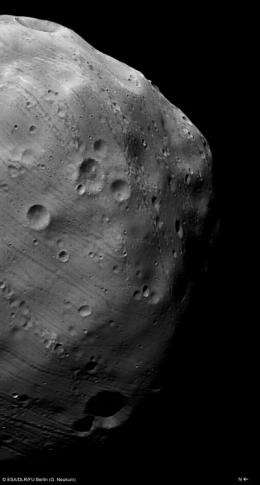
The High Resolution Stereo Camera (HRSC) onboard the ESA spacecraft Mars Express took this image of Phobos using the HRSC nadir channel on March 7, 2010, HRSC Orbit 7915. This image has additionally been enhanced photometrically for better bringing features in the less illuminated part. Resolution: about 4.4 meters per pixel. Credit: ESA/DLR/FU Berlin (G. Neukum)

Images from the recent flyby of Phobos, on 7 March 2010, are released today. The images show Mars' rocky moon in exquisite detail, with a resolution of just 4.4 metres per pixel. They show the proposed landing sites for the forthcoming Phobos-Grunt mission.

ESA's spacecraft orbits the Red Planet in a highly elliptical, polar orbit that brings it close to Phobos every five months. It is the only spacecraft currently in orbit around Mars whose orbit reaches far enough from the planet to provide a close-up view of Phobos.

Like our Moon, Phobos always shows the same side to the planet, so it is only by flying outside the orbit that it becomes possible to observe the far side. did just this on 7, 10 and 13 March 2010. Mars Express also collected data with other instruments.

This video is not supported by your browser at this time.

This is a simulation of the Mars Express Phobos flyby on March 7, 2010. Credit: ESA/DLR/FU Berlin (G. Neukum)

Phobos is an irregular body measuring some 27 × 22 × 19 km. Its origin is debated. It appears to share many surface characteristics with the class of 'carbonaceous C-type' asteroids, which suggests it might have been captured from this population. However, it is difficult to explain either the capture mechanism or the subsequent evolution of the orbit into the equatorial plane of Mars. An alternative hypothesis is that it formed around Mars, and is therefore a remnant from the planetary formation period.

In 2011 Russia will send a mission called Phobos-Grunt (meaning Phobos Soil) to land on the martian moon, collect a soil sample and return it to Earth for analysis.

For operational and landing safety reasons, the proposed landing sites were selected on the far side of Phobos within the area 5°S-5°N, 230-235°E. This region was imaged by the HRSC high-resolution camera of Mars Express during the July-August 2008 flybys of Phobos. But new HRSC images showing the vicinity of the landing area under different conditions, such as better illumination from the Sun, remain highly valuable for mission planners.

It is expected that Earth-based ESA stations will take part in controlling Phobos-Grunt, receiving telemetry and making trajectory measurements, including implementation of very long-baseline interferometry (VLBI). This cooperation is realized on the basis of the agreement on collaboration of the Russian Federal Space Agency and ESA in the framework of the 'Phobos-Grunt' and 'ExoMars' projects.

Express will continue to encounter Phobos until the end of March, when the moon will pass out of range. During the remaining flybys, HRSC and other instruments will continue to collect data.

Provided by European Space Agency (news : web)

4.7 /5 (7 votes)  

Rank 4.7 /5 (7 votes)
Related Stories
Relevant PhysicsForums posts
  • Titan's lack of impact craters
    created17 hours ago
  • Real pictures of black hole eating a star?
    createdFeb 08, 2012
  • Hypothetical way to travel faster than light, but not technically exceed lightspeed
    createdFeb 06, 2012
  • How do scientists monitor the Sun's activity?
    createdFeb 05, 2012
  • Search patterns in observational studies
    createdFeb 05, 2012
  • Derivation of Pogson's law
    createdFeb 03, 2012
  • More from Physics Forums - General Astronomy

More news stories

New views show old NASA Mars landers

(PhysOrg.com) -- The High Resolution Imaging Science Experiment (HiRISE) camera on NASA's Mars Reconnaissance Orbiter recorded a scene on Jan. 29, 2012, that includes the first color image from orbit showing ...

Space & Earth / Space Exploration

created 20 hours ago | popularity 4.9 / 5 (7) | comments 8 | with audio podcast

Deconstructing a mystery: What caused Snowmaggedon?

In the quiet after the storms, streets and cars had all but disappeared under piles of snow. The U.S. Postal Service suspended service for the first time in 30 years. Snow plows struggled to push the evidence ...

Space & Earth / Earth Sciences

created 12 hours ago | popularity 4.7 / 5 (3) | comments 1 | with audio podcast

Black holes and star formation

(PhysOrg.com) -- It has long been recognized that galaxy mergers or even close interactions can play a vital role in shaping the morphology of galaxies. One way they can do so, it is thought, is by triggering ...

Space & Earth / Astronomy

created 19 hours ago | popularity 4.1 / 5 (7) | comments 5 | with audio podcast

Ocean microbe communities changing, but long-term environmental impact is unclear

As oceans warm due to climate change, water layers will mix less and affect the microbes and plankton that pump carbon out of the atmosphere – but researchers say it's still unclear whether these processes ...

Space & Earth / Earth Sciences

created 14 hours ago | popularity 5 / 5 (2) | comments 2 | with audio podcast

Researchers create 3-D laser maps that show how earthquake changes landscape

Geologists have a new tool to study how earthquakes change the landscape down to a few inches, and it's giving them insight into how earthquake faults behave. In the Feb. 10 issue of the journal Science, a team ...

Space & Earth / Earth Sciences

created 14 hours ago | popularity 5 / 5 (4) | comments 0 | with audio podcast


'Dark plasmons' transmit energy

Microscopic channels of gold nanoparticles have the ability to transmit electromagnetic energy that starts as light and propagates via "dark plasmons," according to researchers at Rice University.

FDA-approved drug rapidly clears amyloid from the brain, reverses Alzheimer's symptoms in mice

Neuroscientists at Case Western Reserve University School of Medicine have made a dramatic breakthrough in their efforts to find a cure for Alzheimer's disease. The researchers' findings, published in the journal Science, show t ...

Hydrogen from acidic water: Researchers develop potential low cost alternative to platinum for splitting water

A technique for creating a new molecule that structurally and chemically replicates the active part of the widely used industrial catalyst molybdenite has been developed by researchers with the Lawrence Berkeley ...

Ultraviolet protection molecule in plants yields its secrets

Lying around in the sun all day is hazardous not just for humans but also for plants, which have no means of escape. Ultraviolet (UV) radiation from the sun can damage proteins and DNA inside cells, leading ...

Soraa LED light may dim 50-watt halogen rivals

(PhysOrg.com) -- Soraa, a Fremont, California company founded in 2008, this week launched its first product, a light that uses LEDS (light emitting diodes). The "Soraa LED MR16 lamp" is the "perfect" replacement ...

Anyone can learn to be more inventive, cognitive researcher says

There will always be a wild and unpredictable quality to creativity and invention, says Anthony McCaffrey, a cognitive psychology researcher at the University of Massachusetts Amherst, because an "Aha moment" is rare and ...