To the Antarctic or Brazil for new feathers
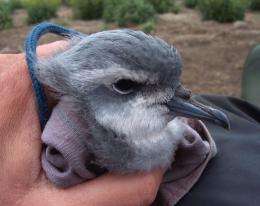
(PhysOrg.com) -- Not only land birds, but also some seabirds, cover enormous distances during migration: the sooty shearwater, for example, circumnavigates the earth one and a half times on its travels. Despite this, relatively little is known about the migratory behaviour of seabirds as compared with that of their land-living counterparts.
Scientists from the Max Planck Institute for Ornithology have studied the migratory behaviour of thin-billed prions and discovered that the animals spend their moulting season in two areas that are at a considerable distance from each other. Thus, it would appear that some seabirds can be extremely flexible and change their habitat if required - a vital adaptation to the unpredictable conditions found on the high seas. (Behavioral Ecology and Sociobiology, first published online on March 9, 2010)
While it has been possible to trace the migratory behaviour of some of the biggest marine birds, in particular the albatross, using satellite transmitters for more than 20 years now, this has not yet been possible for smaller species. Methods used on land, such as ringing and radio telemetry, offer little prospect of success on the open seas. A team of researchers working with Petra Quillfeldt from the Max Planck Institute for Ornithology in Radolfzell managed to overcome these difficulties, however, and succeeded in decoding information about the migratory behaviour of thin-billed prions. This approximately black-bird-sized species of the tubenose family, which also includes the albatrosses, fulmarine petrels and storm petrels, breeds from November to February on the Falkland Islands and neighbouring island groups in the South Atlantic. The Max Planck scientists had already demonstrated in an earlier study that at least some of the birds fly to an area south of the Antarctic Convergence zone to moult and renew their feathers. Thin-billed prions were also observed at the same time off the South American shelf and the Brazilian coast.
According to the researchers, 90 percent of the thin-billed prions visit the Antarctic waters. Most of them remain there for the entire moulting period from April to the end of June. Individual birds moult, however, further north, offshore of South America. Despite having these different destinations, the two populations are not genetically separate groups. The scientists succeeded in ringing individual prions during their breeding sojourns and then traced them over a period of several years. The ringed birds tended to show a preference for the area to which they had flown the previous year; however, there were individuals among them that moulted in the other area. Furthermore, one of the study birds started moult in the Antarctic, but later moved further north. "The results show that not only the entire species but also individual thin-billed prions are extremely flexible in their behaviour. This enables them to survive the winter in vast ocean areas with often unpredictable weather conditions and oceanographic cycles in order to renew their plumage and build up fat reserves for the following breeding season," explains Petra Quillfeldt.
.jpeg "The locations of the moulting areas of the thin-billed prions are not known yet precisely. Up to now it is also unclear whether the antarctic moulting region is in the atlantic or pacific ocean. Image: Max-Planck-Institut für Ornithologie")
The results of the study were obtained with the help of the analysis of carbon and nitrogen atoms of varying weights found in the birds' feathers. The researchers removed one small feather from breeding birds on the Falkland Islands in the South West Atlantic. They also collected the wings of thin-billed prions that had fallen prey to skuas. Small samples of these feathers were then tested for their stable carbon and nitrogen isotope content at the Leibniz Institute for Zoo and Wildlife Research in Berlin; a highly sensitive mass spectrometer was used for this purpose. The heavy carbon isotope 13C is not evenly distributed in the ocean. Its frequency in algae, which form the basis of the oceanic food web, declines with sinking sea temperatures. Therefore, birds in the Antarctic Ocean food web have lower 13C values than those who feed in more moderate seas. New feathers are formed during the moulting period and contain varying volumes of 13C, depending on the area in which moulting takes place. As a result, the new feathers store information about the area in which the bird moulted in the form of a characteristic isotope pattern.
More information: Quillfeldt, P., Voigt, C. C. & Masello, J.F. Plasticity versus repeatability in seabird migratory behaviour. Behavioral Ecology and Sociobiology, March 9th, 2010, online first, DOI:10.1007/s00265-010-0931-2
Provided by Max-Planck-Gesellschaft


