Brain plaques may explain higher risk of Alzheimer's based on mom's history
March 15, 2010
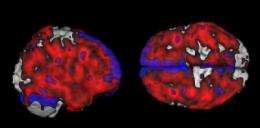
Two views of a composite image of the brains analyzed in the study compare the average increases in amyloid-beta deposits in volunteers with a maternally or paternally inherited risk of Alzheimer's, compared to counterparts with no family history of dementia. Red highlights the regions with more amyloid among 14 volunteers with a maternally inherited risk, while blue shows the regions with more amyloid among 14 volunteers with a paternally inherited risk. Purple denotes higher amyloid deposits in both risk groups. Credit: Lisa Mosconi, Ph.D., Mony J. de Leon, Ed.D.
A family history of Alzheimer's is one of the biggest risk factors for developing the memory-robbing disease, which affects more than 5 million Americans and is the most common form of senile dementia. Now an international collaboration led by NYU Langone Medical Center researchers has found the likely basis for this heightened familial risk—especially from the maternal side.
Aided by a new version of a brain scanning technique, the researchers discovered a far greater number of protein clumps linked to the disease among healthy adult children of parents with Alzheimer's compared to counterparts with no family history of dementia. The average increase in these clumps, called amyloid-beta plaques, was particularly striking among study volunteers whose mothers had been diagnosed with the disease. The plaques appeared throughout most regions of the brain.
The study examined 42 healthy individuals, including 14 whose mothers had Alzheimer's, 14 whose fathers had Alzheimer's, and 14 counterparts with no family history of the disease. On average, the first group of volunteers showed a 15 percent higher burden of amyloid-beta deposits than those with a paternal family history, and a 20 percent higher burden of the protein clumps than those with no familial risk factors.
The new findings, published in the March 15, 2010, online early edition of Proceedings of the National Academy of Sciences, may help explain why a family history is such a big risk factor for the brain disease—individuals with an affected parent have a four- to ten-fold greater risk than those with no family history.
The study was led by Lisa Mosconi, PhD, research assistant professor of psychiatry at NYU Langone, and colleagues at NYU Langone who collaborated with researchers at the University of Turku in Finland and Weill Cornell Medical Center in New York.
"Given that brain pathology begins to accumulate years ahead of memory problems in Alzheimer's disease, our findings are intriguing," says Dr. Mosconi. "There is a great effort underway to find early markers of disease, before symptoms appear, so that therapeutic approaches will one day delay or ultimately prevent this disease."
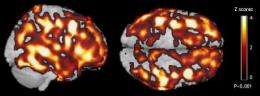
Two views of a composite image of the brains analyzed in Dr. Mosconi's study highlight the average increase in amyloid-beta deposits among 14 healthy adults with a mother affected by Alzheimer's. Regions in yellow have 4 times more amyloid than the corresponding regions of 14 healthy counterparts with no family history of dementia, while regions in red have twice as much amyloid. Credit: Lisa Mosconi, Ph.D., Mony J. de Leon, Ed.D.
Amyloid plaques are one of the hallmarks of Alzheimer's disease, although not everyone with plaques develops the disease. For many years, amyloid-beta plaques could only be measured in autopsied brains, but methods have recently emerged that allow the plaques to be observed in living brains.
The new study combines positron emission tomography (PET) with a fluorescent dye called Pittsburgh Compound B (PiB) that highlights brain amyloid plaques, enabling researchers to actually see the deposits. The dye attaches to plaques and acts like a temporary beacon to highlight their presence during a PET scan. Dr. Mosconi cautions that her team's imaging technique is a potentially powerful research tool and is not ready for use as a diagnostic tool in the clinic.
Plaques begin forming in the brain when, for unknown reasons, normal amyloid-beta proteins change their shape and structure and begin sticking together. The presence of plaques, however, does not necessarily mean an individual will develop Alzheimer's, and much of the harm may arrive well before the plaques appear—no one can yet say whether they are a cause or a consequence of the disease.
It isn't known why the deposits were more common among children of parents with the disease in the study, but Dr. Mosconi suspects that a genetic mechanism is involved. "At this point, we can only speculate that genes that are transmitted from parents, particularly mothers, to their children lead to amyloid depositions, which increase risk for developing dementia," she says.
Dr. Mosconi and her colleagues hope to follow the study's 42 volunteers and more subjects over time to analyze the link between plaque formation and Alzheimer's. For those who never develop dementia, she likewise hopes to determine what preventive factors may be neutralizing the bad effects of amyloid on the brain.
The scanning technique used in the new study also provides more evidence supporting a maternal family link to Alzheimer's, notes Dr. Mosconi, whose previous studies have shown such an association based on reduced glucose metabolism in the brains of healthy adults whose mothers had the disease.
"This imaging study further anchors the risk for Alzheimer's disease associated with having a mother affected by the disease," says Mony J. de Leon, EdD, professor of psychiatry and Director of the Center for Brain Health at NYU Langone Medical Center, and one of the study's authors.
Provided by New York University School of Medicine (news : web)
-
Neuroimaging study describes Alzheimer's disease-like changes in elderly people without the disease
Mar 15, 2010 |
not rated yet |
0
-
A maternal link to Alzheimer's disease
Nov 06, 2007 |
not rated yet |
0
-
Brain imaging study supports the 'cognitive reserve' hypothesis
Nov 10, 2008 |
not rated yet |
0
-
Imaging test detects Alzheimer's disease that is likely to progress
Dec 15, 2009 |
not rated yet |
0
-
Scientists find new cause of Alzheimer's
Apr 19, 2006 |
not rated yet |
0
-
Engineers build first sub-10-nm carbon nanotube transistor
Feb 01, 2012 |
4.9 / 5 (31) |
30
-
Something old, something new: Evolution and the structural divergence of duplicate genes
Jan 31, 2012 |
4.6 / 5 (7) |
1
-
The hidden nanoworld of ice crystals: Revealing the dynamic behavior of quasi-liquid layers
Jan 30, 2012 |
5 / 5 (3) |
1
-
Stock market network reveals investor clustering
Jan 27, 2012 |
3.9 / 5 (23) |
8
-
Of microchemistry and molecules: Electronic microfluidic device synthesizes biocompatible probes
Jan 26, 2012 |
5 / 5 (1) |
0
-
Classical and Quantum Mechanics via Lie algebras
Apr 15, 2011
- More from Physics Forums - Independent Research
More news stories
Complex wiring of the nervous system may rely on a just a handful of genes and proteins
Researchers at the Salk Institute have discovered a startling feature of early brain development that helps to explain how complex neuron wiring patterns are programmed using just a handful of critical genes. ...
11 hours ago |
4.9 / 5 (9) |
1
|
Team isolates nerve cells involved in storing long term memory and gene proteins associated with them
(Medical Xpress) -- A research team in Taiwan has succeeded in isolating two nerve cells in fruit fly brains that are believed to be the major players in allowing for the formation of long term memories. Furthermore, ...
Seeing colors in music, tasting flavors in shapes may happen in life's early months
Famed violinist Itzhak Perlman sees a deep forest green whenever he plays a B-flat on his Stradivarius' G string. The A on the E string is red.
Medicine & Health / Psychology & Psychiatry
18 hours ago |
4.5 / 5 (2) |
2
|
Both maternal and paternal age linked to autism
Older maternal and paternal age are jointly associated with having a child with autism, according to a recently published study led by researchers at The University of Texas Health Science Center at Houston (UTHealth).
Medicine & Health / Psychology & Psychiatry
15 hours ago |
4.3 / 5 (3) |
0
|
New understanding of DNA repair could eventually lead to cancer therapy
A research group in the Faculty of Medicine & Dentistry at the University of Alberta is hoping its latest discovery could one day be used to develop new therapies that target certain types of cancers.
15 hours ago |
4.8 / 5 (6) |
0
|
Anonymous knocks CIA website offline (Update)
The website of the Central Intelligence Agency was inaccessible on Friday after the hacker group Anonymous claimed to have knocked it offline.
New error-correcting codes guarantee the fastest possible rate of data transmission
Error-correcting codes are one of the triumphs of the digital age. Theyre a way of encoding information so that it can be transmitted across a communication channel such as an optical fiber o ...
Humans may have helped the decline of African rainforests 3000 years ago
(PhysOrg.com) -- Large areas of rainforests in Central Africa mysteriously disappeared over three thousand years ago, to be replaced by savannas. The prevailing theory has been that the cause was a change ...
Google users warned of threat to smartphone wallets
Users of Google smartphone wallets were being warned on Friday that there is a way to crack pass codes intended to thwart thieves from going on illicit shopping sprees.
New power source discovered
(PhysOrg.com) -- Researchers at the Massachusetts Institute of Technology (MIT) and RMIT University have made a breakthrough in energy storage and power generation.
The power of estrogen -- male snakes attract other males
A new study has shown that boosting the estrogen levels of male garter snakes causes them to secrete the same pheromones that females use to attract suitors, and turned the males into just about the sexiest ...
