New lunar images and data available to the public
March 15, 2010
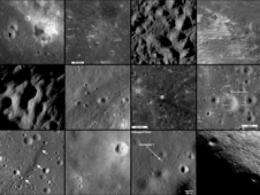
The seven instruments aboard the Lunar Reconnaissance Orbiter provide varied and unique datasets. This photo album published in concert with the first major public data release, gives a small taste of each instrument’s measurements and highlights some of the notable early achievements of the mission. Credit: NASA/GSFC/ASU
The public can follow along with NASA on its journey of lunar discovery. On March 15, the publicly accessible Planetary Data System will release data sets from the seven instruments on board NASA's Lunar Reconnaissance Orbiter.
"The Planetary Data System is a NASA funded program to archive data from past and present planetary missions as well as astronomical observations and laboratory data," said Dr. John Keller, LRO Deputy Project Scientist from NASA Goddard Space Flight Center in Greenbelt, Md. "The purpose of the Planetary Data System is to make available to the public the fruits of NASA funded research and to allow advanced research on solar system science."
Each of the seven instruments is unique and will provide data in different formats to the Planetary Data System. Much of the data will be in a relatively low level form, not highly processed, which allows researchers to maximize flexibility in working with the data. The instrument teams will also provide higher level data products in the form of maps and calibrated images for the general public. Many of the images can be accessed using a computer with an internet browser.
Prior to the formal release of LRO data, the Lunar Reconnaissance Orbiter Camera team released several hundred images from the pair of Narrow Angle Cameras on-board the spacecraft. These images were released to give researchers a head start on using the data before the tidal wave of data was unleashed.
"We're able to take advantage of the close proximity of the Moon, compared to other objects in the solar system, to transmit data from LRO back to Earth at a very high rate," said Keller. "The first data release is 55 terabytes. The one year exploration mission will deliver 130 terabytes of data, enabling a more detailed study our nearest celestial neighbor. We expect LRO to provide more data than all of the previous planetary missions combined."
LRO was mandated to release data to the Planetary Data System beginning six months after initial operation. Some of the higher level data products require the full year of measurements and won't be released until after the end of the exploration mission. LRO will move into its science phase in September, when the program management responsibility moves from the Exploration Systems Mission Directorate to the Science Mission Directorate at NASA Headquarters.
LRO is scheduled for a one year exploration mission in a polar orbit about 31 miles above the lunar surface. During this time, LRO will produce a comprehensive map of the lunar surface in unprecedented detail, search for resources and potential safe landing sites for a potential future return to the moon and measure lunar temperatures and radiation levels.
The lunar bound spacecraft launched from Kennedy Space Center, Fla. on June 18, 2009. Since that time the spacecraft has completed calibration and commissioning. LRO formally began its detailed survey of the moon in September 2009. First results from the mission included - new looks at the Apollo landing sites; indications that permanently shadowed and nearby regions may harbor water and hydrogen; observations that large areas in the permanently shadowed regions are colder than Pluto; and detailed information on lunar terrain. LRO also supported the Lunar Crater Observation and Sensing Satellite impact, first by helping to select a promising site and second by observing both the expanding plume that arose after the impact and the evolving temperature at the impact site.
More information: To access the Planetary Data System, go to: http://pds.jpl.nasa.gov
-
Send Your Name to the Moon Aboard LRO
May 01, 2008 |
not rated yet |
0
-
NASA Lunar Spacecraft Ships South in Preparation for Launch
Feb 11, 2009 |
not rated yet |
0
-
Scientist to Work With NASA's Lunar Orbiter
Jan 25, 2005 |
not rated yet |
0
-
LRO lunar mission successfully enters moon orbit
Jun 23, 2009 |
not rated yet |
0
-
NASA Lunar Satellite Begins Detailed Mapping of Moon's South Pole
Sep 17, 2009 |
not rated yet |
0
-
Engineers build first sub-10-nm carbon nanotube transistor
Feb 01, 2012 |
4.9 / 5 (31) |
30
-
Something old, something new: Evolution and the structural divergence of duplicate genes
Jan 31, 2012 |
4.6 / 5 (7) |
1
-
The hidden nanoworld of ice crystals: Revealing the dynamic behavior of quasi-liquid layers
Jan 30, 2012 |
5 / 5 (3) |
1
-
Stock market network reveals investor clustering
Jan 27, 2012 |
3.9 / 5 (23) |
8
-
Of microchemistry and molecules: Electronic microfluidic device synthesizes biocompatible probes
Jan 26, 2012 |
5 / 5 (1) |
0
-
Scale of the Universe
12 hours ago
-
Titan's lack of impact craters
Feb 09, 2012
-
Real pictures of black hole eating a star?
Feb 08, 2012
-
Hypothetical way to travel faster than light, but not technically exceed lightspeed
Feb 06, 2012
-
How do scientists monitor the Sun's activity?
Feb 05, 2012
-
Search patterns in observational studies
Feb 05, 2012
- More from Physics Forums - General Astronomy
More news stories
Humans may have helped the decline of African rainforests 3000 years ago
(PhysOrg.com) -- Large areas of rainforests in Central Africa mysteriously disappeared over three thousand years ago, to be replaced by savannas. The prevailing theory has been that the cause was a change ...
Could Venus be shifting gear?
(PhysOrg.com) -- ESAs Venus Express spacecraft has discovered that our cloud-covered neighbour spins a little slower than previously measured. Peering through the dense atmosphere in the infrared, the ...
Space & Earth / Space Exploration
19 hours ago |
5 / 5 (7) |
8
|
NASA budget will axe Mars deal with Europe: scientists
US President Barack Obama's budget proposal to be submitted next week for 2013 will cut NASA's budget by 20 percent and eliminate a major partnership with Europe on Mars exploration, scientists said Thursday.
Space & Earth / Space Exploration
22 hours ago |
5 / 5 (2) |
19
Mars Science Laboratory computer issue resolved
(PhysOrg.com) -- Engineers have found the root cause of a computer reset that occurred two months ago on NASA's Mars Science Laboratory and have determined how to correct it.
Space & Earth / Space Exploration
20 hours ago |
4.7 / 5 (6) |
4
|
Two new moons for Jupiter
Advances in technology have lead to the discovery of new planets outside of our Solar System, and now even new moons in our own backyard.
Space & Earth / Space Exploration
19 hours ago |
4 / 5 (1) |
7
Anonymous knocks CIA website offline (Update)
The website of the Central Intelligence Agency was inaccessible on Friday after the hacker group Anonymous claimed to have knocked it offline.
New error-correcting codes guarantee the fastest possible rate of data transmission
Error-correcting codes are one of the triumphs of the digital age. Theyre a way of encoding information so that it can be transmitted across a communication channel such as an optical fiber o ...
Small modular reactor design could be a 'SUPERSTAR'
(PhysOrg.com) -- Though most of today's nuclear reactors are cooled by water, we've long known that there are alternatives; in fact, the world's first nuclear-powered electricity in 1951 came from a reactor ...
New power source discovered
(PhysOrg.com) -- Researchers at the Massachusetts Institute of Technology (MIT) and RMIT University have made a breakthrough in energy storage and power generation.
The power of estrogen -- male snakes attract other males
A new study has shown that boosting the estrogen levels of male garter snakes causes them to secrete the same pheromones that females use to attract suitors, and turned the males into just about the sexiest ...
Google users warned of threat to smartphone wallets
Users of Google smartphone wallets were being warned on Friday that there is a way to crack pass codes intended to thwart thieves from going on illicit shopping sprees.
Mar 16, 2010
Rank: 1 / 5 (1)
Obama wants to save Mother Gaia first.
Maybe the Chinese or Indians can use this data...