Powerful Cyclone Tomas battering Northern Fiji islands
March 15, 2010
Powerful Cyclone Tomas battering Northern Fiji islands

Enlarge

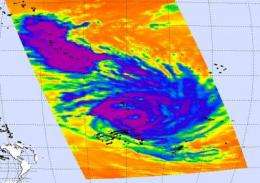
NASA's AIRS instrument provided an infrared look at Tomas' cold thunderstorm cloudtops (blue and purple) on March 14 at 0135 UTC. The storm is more than 300 miles in diameter. The AIRS image gives a viewer a good idea of the size of the storm. Credit: NASA JPL, Ed Olsen

Tomas grew into a monster Category 4 cyclone and thrashed the northern Fiji Islands with heavy rains and maximum sustained winds of up to 170 mph (275 km). The Moderate Resolution Imaging Spectroradiometer instrument on NASA's Aqua satellite captured a visible image of most of Cyclone Tomas on Mar. 14 10:21 p.m. ET and noticed the storm's eye is cloud-filled.

Another instrument on NASA's Aqua satellite measured the cloud top temperatures of Tomas' thunderstorms, and revealed very high, cold thunderstorms (as cold as minus 63 degree Fahrenheit) surrounding Tomas' 34-mile in diameter-wide-eye. The Atmospheric Infrared Sounder (AIRS) instrument showed forecasters that the thunderstorm "engine" in Tomas' center was very powerful with strong thunderstorms, dropping heavy rainfall.

Tomas has already caused damages for residents of the northern Fiji islands. Damage reports are still coming in, but power losses and flooding have been reported. Evacuations have taken place in Labassa, Wainiika, Nuku and Vatu because of flooding. Other reports indicate that schools and government buildings have been closed. Tourists were evacuated and flights have been temporarily canceled to and from Fiji's main airport.

At 0828 UTC March 15 (4:28 a.m. EDT), Tomas was packing near 120 mph (105 knots). The center of the storm was approximately 200 nautical miles northeast of Nadi, Fiji, near 16.1 South and 179.5 West. Tomas is moving south at 7 mph (6 knots). Tomas' estimated minimum central pressure was 930 millibars.

Cyclone-force winds extend 40 miles out from the center, while tropical storm-force winds extend out 150 miles from the center, making the storm 300 miles in diameter. Tomas' eye is 30 nautical miles (34 miles) in diameter.

shows that Tomas has maintained its banding or wrapping around of thunderstorms around the storm's low-level center of circulation. As Tomas continues to track in a southerly direction over the next day and a half, it is forecast to intensify a little (due to the warm ocean waters it will be passing through), then will run into increasing wind shear which will weaken the storm.

Provided by NASA's Goddard Space Flight Center (news : web)


Rank not rated yet
Relevant PhysicsForums posts
  • Discrepancy between oxygen and carbon-dioxide levels
    createdFeb 09, 2012
  • where gems are found in the world
    createdFeb 09, 2012
  • Wind Waves in Reservoir ~ Wind run-up and Wind set-up
    createdFeb 08, 2012
  • Balance of oxygen in the atmosphere
    createdFeb 01, 2012
  • The case for a methanol-based economy
    createdJan 30, 2012
  • Weather in a rotating cylinder
    createdJan 25, 2012
  • More from Physics Forums - Earth

More news stories

Humans may have helped the decline of African rainforests 3000 years ago

(PhysOrg.com) -- Large areas of rainforests in Central Africa mysteriously disappeared over three thousand years ago, to be replaced by savannas. The prevailing theory has been that the cause was a change ...

Space & Earth / Environment

created 23 hours ago | popularity 4.3 / 5 (13) | comments 13 | with audio podcast report

Could Venus be shifting gear?

(PhysOrg.com) -- ESA’s Venus Express spacecraft has discovered that our cloud-covered neighbour spins a little slower than previously measured. Peering through the dense atmosphere in the infrared, the ...

Space & Earth / Space Exploration

created 19 hours ago | popularity 5 / 5 (7) | comments 8 | with audio podcast

NASA budget will axe Mars deal with Europe: scientists

US President Barack Obama's budget proposal to be submitted next week for 2013 will cut NASA's budget by 20 percent and eliminate a major partnership with Europe on Mars exploration, scientists said Thursday.

Space & Earth / Space Exploration

created 22 hours ago | popularity 5 / 5 (2) | comments 19

Mars Science Laboratory computer issue resolved

(PhysOrg.com) -- Engineers have found the root cause of a computer reset that occurred two months ago on NASA's Mars Science Laboratory and have determined how to correct it.

Space & Earth / Space Exploration

created 20 hours ago | popularity 4.7 / 5 (6) | comments 4 | with audio podcast

Two new moons for Jupiter

Advances in technology have lead to the discovery of new planets outside of our Solar System, and now even new moons in our own backyard.

Space & Earth / Space Exploration

created 19 hours ago | popularity 4 / 5 (1) | comments 7


Anonymous knocks CIA website offline (Update)

The website of the Central Intelligence Agency was inaccessible on Friday after the hacker group Anonymous claimed to have knocked it offline.

New error-correcting codes guarantee the fastest possible rate of data transmission

Error-correcting codes are one of the triumphs of the digital age. They’re a way of encoding information so that it can be transmitted across a communication channel — such as an optical fiber o ...

Small modular reactor design could be a 'SUPERSTAR'

(PhysOrg.com) -- Though most of today's nuclear reactors are cooled by water, we've long known that there are alternatives; in fact, the world's first nuclear-powered electricity in 1951 came from a reactor ...

New power source discovered

(PhysOrg.com) -- Researchers at the Massachusetts Institute of Technology (MIT) and RMIT University have made a breakthrough in energy storage and power generation.

The power of estrogen -- male snakes attract other males

A new study has shown that boosting the estrogen levels of male garter snakes causes them to secrete the same pheromones that females use to attract suitors, and turned the males into just about the sexiest ...

Google users warned of threat to smartphone wallets

Users of Google smartphone wallets were being warned on Friday that there is a way to crack pass codes intended to thwart thieves from going on illicit shopping sprees.