Super Supernova: White Dwarf Star System Exceeds Mass Limit
March 15, 2010
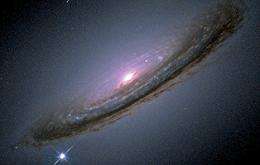
Cosmologists use Type Ia supernovae, like the one visible in the lower left corner of this galaxy, to explore the past and future expansion of the universe and the nature of dark energy. (Photo: High-Z Supernova Search Team, HST, NASA)
(PhysOrg.com) -- An international team led by Yale University has, for the first time, measured the mass of a type of supernova thought to belong to a unique subclass and confirmed that it surpasses what was believed to be an upper mass limit. Their findings, which appear online and will be published in an upcoming issue of the Astrophysical Journal, could affect the way cosmologists measure the expansion of the universe.
Cosmologists use Type Ia supernovae—the violent explosions of dead cores of stars called white dwarfs—as a kind of cosmic ruler to measure distances to the supernovae's host galaxies and, as such, to understand the past and future expansion of the universe and explore the nature of dark energy. Until recently, it was thought that white dwarfs could not exceed what is known as the Chandrasekhar limit, a critical mass equaling about 1.4 times that of the Sun, before exploding in a supernova. This uniform limit is a key tool in measuring distances to supernovae.
Since 2003, four supernovae have been discovered that were so bright, cosmologists wondered whether their white dwarfs had surpassed the Chandrasekhar limit. These supernovae have been dubbed the "super-Chandrasekhar" supernovae.
Now Richard Scalzo of Yale, as part of a collaboration of American and French physicists called the Nearby Supernova Factory, has measured the mass of the white dwarf star that resulted in one of these rare supernovae, called SN 2007if, and confirmed that it exceeded the Chandrasekhar limit. They also discovered that the unusually bright supernova had not only a central mass, but a shell of material that was ejected during the explosion as well as a surrounding envelope of pre-existing material. The team hopes this discovery will provide a structural model with which to understand the other supermassive supernovae.
Using observations from telescopes in Chile, Hawaii and California, the team was able to measure the mass of the central star, the shell and the envelope individually, providing the first conclusive evidence that the star system itself did indeed surpass the Chandrasekhar limit. They found that the star itself appears to have had a mass of 2.1 times the mass of the Sun (plus or minus 10 percent), putting it well above the limit.
Being able to measure masses for all parts of the star system tells the physicists about how the system may have evolved—a process that is currently poorly understood. "We don't really know much about the stars that lead to these supernovae," Scalzo said. "We want to know more about what kind of stars they were, and how they formed and evolved over time."
Scalzo believes there's a good chance that SN 2007if resulted from the merging of two white dwarfs, rather than the explosion of a single white dwarf and hopes to study the other super-Chandrasekhar supernovae to determine whether they, too, could have involved a merger of two white dwarfs.
Theorists continue to explore how stars with masses above the Chandrasekhar limit, which is based on a simplified star model, could exist without collapsing under their own weight. Either way, a subclass of supernovae governed by different physics could have a dramatic effect on the way cosmologists use them to measure the expansion of the universe.
"Supernovae are being used to make statements about the fate of the universe and our theory of gravity," Scalzo said. "If our understanding of supernovae changes, it could significantly impact of our theories and predictions."
More information: Paper: http://arxiv.org/abs/1003.2217
-
Astronomers simulate how white dwarf stars merge and become a supernova
Jan 07, 2010 |
not rated yet |
0
-
Chandra Reveals Origin of Key Cosmic Explosions
Feb 17, 2010 |
not rated yet |
0
-
XMM-Newton uncovers a celestial Rosetta stone
Sep 03, 2009 |
not rated yet |
0
-
Better Supernovae Measurements Aim To Improve Understanding of Dark Energy
May 22, 2009 |
not rated yet |
0
-
Queen's astronomers propose new supernova interpretation
Jun 09, 2009 |
not rated yet |
0
-
Engineers build first sub-10-nm carbon nanotube transistor
Feb 01, 2012 |
4.9 / 5 (31) |
30
-
Something old, something new: Evolution and the structural divergence of duplicate genes
Jan 31, 2012 |
4.6 / 5 (7) |
1
-
The hidden nanoworld of ice crystals: Revealing the dynamic behavior of quasi-liquid layers
Jan 30, 2012 |
5 / 5 (3) |
1
-
Stock market network reveals investor clustering
Jan 27, 2012 |
3.9 / 5 (23) |
8
-
Of microchemistry and molecules: Electronic microfluidic device synthesizes biocompatible probes
Jan 26, 2012 |
5 / 5 (1) |
0
-
Scale of the Universe
12 hours ago
-
Titan's lack of impact craters
Feb 09, 2012
-
Real pictures of black hole eating a star?
Feb 08, 2012
-
Hypothetical way to travel faster than light, but not technically exceed lightspeed
Feb 06, 2012
-
How do scientists monitor the Sun's activity?
Feb 05, 2012
-
Search patterns in observational studies
Feb 05, 2012
- More from Physics Forums - General Astronomy
More news stories
Humans may have helped the decline of African rainforests 3000 years ago
(PhysOrg.com) -- Large areas of rainforests in Central Africa mysteriously disappeared over three thousand years ago, to be replaced by savannas. The prevailing theory has been that the cause was a change ...
Could Venus be shifting gear?
(PhysOrg.com) -- ESAs Venus Express spacecraft has discovered that our cloud-covered neighbour spins a little slower than previously measured. Peering through the dense atmosphere in the infrared, the ...
Space & Earth / Space Exploration
19 hours ago |
5 / 5 (7) |
8
|
NASA budget will axe Mars deal with Europe: scientists
US President Barack Obama's budget proposal to be submitted next week for 2013 will cut NASA's budget by 20 percent and eliminate a major partnership with Europe on Mars exploration, scientists said Thursday.
Space & Earth / Space Exploration
22 hours ago |
5 / 5 (2) |
19
Mars Science Laboratory computer issue resolved
(PhysOrg.com) -- Engineers have found the root cause of a computer reset that occurred two months ago on NASA's Mars Science Laboratory and have determined how to correct it.
Space & Earth / Space Exploration
20 hours ago |
4.7 / 5 (6) |
4
|
Two new moons for Jupiter
Advances in technology have lead to the discovery of new planets outside of our Solar System, and now even new moons in our own backyard.
Space & Earth / Space Exploration
19 hours ago |
4 / 5 (1) |
7
Anonymous knocks CIA website offline (Update)
The website of the Central Intelligence Agency was inaccessible on Friday after the hacker group Anonymous claimed to have knocked it offline.
New error-correcting codes guarantee the fastest possible rate of data transmission
Error-correcting codes are one of the triumphs of the digital age. Theyre a way of encoding information so that it can be transmitted across a communication channel such as an optical fiber o ...
Small modular reactor design could be a 'SUPERSTAR'
(PhysOrg.com) -- Though most of today's nuclear reactors are cooled by water, we've long known that there are alternatives; in fact, the world's first nuclear-powered electricity in 1951 came from a reactor ...
New power source discovered
(PhysOrg.com) -- Researchers at the Massachusetts Institute of Technology (MIT) and RMIT University have made a breakthrough in energy storage and power generation.
The power of estrogen -- male snakes attract other males
A new study has shown that boosting the estrogen levels of male garter snakes causes them to secrete the same pheromones that females use to attract suitors, and turned the males into just about the sexiest ...
Google users warned of threat to smartphone wallets
Users of Google smartphone wallets were being warned on Friday that there is a way to crack pass codes intended to thwart thieves from going on illicit shopping sprees.
Mar 15, 2010
Rank: 2.8 / 5 (4)
After all, theorists posit rapid rotation for millisecond pulsars, which they are supposed to acquire gradually over time as matter continues to accrete onto them from a co-spinning disk. Well, Type 1A supernovae are also supposed to be driven by accretion (presumably, from an accretion disk...) -- so they ought to be getting "spun up" by the selfsame process as ultimately brings them to the threshold of detonation.
Mar 15, 2010
Rank: 3 / 5 (2)
Mar 15, 2010
Rank: 3.3 / 5 (3)
http://en.wikiped...ar_limit
While rotation can play some role, it is not a necessary component for white dwarf origins. The key underlying process for the formation of white dwarfs, is depletion of hydrogen at the star's core, which leads to more energetic fusion reactions, which lead to a red giant phase, and then planetary nebula phase when the outgoing radiation pressure erodes away the outer layers of the star.
Mar 16, 2010
Rank: 5 / 5 (4)
And if they find such models the outcome might even be worse for the usability of that standard candle.
Mar 16, 2010
Rank: not rated yet
I hope astronomers constantly keep an open mind to the possibilities of "facts" not always being "facts"
Mar 16, 2010
Rank: 3 / 5 (2)
Mar 16, 2010
Rank: not rated yet
If I had the lecture notes online from the cosmology class I took 10 years ago, I'd post them. As it stands, Wikipedia is a pretty convenient reference, and it happens to be quite correct. Chandrasekhar's calculations addressed only a strictly non-rotating problem, just like Schwarzschild addressed only the metric of non-rotating black holes. Lack of rotation makes the math a lot more manageable...
Mar 16, 2010
Rank: 5 / 5 (1)
Mar 16, 2010
Rank: 5 / 5 (3)
Consider also, that for rotating objects there's no single solution. The dynamics depend entirely on how fast the object is spinning. One could, of course, take it to the absurd limit where the object's surface at the equator approaches light speed, but this wouldn't be remotely realistic, as no objects even close to such a limit would be likely to exist.
A nice thing about non-rotating objects, is that they produce a single, nice, final answer that only depends on mass as the single free parameter...
Anyway, to me rotation seems to just be a no-brainer when it comes to exceeding the Chandrasekhar limit. It is so simple, and so obvious, it's screaming for recognition. I find it actually rather odd, that it wasn't mentioned in the writeup to begin with. It seems to me much more likely, than a merging-of-two-dwarfs scenario. Not to say that the latter isn't possible, but it's just true that all stars spin, and most accretion disks spin up the target of accretion...
Mar 16, 2010
Rank: 5 / 5 (2)
So ultimately, the question would be settled by a balance between how much variation there is, vs. how large is the population of measured events. But at any rate, the error bars just widened considerably...
Mar 16, 2010
Rank: not rated yet
I mean, seriously - Type 1 supernovae have been studied for at least a couple of decades now, and white dwarfs for another couple of decades before that, and *NOBODY* has bothered to compute what rotation does?
Now that I think about it, I am pretty sure Dr. Forward must have, when he was writing Dragon's Egg - though that concerns a neutron star, and not a white dwarf.
Mar 16, 2010
Rank: 5 / 5 (3)
As for mass limit not being significantly affected by rotation, even a simple Newtonian analysis ought to convince you that's false. The gravitational acceleration at the surface of a white dwarf can be easily compensated by kinetic energy of a rapidly rotating surface.