Study highlights forest protected areas as a critical strategy for slowing climate change
March 16, 2010
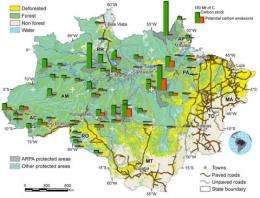
A MAP showing carbon stocks and potential emissions of selected forest protected areas in the Brazilian Amazon.
A new study involving scientists from 13 different organizations, universities and research institutions states that forest protection offers one of the most effective, practical, and immediate strategies to combat climate change. The study, "Indigenous Lands, Protected Areas, and Slowing Climate Change," was published in PLoS Biology, a peer-reviewed scientific journal, and makes specific recommendations for incorporating protected areas into overall strategies to reduce emissions of greenhouse gasses from deforestation and degradation (nicknamed REDD).
"Deforestation leads to about 15 percent of the world's greenhouse gas emissions, more than all the cars, trucks, trains, ships, and planes on earth. If we fail to reduce it, we'll fail to stabilize our climate," said Taylor Ricketts, director of World Wildlife Fund's science program and lead author of the study. "Our paper emphasizes that creating and strengthening indigenous lands and other protected areas can offer an effective means to cut emissions while garnering numerous additional benefits for local people and wildlife."
The authors highlight analyses showing that since 2002, deforestation in the Brazilian Amazon has been 7 to 11 times lower inside of indigenous lands and other protected areas than elsewhere. Simulation models suggest that protected areas established between 2003 and 2007 could prevent an estimated area of 100,000 square miles of deforestation through 2050. That is roughly the size of the state of Colorado, representing enough carbon to equal 1/3 of the world's annual CO2 emissions. Within these efforts, location matters; protected areas in regions that face deforestation pressures would be most effective at truly reducing emissions.
"This study reinforces the wisdom behind global investments in protected areas," says Gustavo A.B. da Fonseca, co-author of the study and Team Leader Natural Resources of the Global Environment Facility (GEF). "In addition to protecting globally important species and ecosystems, the 2,302 protected areas supported by the GEF alone span over 634 million hectares and together store an impressive 30 billion tons of CO2"
International policies for compensating forest nations for REDD are under active negotiation. To access the resulting funds, developing countries will need to develop programs and institutions to reduce forest emissions. "Protected areas represent a valuable component of national REDD programs since they already contain the necessary institutions and infrastructure to handle funds, strengthen protection and generate results," said Claudio Maretti, Conservation Director, WWF Brazil. "Establishing protected areas usually clarifies land tenure and the associated carbon rights, which has been a sticking point in some negotiations."
In addition, the study estimates that the cost of creating and better managing protected areas is lower than many other options to reduce emissions from deforestation. Completing and managing a network of protected areas in the developing world might require $4 billion USD annually, which is roughly 1/10 of the capital that could be mobilized by international REDD policies.
According to the study, forest nations can strengthen the role of protected areas in their REDD strategies by:
- Identifying where Indigenous Lands and Protected Areas would most effectively reduce deforestation rates and associated emissions;
- Establishing national monitoring to measure deforestation rates and quantify carbon emissions reductions;
- Establishing insurance mechanisms for illegal logging or forest fires;
- Providing indigenous groups and local communities the information and capacities they need to participate;
- Distributing payments transparently to reward those responsible for reducing emissions.
More information: The publication "Indigenous Lands, Protected Areas, and Slowing Climate Change" is available at http://www.worldwi … tem15590.pdf
Provided by World Wildlife Fund
-
Cautious conservation: How to ensure that slowing global warming will protect biodiversity
Nov 16, 2009 |
not rated yet |
0
-
Carbon payments payments could protect orangutans, pygmy elephants in Borneo
Jun 04, 2009 |
not rated yet |
0
-
New research provides insights into potential ecological costs and cobenefits of REDD
Nov 16, 2009 |
not rated yet |
0
-
New climate treaty could put species at risk
Nov 16, 2009 |
not rated yet |
0
-
The end of deforestation in the Brazilian Amazon?
Dec 03, 2009 |
not rated yet |
0
-
Engineers build first sub-10-nm carbon nanotube transistor
Feb 01, 2012 |
4.9 / 5 (31) |
30
-
Something old, something new: Evolution and the structural divergence of duplicate genes
Jan 31, 2012 |
4.6 / 5 (7) |
1
-
The hidden nanoworld of ice crystals: Revealing the dynamic behavior of quasi-liquid layers
Jan 30, 2012 |
5 / 5 (3) |
1
-
Stock market network reveals investor clustering
Jan 27, 2012 |
3.9 / 5 (23) |
8
-
Of microchemistry and molecules: Electronic microfluidic device synthesizes biocompatible probes
Jan 26, 2012 |
5 / 5 (1) |
0
-
Discrepancy between oxygen and carbon-dioxide levels
Feb 09, 2012
-
where gems are found in the world
Feb 09, 2012
-
Wind Waves in Reservoir ~ Wind run-up and Wind set-up
Feb 08, 2012
-
Balance of oxygen in the atmosphere
Feb 01, 2012
-
The case for a methanol-based economy
Jan 30, 2012
-
Weather in a rotating cylinder
Jan 25, 2012
- More from Physics Forums - Earth
More news stories
Humans may have helped the decline of African rainforests 3000 years ago
(PhysOrg.com) -- Large areas of rainforests in Central Africa mysteriously disappeared over three thousand years ago, to be replaced by savannas. The prevailing theory has been that the cause was a change ...
Could Venus be shifting gear?
(PhysOrg.com) -- ESAs Venus Express spacecraft has discovered that our cloud-covered neighbour spins a little slower than previously measured. Peering through the dense atmosphere in the infrared, the ...
Space & Earth / Space Exploration
14 hours ago |
5 / 5 (7) |
7
|
NASA budget will axe Mars deal with Europe: scientists
US President Barack Obama's budget proposal to be submitted next week for 2013 will cut NASA's budget by 20 percent and eliminate a major partnership with Europe on Mars exploration, scientists said Thursday.
Space & Earth / Space Exploration
17 hours ago |
5 / 5 (2) |
18
Mars Science Laboratory computer issue resolved
(PhysOrg.com) -- Engineers have found the root cause of a computer reset that occurred two months ago on NASA's Mars Science Laboratory and have determined how to correct it.
Space & Earth / Space Exploration
15 hours ago |
4.7 / 5 (6) |
3
|
Two new moons for Jupiter
Advances in technology have lead to the discovery of new planets outside of our Solar System, and now even new moons in our own backyard.
Space & Earth / Space Exploration
14 hours ago |
4 / 5 (1) |
7
Anonymous knocks CIA website offline (Update)
The website of the Central Intelligence Agency was inaccessible on Friday after the hacker group Anonymous claimed to have knocked it offline.
Google users warned of threat to smartphone wallets
Users of Google smartphone wallets were being warned on Friday that there is a way to crack pass codes intended to thwart thieves from going on illicit shopping sprees.
New error-correcting codes guarantee the fastest possible rate of data transmission
Error-correcting codes are one of the triumphs of the digital age. Theyre a way of encoding information so that it can be transmitted across a communication channel such as an optical fiber o ...
Complex wiring of the nervous system may rely on a just a handful of genes and proteins
Researchers at the Salk Institute have discovered a startling feature of early brain development that helps to explain how complex neuron wiring patterns are programmed using just a handful of critical genes. ...
The power of estrogen -- male snakes attract other males
A new study has shown that boosting the estrogen levels of male garter snakes causes them to secrete the same pheromones that females use to attract suitors, and turned the males into just about the sexiest ...
New power source discovered
(PhysOrg.com) -- Researchers at the Massachusetts Institute of Technology (MIT) and RMIT University have made a breakthrough in energy storage and power generation.