Time's rising tide may swamp Delta marshes

March 16, 2010 by Anne M. Stark
Time's rising tide may swamp Delta marshes

Enlarge

A view of the Delta. Photo by MaryAnn Harral

While marshes in the Sacramento-San Joaquin Delta area are currently keeping pace with rising sea levels, they may not be sustainable under future sea-level increases.

The current rate of vertical soil formation or accretion may not be enough to keep rising marshes from being flooded in the future. These results are part of a new study in the January 2009 issue of the journal, Estuaries and Coast, by Lab scientist Tom Brown in collaboration with Judith Drexler and Christian de Fontaine of the U.S. Geological Survey.

Using the radiocarbon measurement capabilities of the Lab’s Center for Accelerator Mass Spectrometry, Brown analyzed macrofossils in peat soil samples to determine how quickly peat has formed over the past 6,700 years. At four of the marsh sites, peat has accreted from .03 to .49 centimeters per year.

Marshes form where hydrologic, geomorphic and ecological factors are conducive to the initial and continued buildup of mineral sediment and organic matter. In tidal freshwater marshes, this accrual of material results in the formation of organic, peat soils.

To date, most marsh studies looking at peat accretion rates have only focused on short timescales (from 10 years up to 100 years). But Drexler, de Fontaine and Brown suggest that more studies are needed that estimate peat formation processes over timescales that approach or incorporate the entire lifetime of a marsh. In this study, the timescale went back more than 6,000 years.

“Long-term rates at the millennial scale can provide a broader context for understanding the ability of marshes to continue providing crucial ecosystem services under scenarios of rising sea levels associated with global ,” Brown said.

The Delta contains a long continuous peat record, which makes it an ideal area for studying marsh levels for the last several millennia. The Delta, which is the landward limit of the San Francisco Bay Estuary, was once a 1,400-square-kilometer tidal marsh region that began forming about 6,700 years ago.

Between the 1860s and 1930s, the Delta was transformed by drainage and extensive levee building into an agricultural landscape with about 57 farmed islands and tracts. Drainage of marshes and subsequent oxidation of organic peat soils in the agricultural areas resulted in massive losses of soil and subsidence of the land surface up to eight meters below mean sea level.

Brown and his colleagues determined peat accretion rates over the past several thousand years to understand the vulnerability of the marshes to possible flooding from sea level rise.

“There have been studies on the peat distribution and thickness to date, but no one really knows exactly how peat started forming in the Delta and how quickly it has accreted through time,” Brown said.
Time's rising tide may swamp Delta marshes
Enlarge

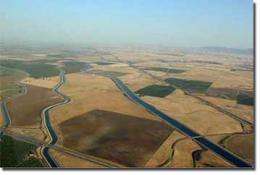
An aerial view of the Sacramento-San Joaquin Delta. Photo courtesy of U.S. Department of Interior/Bureau of Reclamation

Brown radiocarbon dated macrofossils found in the peat to determine the rate of peat accretion. The mean accretion rate in each marsh was well within the 0.1 to 0.2 centimeter estimated rate of sea-level rise during the past 6,000 years in the Estuary and very close to the estimated 20th century sea level rise of 0.17 centimeters per year.

However, sea level rise estimates for 2090-2099, from the Intergovernmental Panel on Climate Change, span a range of 0.15 to 0.97 centimeters per year and the central IPCC estimate of 0.38 centimeters per year is greater than the mean accretion rates for all the marshes in the study.

Although peat accretion rates in marshes have been known to increase to compensate for sea level rise, it is unclear whether the Sacramento-San Joaquin Delta marshes are capable of such large increases in accretion rates.

In addition, in the Delta region, there has been a decline in the amount of suspended sediment in the Sacramento and San Joaquin rivers due to upstream dam construction.

As sediment is an important component in the peat that forms in the marshes, declining sediment availability may make it even harder for marshes to keep pace with future rise.

Provided by Lawrence Livermore National Laboratory

Filter


Move the slider to adjust rank threshold, so that you can hide some of the comments.


Display comments: newest first

Shootist
Mar 16, 2010

Rank: 1 / 5 (1)
"While marshes in the Sacramento-San Joaquin Delta area are currently keeping pace with rising sea levels, they may not be sustainable under future sea-level increases."

So keeping with a billion year old tradition, somewhere else, new marshes will form.
Rank not rated yet
Relevant PhysicsForums posts
  • Discrepancy between oxygen and carbon-dioxide levels
    created17 hours ago
  • where gems are found in the world
    created21 hours ago
  • Wind Waves in Reservoir ~ Wind run-up and Wind set-up
    createdFeb 08, 2012
  • Balance of oxygen in the atmosphere
    createdFeb 01, 2012
  • The case for a methanol-based economy
    createdJan 30, 2012
  • Weather in a rotating cylinder
    createdJan 25, 2012
  • More from Physics Forums - Earth

More news stories

Humans may have helped the decline of African rainforests 3000 years ago

(PhysOrg.com) -- Large areas of rainforests in Central Africa mysteriously disappeared over three thousand years ago, to be replaced by savannas. The prevailing theory has been that the cause was a change ...

Space & Earth / Environment

created 10 hours ago | popularity 5 / 5 (4) | comments 10 | with audio podcast report

Could Venus be shifting gear?

(PhysOrg.com) -- ESA’s Venus Express spacecraft has discovered that our cloud-covered neighbour spins a little slower than previously measured. Peering through the dense atmosphere in the infrared, the ...

Space & Earth / Space Exploration

created 6 hours ago | popularity 5 / 5 (5) | comments 7 | with audio podcast

Mars Science Laboratory computer issue resolved

(PhysOrg.com) -- Engineers have found the root cause of a computer reset that occurred two months ago on NASA's Mars Science Laboratory and have determined how to correct it.

Space & Earth / Space Exploration

created 7 hours ago | popularity 5 / 5 (5) | comments 3 | with audio podcast

Clam fields found at deep, low-temperature Mariana vents

(PhysOrg.com) -- Scientists have marveled at the unusual life forms thriving at high temperature hydrothermal vents of the deep ocean.

Space & Earth / Earth Sciences

created 7 hours ago | popularity not rated yet | comments 0 | with audio podcast

Two new moons for Jupiter

Advances in technology have lead to the discovery of new planets outside of our Solar System, and now even new moons in our own backyard.

Space & Earth / Space Exploration

created 6 hours ago | popularity not rated yet | comments 4


Complex wiring of the nervous system may rely on a just a handful of genes and proteins

Researchers at the Salk Institute have discovered a startling feature of early brain development that helps to explain how complex neuron wiring patterns are programmed using just a handful of critical genes. ...

The power of estrogen -- male snakes attract other males

A new study has shown that boosting the estrogen levels of male garter snakes causes them to secrete the same pheromones that females use to attract suitors, and turned the males into just about the sexiest ...

Human cognitive performance suffers following natural disasters, researchers find

Not surprisingly, victims of a natural disaster can experience stress and anxiety, but a new study indicates that it might also cause them to make more errors - some serious - in their daily lives. In their upcoming Human Fa ...

New error-correcting codes guarantee the fastest possible rate of data transmission

Error-correcting codes are one of the triumphs of the digital age. They’re a way of encoding information so that it can be transmitted across a communication channel — such as an optical fiber o ...

Both maternal and paternal age linked to autism

Older maternal and paternal age are jointly associated with having a child with autism, according to a recently published study led by researchers at The University of Texas Health Science Center at Houston (UTHealth).

Curry spice component may help slow prostate tumor growth

Curcumin, an active component of the Indian curry spice turmeric, may help slow down tumor growth in castration-resistant prostate cancer patients on androgen deprivation therapy (ADT), a study from researchers ...