Frogs, Foam and Fuel: Researchers Convert Solar Energy to Sugars
March 16, 2010 By Wendy Beckman
Frogs, Foam and Fuel: Researchers Convert Solar Energy to Sugars

Enlarge

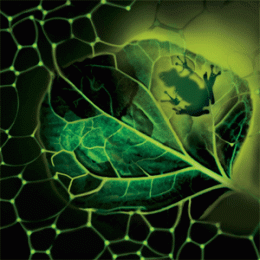
(PhysOrg.com) -- Engineers from the University of Cincinnati devise a foam that captures energy and removes excess carbon dioxide from the air -- thanks to semi-tropical frogs.

For decades, farmers have been trying to find ways to get more energy out of the sun.

In natural photosynthesis, plants take in and carbon dioxide and then convert it to oxygen and sugars. The oxygen is released to the air and the sugars are dispersed throughout the plant — like that we look for in the summer. Unfortunately, the allocation of light energy into products we use is not as efficient as we would like. Now engineering researchers at the University of Cincinnati are doing something about that.

The researchers are finding ways to take energy from the sun and carbon from the air to create new forms of biofuels, thanks to a semi-tropical frog species. Their results have just been published online in “ in Ranaspumin-2 Based Foam” (March 5, 2010) in the journal “.” (It will be a cover story for the print edition in the fall.)

Research Assistant Professor David Wendell, student Jacob Todd and College of Engineering and Applied Science Dean Carlo Montemagno co-authored the paper, based on research in Montemagno’s lab in the Department of Biomedical Engineering. Their work focused on making a new artificial photosynthetic material which uses plant, bacterial, frog and fungal enzymes, trapped within a foam housing, to produce sugars from sunlight and carbon dioxide.

Foam was chosen because it can effectively concentrate the reactants but allow very good light and air penetration. The design was based on the foam nests of a semi-tropical frog called the Tungara , which creates very long-lived foams for its developing tadpoles.

“The advantage for our system compared to plants and algae is that all of the captured solar energy is converted to sugars, whereas these organisms must divert a great deal of energy to other functions to maintain life and reproduce,” says Wendell. “Our foam also uses no soil, so food production would not be interrupted, and it can be used in highly enriched carbon dioxide environments, like the exhaust from coal-burning power plants, unlike many natural photosynthetic systems.”

He adds, “In natural plant systems, too much carbon dioxide shuts down , but ours does not have this limitation due to the bacterial-based photo-capture strategy.”

There are many benefits to being able to create a plant-like foam.

“You can convert the sugars into many different things, including ethanol and other biofuels,” Wendell explains. “And it removes from the air, but maintains current arable land for food production.”

“This new technology establishes an economical way of harnessing the physiology of living systems by creating a new generation of functional materials that intrinsically incorporates life processes into its structure,” says Dean Montemagno. “Specifically in this work it presents a new pathway of harvesting solar energy to produce either oil or food with efficiencies that exceed other biosolar production methodologies. More broadly it establishes a mechanism for incorporating the functionality found in living systems into systems that we engineer and build.”

The next step for the team will be to try to make the technology feasible for large-scale applications like carbon capture at coal-burning power plants.

“This involves developing a strategy to extract both the lipid shell of the algae (used for biodiesel) and the cytoplasmic contents (the guts), and reusing these proteins in the foam,” says Wendell. “We are also looking into other short carbon molecules we can make by altering the enzyme cocktail in the .”

Montemagno adds, “It is a significant step in delivering the promise of nanotechnology.”

More information: Paper: http://pubs.acs.or … 21/nl100550k

Provided by University of Cincinnati (news : web)

Filter


Move the slider to adjust rank threshold, so that you can hide some of the comments.


Display comments: newest first

Illure
Mar 16, 2010

Rank: not rated yet
That foam has a lot of protential.

Although, I can imagine bacteria making this sugar producing foam their home. When bacteria metabolizes sugar, the by-product is often a strong acid (much like the ones in our mouths). Thus, shortening the product's life.
Skeptic_Heretic
Mar 16, 2010

Rank: not rated yet
That foam has a lot of protential.

Although, I can imagine bacteria making this sugar producing foam their home. When bacteria metabolizes sugar, the by-product is often a strong acid (much like the ones in our mouths). Thus, shortening the product's life.

Actually a lot of bacterias produce alcohols, hydrocarbons, and other non-acids when digesting sugars.
JCincy
Mar 16, 2010

Rank: 1 / 5 (1)
Fascinating.

If I use this foam in my couch, will it still capture my loose change?

Rank 5 /5 (7 votes)
Related Stories
Relevant PhysicsForums posts
  • Rubber production is likely to gradually reduce
    created3 hours ago
  • Help! Physics Momentum/Impulse problem!
    created3 hours ago
  • Gauss' law cubes, how to prove
    created5 hours ago
  • A grandfather pulls his granddaughter, whose mass is 20.5 kg
    created6 hours ago
  • what is significance of torque
    created6 hours ago
  • Difference between volume displaced fluid and volume of the object
    created7 hours ago
  • More from Physics Forums - General Physics

More news stories

'Dark plasmons' transmit energy

Microscopic channels of gold nanoparticles have the ability to transmit electromagnetic energy that starts as light and propagates via "dark plasmons," according to researchers at Rice University.

Nanotechnology / Nanophysics

created 10 hours ago | popularity 5 / 5 (4) | comments 0 | with audio podcast

Nanotube therapy takes aim at breast cancer stem cells

Wake Forest Baptist Medical Center researchers have again proven that injecting multiwalled carbon nanotubes (MWCNTs) into tumors and heating them with a quick, 30-second laser treatment can kill them.

Nanotechnology / Bio & Medicine

created 15 hours ago | popularity 5 / 5 (1) | comments 0 | with audio podcast

Inspired by steel, nanomanufacturing gets wear-resistant carbide tip

(PhysOrg.com) -- Scientists at the University of Pennsylvania, the University of Wisconsin-Madison and IBM Research - Zurich have fabricated an ultrasharp silicon carbide tip possessing such high strength ...

Nanotechnology / Nanophysics

created 20 hours ago | popularity 5 / 5 (3) | comments 1 | with audio podcast

New kind of solar cell could capture significantly more energy than current cells

New solar cells could increase the maximum efficiency of solar panels by over 25%, according to scientists from the University of Cambridge.

Nanotechnology / Nanophysics

created Feb 08, 2012 | popularity 4.5 / 5 (11) | comments 14 | with audio podcast

New technology platform for molecule-based electronics

Researchers at the Nano-Science Center at the University of Copenhagen have developed a new nano-technology platform for the development of molecule-based electronic components using the wonder material graphene. At the same ...

Nanotechnology / Nanomaterials

created 17 hours ago | popularity 5 / 5 (2) | comments 0


FDA-approved drug rapidly clears amyloid from the brain, reverses Alzheimer's symptoms in mice

Neuroscientists at Case Western Reserve University School of Medicine have made a dramatic breakthrough in their efforts to find a cure for Alzheimer's disease. The researchers' findings, published in the journal Science, show t ...

Hydrogen from acidic water: Researchers develop potential low cost alternative to platinum for splitting water

A technique for creating a new molecule that structurally and chemically replicates the active part of the widely used industrial catalyst molybdenite has been developed by researchers with the Lawrence Berkeley ...

Ultraviolet protection molecule in plants yields its secrets

Lying around in the sun all day is hazardous not just for humans but also for plants, which have no means of escape. Ultraviolet (UV) radiation from the sun can damage proteins and DNA inside cells, leading ...

Soraa LED light may dim 50-watt halogen rivals

(PhysOrg.com) -- Soraa, a Fremont, California company founded in 2008, this week launched its first product, a light that uses LEDS (light emitting diodes). The "Soraa LED MR16 lamp" is the "perfect" replacement ...

Anyone can learn to be more inventive, cognitive researcher says

There will always be a wild and unpredictable quality to creativity and invention, says Anthony McCaffrey, a cognitive psychology researcher at the University of Massachusetts Amherst, because an "Aha moment" is rare and ...

Engineers find inspiration for new materials in Piranha-proof armor

(PhysOrg.com) -- It’s a matchup worthy of a late-night cable movie: put a school of starving piranha and a 300-pound fish together, and who comes out the winner?