Study says therapeutics for trauma patients may not be effective due to an infection
March 16, 2010
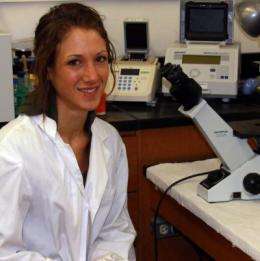
Diana Hylton is a K-State senior in microbiology, nutritional sciences and premedicine. She is analyzing how the immune system is involved in damage to the intestines following hemorrhagic shock. Credit: Kansas State University
A Kansas State University study aimed at alleviating intestinal damage in trauma patients digressed to an important finding that could affect medication given to the individuals.
Diana Hylton is a K-State senior in microbiology, nutritional sciences and pre-medicine. She is analyzing how the immune system is involved in damage to the intestines following hemorrhagic shock. While studying the effects of a complement inhibitor given following hemorrhage, she found that Helicobacter infection changes the body's mechanistic response and would therefore affect the therapeutics given to trauma patients.
"The understanding of the different immune processes involved after hemorrhage suggests that the therapeutic potential of some drugs might not be effective on trauma patients with undiagnosed Helicobacter infections," Hylton said.
Hylton is working with Sherry Fleming, assistant professor in the Division of Biology. Hylton's project involves studying a mouse model of hemorrhage, which is associated with a sudden rapid loss of a significant amount of blood, and it is common in trauma patients. Hemorrhage causes intestinal damage, and the body responds by activating the complement system.
The complement system is part of the body's natural immune mechanisms to defend against infections. However, uncontrolled and excessive activation can result in inflammatory tissue damage, so trauma victims are given therapeutics to stop the activation. If a therapeutic could stop complement activation briefly, trauma victims would get less tissue damage and improved survival and recovery because the natural immune functions would remain intact.
Hylton has been analyzing changes in the mouse model concerning the intestinal tissue injury and inflammatory response. During the study, the mice became infected with Helicobacter, which is a bacteria found in the intestines of animals and humans. The infection often does not show obvious symptoms and therefore is commonly undiagnosed, which causes ulcers as well as liver and colon cancer.
Hylton found that when Helicobacter infections are present, they dramatically change the mechanism causing intestinal injury after hemorrhage. Infected mice did not get intestinal damage from complement activation but rather a different component of the immune system was involved.
"Diana found that mice infected with Helicobacter sustain significant intestinal damage in response to hemorrhage, but it is not complement-mediated," Fleming said. "This is important, as many of the therapeutics for hemorrhage are aimed at stopping the complement system, and they do not improve the outcome of infected mice. Thus, trauma patients with undiagnosed infections may require different therapeutics."
Hylton is finishing her central project that involves using a complement inhibitor, administered after hemorrhage, to analyze the changes in the intestinal tissue injury and inflammatory response. The complement inhibitor is delivered locally to the intestinal tissue where complement is activated and binds to certain molecules that have covered the injured cells. This selective binding blocks any further undesirable complement activation that would injure the intestinal tissue.
"I am eager to learn more about how the immune response following hemorrhage is influenced by other immune cells and their secretions," Hylton said. "Cytokines are an exciting area of research because they can have different biological functions in different parts of the body and with different immune responses."
She said initial studies show that IL-12, a small non-antibody molecule that communicates between cells in the body, increases after hemorrhage and is blocked when complement is inhibited. By using mice that are IL-12 deficient, she is studying the pathways and cells involved in IL-12 production after hemorrhage.
Hylton has presented the Helicobacter research at the Annual Meeting of the Society of Leukocyte Biology and at the Annual K-State Research Forum. She presented both the Helicobacter and complement inhibitor research at the Kansas Institutional Development Award Network of Biomedical Research Excellence symposium.
-
Flu deaths could be reduced thanks to cancer research
Nov 17, 2008 |
not rated yet |
0
-
Gastric ulcer bacteria turn immune defense inwards
Jan 25, 2010 |
not rated yet |
0
-
Friend or Foe? Scientists Determine How the Intestine Keeps Us Safe From Microbial Invaders
Feb 21, 2007 |
not rated yet |
0
-
Structures from the human immune system's oldest branch shed light on a range of diseases
Jun 17, 2009 |
not rated yet |
0
-
Piece from childhood virus may save soldiers' lives
Sep 06, 2009 |
not rated yet |
0
-
Engineers build first sub-10-nm carbon nanotube transistor
Feb 01, 2012 |
4.9 / 5 (30) |
30
-
Something old, something new: Evolution and the structural divergence of duplicate genes
Jan 31, 2012 |
4.6 / 5 (7) |
1
-
The hidden nanoworld of ice crystals: Revealing the dynamic behavior of quasi-liquid layers
Jan 30, 2012 |
5 / 5 (3) |
1
-
Stock market network reveals investor clustering
Jan 27, 2012 |
3.9 / 5 (23) |
8
-
Of microchemistry and molecules: Electronic microfluidic device synthesizes biocompatible probes
Jan 26, 2012 |
5 / 5 (1) |
0
-
Classical and Quantum Mechanics via Lie algebras
Apr 15, 2011
- More from Physics Forums - Independent Research
More news stories
Seeing colors in music, tasting flavors in shapes may happen in life's early months
Famed violinist Itzhak Perlman sees a deep forest green whenever he plays a B-flat on his Stradivarius' G string. The A on the E string is red.
Medicine & Health / Psychology & Psychiatry
42 minutes ago |
5 / 5 (1) |
0
|
Study suggests girls can 'rewire' brains to ward off depression
(Medical Xpress) -- What if you could teach your brain to respond differently to things that make you feel sad, down or stressed out? What if doing that helped ward off depression?
Medicine & Health / Psychology & Psychiatry
1 hour ago |
5 / 5 (1) |
0
UNC investigator issues call to action for schizophrenia research
(Medical Xpress) -- Much of medical research is aimed at figuring out what role a single gene or molecule plays in the development of disease.
Medicine & Health / Psychology & Psychiatry
1 hour ago |
5 / 5 (1) |
0
What does love look like?
What does love look like? A dozen roses delivered on an ordinary weekday? Breakfast in bed? Or just a knowing glance between lovers?
Medicine & Health / Psychology & Psychiatry
1 hour ago |
not rated yet |
0
Numeracy: The educational gift that keeps on giving?
(Medical Xpress) -- Cancer risks. Investment alternatives. Calories. Numbers are everywhere in daily life, and they figure into all sorts of decisions. A new article published in Current Directions in Psychological Science, a journal of the Association for Psychological Science, examin ...
Medicine & Health / Psychology & Psychiatry
56 minutes ago |
not rated yet |
0
|
Mars Science Laboratory computer issue resolved
(PhysOrg.com) -- Engineers have found the root cause of a computer reset that occurred two months ago on NASA's Mars Science Laboratory and have determined how to correct it.
Advanced power-grid model finds low-cost, low-carbon future in West
(PhysOrg.com) -- The least expensive way for the Western U.S. to reduce greenhouse gas emissions enough to help prevent the worst consequences of global warming is to replace coal with renewable and other ...
Small modular reactor design could be a 'SUPERSTAR'
(PhysOrg.com) -- Though most of today's nuclear reactors are cooled by water, we've long known that there are alternatives; in fact, the world's first nuclear-powered electricity in 1951 came from a reactor ...
Clam fields found at deep, low-temperature Mariana vents
(PhysOrg.com) -- Scientists have marveled at the unusual life forms thriving at high temperature hydrothermal vents of the deep ocean.
Could Venus be shifting gear?
(PhysOrg.com) -- ESAs Venus Express spacecraft has discovered that our cloud-covered neighbour spins a little slower than previously measured. Peering through the dense atmosphere in the infrared, the ...
The question of life in the ancient world
Theres a general feeling that we dont get the Greeks ancient or modern. Many, including heads of state like Angela Merkel, visibly shake their head in exasperation, rightly or wrongly, at ...