Cloves are the best natural antioxidant
March 16, 2010
Cloves are the best natural antioxidant

Enlarge

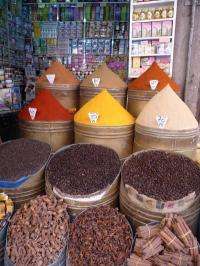
Cloves are the best natural antioxidant. Credit: SINC

Using spices eaten in the Mediterranean diet as natural antioxidants is a good way forward for the food industry, given the beneficial health effects of these products. This has been shown by researchers from the Miguel Hernández University (UMH), who have put the clove in first place.

Researchers from the Miguel Hernández University have identified cloves (Syzygium aromaticum) as the best antioxidant spice, due to the fact they contain high levels of phenolic compounds, as well as having other properties.

"Out of the five antioxidant properties tested, cloves had the highest capacity to give off hydrogen, reduced lipid peroxidation well, and was the best iron reducer", Juana Fernández-López, one of the authors of the study and a researcher at the UMH, tells SINC.

As a result, the research study published in the latest issue of the Flavour and Fragrance Journal ranks this spice as the best .

"The results show that use of the natural oxidants occurring in spices used in the Mediterranean diet, or their extracts, is a viable option for the , as long as the organoleptic characteristics of the food product are not affected", adds the researcher.

"These substances exhibit high antioxidant capacity, and could have beneficial effects for health", says the researcher

The team also evaluated the antioxidant effect of the essential oils from other spices used in the - oregano (Origanum vulgare), thyme (Thymus vulgaris), rosemary, (Rosmarinus funcionarios cinalis) and sage (Salvia funcionarios cinalis).

The objective of the study is to enable these spices to be incorporated into food products (above all meat products) as natural antioxidants.

Changing the food industry

"Lipid oxidation is one of the main reasons for foods deteriorating, and causes a significant reduction in their nutritional value, as well as loss of taste", says Fernández-López.

These alterations lead to a reduction in the useful lifespan of the food product. To avoid such deterioration, the food industry uses synthetic antioxidants in its products. However, as these are chemical compounds, questions have been raised about their potential toxicity and side-effects.

As a result, there is a growing interest in using plant-based products (spices, aromatic and medicinal plants) with potential antioxidant activity, in order to replace the synthetic with "natural" substances.

More information: Manuel Viuda-Martos, Yolanda Ruiz Navajas, Elena Sánchez Zapata, Juana Fernández-López y José A. Pérez-Álvarez. "Antioxidant activity of essential oils of five spice plants widely used in a Mediterranean diet". Flavour and Fragrance Journal 25, 13-19, Feb 2010.

Provided by FECYT - Spanish Foundation for Science and Technology

4.9 /5 (7 votes)  

Filter


Move the slider to adjust rank threshold, so that you can hide some of the comments.


Display comments: newest first

shadfurman
Mar 18, 2010

Rank: not rated yet
I wonder if people had previously learned this from experience and part of the reason some sausage is so heavily spiced, kinda like salted meats, to keep them better.
Rank 4.9 /5 (7 votes)
Relevant PhysicsForums posts
  • Stoichiometry
    created2 hours ago
  • Boiling and melting point of impure substances
    created3 hours ago
  • Safe nitrogen compound to decompose a 500 deg C in a furnace?
    created10 hours ago
  • [ask]electron inside drinking water
    createdFeb 08, 2012
  • How to avoid formation of Lithium Chromate ???
    createdFeb 08, 2012
  • how to choose a reduced or oxidated form in a redox
    createdFeb 08, 2012
  • More from Physics Forums - Chemistry

More news stories

Hydrogen from acidic water: Researchers develop potential low cost alternative to platinum for splitting water

A technique for creating a new molecule that structurally and chemically replicates the active part of the widely used industrial catalyst molybdenite has been developed by researchers with the Lawrence Berkeley ...

Chemistry / Materials Science

created 13 hours ago | popularity 5 / 5 (10) | comments 11 | with audio podcast

Engineers find inspiration for new materials in Piranha-proof armor

(PhysOrg.com) -- It’s a matchup worthy of a late-night cable movie: put a school of starving piranha and a 300-pound fish together, and who comes out the winner?

Chemistry / Materials Science

created 19 hours ago | popularity 4.3 / 5 (3) | comments 2 | with audio podcast

Flexible paper robots

(PhysOrg.com) -- These inexpensive robots can stretch, bend and twist under control, and lift objects up to 120 times their own weight. Being soft, they can apply gentle and even pressure, and adapt to varied ...

Chemistry / Materials Science

created 11 hours ago | popularity 5 / 5 (5) | comments 2 | with audio podcast

New method makes culture of complex tissue possible in any lab

Scientists at the University of California, San Diego have developed a new method for making scaffolds for culturing tissue in three-dimensional arrangements that mimic those in the body. This advance, published online in ...

Chemistry / Biochemistry

created 10 hours ago | popularity 5 / 5 (4) | comments 0 | with audio podcast

Materials that shrink when heated

One common reason that people with fillings experience toothache is that their fillings expand at a different rate to the original tooth when, for example, drinking a hot drink. Contrary to intuition, however, ...

Chemistry / Materials Science

created 12 hours ago | popularity 5 / 5 (2) | comments 1


'Dark plasmons' transmit energy

Microscopic channels of gold nanoparticles have the ability to transmit electromagnetic energy that starts as light and propagates via "dark plasmons," according to researchers at Rice University.

FDA-approved drug rapidly clears amyloid from the brain, reverses Alzheimer's symptoms in mice

Neuroscientists at Case Western Reserve University School of Medicine have made a dramatic breakthrough in their efforts to find a cure for Alzheimer's disease. The researchers' findings, published in the journal Science, show t ...

Ultraviolet protection molecule in plants yields its secrets

Lying around in the sun all day is hazardous not just for humans but also for plants, which have no means of escape. Ultraviolet (UV) radiation from the sun can damage proteins and DNA inside cells, leading ...

Soraa LED light may dim 50-watt halogen rivals

(PhysOrg.com) -- Soraa, a Fremont, California company founded in 2008, this week launched its first product, a light that uses LEDS (light emitting diodes). The "Soraa LED MR16 lamp" is the "perfect" replacement ...

Anyone can learn to be more inventive, cognitive researcher says

There will always be a wild and unpredictable quality to creativity and invention, says Anthony McCaffrey, a cognitive psychology researcher at the University of Massachusetts Amherst, because an "Aha moment" is rare and ...

Explained: Sigma

It's a question that arises with virtually every major new finding in science or medicine: What makes a result reliable enough to be taken seriously? The answer has to do with statistical significance -- but ...