UV exposure has increased over the last 30 years, but stabilized since the mid-1990s (w/ Video)
March 16, 2010 by Adam Voiland
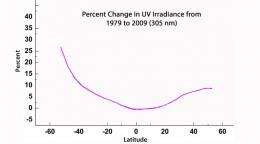
The high latitudes of the southern hemisphere have seen ultraviolet exposure increase by as much as a quarter. The low latitudes have seen little increase, and the mid-and-high latitudes of the northern hemisphere have seen about a five percent increase. Though the size of UV wavelengths ranges from 290 to 400 nanometers, 305 nanometer UV is one of the most damaging wavelengths for humans. Credit: NASA's Goddard Space Flight Center/Jay Herman
(PhysOrg.com) -- NASA scientists analyzing 30 years of satellite data have found that the amount of ultraviolet (UV) radiation reaching Earth's surface has increased markedly over the last three decades. Most of the increase has occurred in the mid-and-high latitudes, and there's been little or no increase in tropical regions.
The new analysis shows, for example, that at one line of latitude 32.5 degrees a line that runs through central Texas in the northern hemisphere and the country of Uruguay in the southern hemisphere, 305 nanometer UV levels have gone up by some 6 percent on average since 1979.
The primary culprit: decreasing levels of stratospheric ozone, a colorless gas that acts as Earth's natural sunscreen by shielding the surface from damaging UV radiation.
The finding reinforces previous observations that show UV levels are stabilizing after countries began signing an international treaty that limited the emissions of ozone-depleting gases in 1987. The study also shows that increased cloudiness in the southern hemisphere over the 30-year period has impacted UV.
Jay Herman, a scientist at NASA's Goddard Space Flight Center in Greenbelt, Md., stitched together data from several earth observing satellites including NASA's Aura satellite, NOAA weather satellites, and commercial satellites to draw his conclusions. The results were published in the Journal of Geophysical Research in February.
This video is not supported by your browser at this time.
This short video combines dynamic ozone visualizations with an interview with leading atmospheric NASA scientist, Dr. Paul Newman. Dr. Newman explains why ozone is important, he cites the ingredients that cause an ozone hole to form, and he remarks on the future of the ozone, pointing to exciting new areas of ozone research, including the role climate change will play in future years.
"Overall, we're still not where we'd like to be with ozone, but we're on the right track," said Jay Herman. "We do still see an increase in UV on a 30-year timescale, but it's moderate, it could have been worse, and it appears to have leveled off."In the tropics, the increase has been minimal, but in the mid-latitudes it has been more obvious. During the summer, for example, UV has increased by more than 20 percent in Patagonia and the southern portions of South America. It has risen by nearly 10 percent in Buenos Aires, a city that's about the same distance from the equator as Little Rock, Ark. At Washington, D.C.'s latitude about 35 degrees north UV has increased by about 9 percent since 1979.
The southern hemisphere tends to have more UV exposure because of the ozone hole, a seasonal depletion of the ozone layer centered on the South Pole. There are also fewer particles of air pollution which help block UV due to the comparatively small numbers of people who live in the southern hemisphere.
Despite the overall increases, there are clear signs that ultraviolet radiation levels are on the verge of falling. Herman's analysis, which is in agreement with a World Meteorological Report published in recent years, shows that decreases in ozone and corresponding increases in UV irradiance leveled off in the mid-nineties.
The Many Sides of Radiation
Shorter ultraviolet wavelengths of light contain more energy than the infrared or visible portions of sunlight that reach Earth's surface. Because of this, UV photons can break atmospheric chemical bonds and cause complex health effects.
Longer wavelengths (from 320 to 400 nanometers) called UV-A cause sunburn and cataracts. Yet, UV-A can also improve health by spurring the production of Vitamin D, a substance that's critical for calcium absorption in bones and that helps stave off a variety of chronic diseases.
UV-B, which has slightly shorter wavelengths (from 320 to 290 nanometers), damages DNA by tangling and distorting its ladder-like structure, causing a range of health problems such as skin cancer and diseases affecting the immune system.
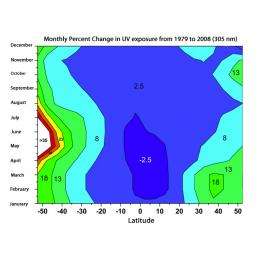
Larger image The high latitudes of the southern hemisphere have seen ultraviolet exposure increase by as much as a quarter. The low latitudes have seen little increase, and the mid-and-high latitudes of the northern hemisphere have seen about a five percent increase. Though the size of UV wavelengths ranges from 290 to 400 nanometers, 305 nanometer UV is one of the most damaging wavelengths for humans. Credit: NASA's Goddard Space Flight Center/Jay Herman Exploring Ozone Video This short video, produced in 2008, describes the status of the stratospheric ozone hole. Credit: NASA/Goddard Space Flight Center Larger image Electromagnetic radiation exists in a range of wavelengths, which are delineated into major divisions for our convenience. Ultraviolet-B, from 290 to 320, poses the greatest threat to living organisms, though it represents just a small portion of the spectrum. Credit: NASA's Earth Observatory/Robert Simmon NASA scientists analyzing 30 years of satellite data have found that the amount of ultraviolet (UV) radiation reaching Earth's surface has increased markedly over the last three decades. Most of the increase has occurred in the mid-and-high latitudes, and there's been little or no increase in tropical regions. The new analysis shows, for example, that at one line of latitude 32.5 degrees a line that runs through central Texas in the northern hemisphere and the country of Uruguay in the southern hemisphere, 305 nanometer UV levels have gone up by some 6 percent on average since 1979. The primary culprit: decreasing levels of stratospheric ozone, a colorless gas that acts as Earths natural sunscreen by shielding the surface from damaging UV radiation. The finding reinforces previous observations that show UV levels are stabilizing after countries began signing an international treaty that limited the emissions of ozone-depleting gases in 1987. The study also shows that increased cloudiness in the southern hemisphere over the 30-year period has impacted UV. Jay Herman, a scientist at NASA's Goddard Space Flight Center in Greenbelt, Md., stitched together data from several earth observing satellites including NASA's Aura satellite, NOAA weather satellites, and commercial satellites to draw his conclusions. The results were published in the Journal of Geophysical Research in February. The largest increases in UV (shown in white, red, orange, and yellow) have occurred in the southern hemisphere during summers. In the tropics, increases in UV have been minimal (shown in blue). Though the size of UV wavelengths ranges from 290 to 400 nanometers, 305 nanometer UV is one of the most damaging types for humans. Credit: NASA's Goddard Space Flight Center/Jay Herman
As part of his study, Herman developed a mathematical technique to quantify the biological impacts of UV exposure. He examined and calculated how changing levels of ozone and ultraviolet irradiance affect life. For Greenbelt, Md., for example, he calculated that a 7 percent increase in UV yielded a 4.4 percent increase in the damage to skin, a 4.8 percent increase in damage to DNA, a 5 percent increase in Vitamin D production, and less than a percent of increase in plant growth."If you go to the beach these days, you're at slightly higher risk of getting skin cancer (without protection)," Herman said, though he noted the risk would have been even greater in the absence of regulations on ozone-depleting substances.
Last year, one of Herman's Goddard colleagues, Paul Newman, published a study showing that the ozone hole likely would have become a year-round fixture and UV radiation would increase 650 percent by 2065 in mid-latitude cities if not for the Montreal Protocol, an international treaty signed in 1987 that limited the amount of ozone-depleting gases countries could emit.
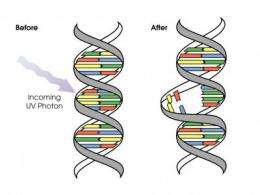
Ultraviolet radiation can damage DNA by distorting its structure. Credit: NASA's Earth Observatory/David Herring
Clouds and Hemispheric DimmingIn addition to analyzing ozone and ultraviolet trends, Herman also used satellite data to study whether changes in cloudiness have affected UV trends. To his surprise, he found that increased cloudiness in the southern hemisphere produced a dimming effect that increased the shielding from UV compared to previous years.
In the higher latitudes especially, he detected a slight reduction typically of 2 to 4 percent -- in the amount of UV passing through the atmosphere and reaching the surface due to clouds. "It's not a large amount, but it's intriguing," Herman said. "We aren't sure what's behind it yet."
Vitali Fioletov, a Canadian scientist and member of the World Meteorological Organization's advisory group on ultraviolet radiation, agreed that Herman's findings about cloudiness warrant additional investigation. "I found the cloud effects on the global scale to be the most interesting aspect of the study," he said. "This isn't something you could see without satellites."
Herman synthesized measurements from the Total Ozone Mapping Spectrometer (TOMS) aboard Nimbus 7 and Earth Probe, the Ozone Monitoring Instrument (OMI) on NASA's Aura satellite, NASA's Sea-Viewing Wide Field-of-view sensor (SeaWiFS) on the commercial SeaStar satellite, and the Solar Backscatter Ultraviolet Instrument (SBUV) on several polar orbiting NOAA weather satellites.
More information: Paper: http://www.agu.org … 012219.shtml
-
Ozone: Climate change boosts ultraviolet risk for high latitudes
Sep 06, 2009 |
not rated yet |
0
-
Ozone layer decline leveling off, according to new study
Aug 29, 2005 |
not rated yet |
0
-
New simulation shows consequences of a world without Earth's natural sunscreen (w/Video)
Mar 19, 2009 |
not rated yet |
0
-
Patch of thin ozone layer in New Zealand
Sep 24, 2006 |
not rated yet |
0
-
Study Finds Clock Ticking Slower On Ozone Hole Recovery
Jun 30, 2006 |
not rated yet |
0
-
Engineers build first sub-10-nm carbon nanotube transistor
Feb 01, 2012 |
4.9 / 5 (31) |
30
-
Something old, something new: Evolution and the structural divergence of duplicate genes
Jan 31, 2012 |
4.6 / 5 (7) |
1
-
The hidden nanoworld of ice crystals: Revealing the dynamic behavior of quasi-liquid layers
Jan 30, 2012 |
5 / 5 (3) |
1
-
Stock market network reveals investor clustering
Jan 27, 2012 |
3.9 / 5 (23) |
8
-
Of microchemistry and molecules: Electronic microfluidic device synthesizes biocompatible probes
Jan 26, 2012 |
5 / 5 (1) |
0
-
Discrepancy between oxygen and carbon-dioxide levels
Feb 09, 2012
-
where gems are found in the world
Feb 09, 2012
-
Wind Waves in Reservoir ~ Wind run-up and Wind set-up
Feb 08, 2012
-
Balance of oxygen in the atmosphere
Feb 01, 2012
-
The case for a methanol-based economy
Jan 30, 2012
-
Weather in a rotating cylinder
Jan 25, 2012
- More from Physics Forums - Earth
More news stories
Humans may have helped the decline of African rainforests 3000 years ago
(PhysOrg.com) -- Large areas of rainforests in Central Africa mysteriously disappeared over three thousand years ago, to be replaced by savannas. The prevailing theory has been that the cause was a change ...
Could Venus be shifting gear?
(PhysOrg.com) -- ESAs Venus Express spacecraft has discovered that our cloud-covered neighbour spins a little slower than previously measured. Peering through the dense atmosphere in the infrared, the ...
Space & Earth / Space Exploration
18 hours ago |
5 / 5 (7) |
8
|
NASA budget will axe Mars deal with Europe: scientists
US President Barack Obama's budget proposal to be submitted next week for 2013 will cut NASA's budget by 20 percent and eliminate a major partnership with Europe on Mars exploration, scientists said Thursday.
Space & Earth / Space Exploration
21 hours ago |
5 / 5 (2) |
18
Two new moons for Jupiter
Advances in technology have lead to the discovery of new planets outside of our Solar System, and now even new moons in our own backyard.
Space & Earth / Space Exploration
18 hours ago |
4 / 5 (1) |
7
Mars Science Laboratory computer issue resolved
(PhysOrg.com) -- Engineers have found the root cause of a computer reset that occurred two months ago on NASA's Mars Science Laboratory and have determined how to correct it.
Space & Earth / Space Exploration
19 hours ago |
4.7 / 5 (6) |
3
|
Anonymous knocks CIA website offline (Update)
The website of the Central Intelligence Agency was inaccessible on Friday after the hacker group Anonymous claimed to have knocked it offline.
New error-correcting codes guarantee the fastest possible rate of data transmission
Error-correcting codes are one of the triumphs of the digital age. Theyre a way of encoding information so that it can be transmitted across a communication channel such as an optical fiber o ...
Google users warned of threat to smartphone wallets
Users of Google smartphone wallets were being warned on Friday that there is a way to crack pass codes intended to thwart thieves from going on illicit shopping sprees.
New power source discovered
(PhysOrg.com) -- Researchers at the Massachusetts Institute of Technology (MIT) and RMIT University have made a breakthrough in energy storage and power generation.
Small modular reactor design could be a 'SUPERSTAR'
(PhysOrg.com) -- Though most of today's nuclear reactors are cooled by water, we've long known that there are alternatives; in fact, the world's first nuclear-powered electricity in 1951 came from a reactor ...
The power of estrogen -- male snakes attract other males
A new study has shown that boosting the estrogen levels of male garter snakes causes them to secrete the same pheromones that females use to attract suitors, and turned the males into just about the sexiest ...

