Brain abnormalities identified that result from prenatal meth exposure
March 16, 2010
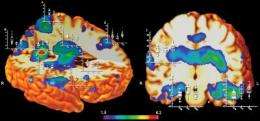
Studies show that certain brain structures are smaller or larger than normal in alcohol-exposed children, while brain regions in meth-exposed children were similarly affected, if not more so. Shown in color are brain areas that differed among alcohol-exposed, meth-exposed and unexposed children -- notably the caudate nucleus (left) and the cingulate cortex (right). Superimposed graphs show group differences. Credit: Courtesy, with permission: Sowell et al. The Journal of Neuroscience 2010
Children whose mothers abused methamphetamine (meth) during pregnancy show brain abnormalities that may be more severe than that of children exposed to alcohol prenatally, according to a study in the March 17 issue of The Journal of Neuroscience. While researchers have long known that drug abuse during pregnancy can alter fetal brain development, this finding shows the potential impact of meth. Identifying vulnerable brain structures may help predict particular learning and behavioral problems in meth-exposed children.
"We know that alcohol exposure is toxic to the developing fetus and can result in lifelong brain, cognitive, and behavioral problems," said Elizabeth Sowell, PhD, of the University of California, Los Angeles, who led the research team. "In this study, we show that the effects of prenatal meth exposure, or the combination of meth and alcohol exposure, may actually be worse. Our findings stress the importance of drug abuse treatment for pregnant women," Sowell said. A structure called the caudate nucleus, which is important for learning and memory, motor control, and motivation, was one of the regions more reduced by meth than alcohol exposure.
Of the more than 16 million Americans over the age of 12 who have used meth, about 19,000 are pregnant women, according to data from the National Surveys on Drug Use and Health. About half of women who say they used meth during pregnancy also used alcohol, so isolating the effects of meth on the developing brain is difficult.
Sowell's team evaluated the specific effects of prenatal meth-exposure by comparing brain scans of 61 children: 21 with prenatal meth and alcohol exposure, 13 with heavy alcohol exposure only, and 27 unexposed. Structural magnetic resonance imaging (MRI) showed that the sizes and shapes of certain brain structures varied depending on prenatal drug exposure.
Previous studies have shown that certain brain structures are smaller in alcohol-exposed children. In this study, the authors found these brain regions in meth-exposed children were similar to the alcohol-exposed children, and in some areas were smaller still. Some brain regions were larger than normal. An abnormal volume increase was noted in meth-exposed children in a region called the cingulate cortex, which is associated with control and conflict resolution.
The researchers were also able to predict a child's past exposure to drugs based on brain images and IQ information. Detailed data about vulnerable brain structures may eventually be used to diagnose children with cognitive or behavioral problems but without well-documented histories of drug exposure. Christian Beaulieu, PhD, of the University of Alberta in Canada, who was unaffiliated with the study, said this finding will help researchers understand which brain areas are most sensitive to injury during development.
"Ultimately, the goal would be to come up with strategies to first, minimize brain damage in the womb, and second, to improve the child's cognitive performance," Beaulieu said.
-
Prenatal meth exposure linked to abnormal brain development
Apr 15, 2009 |
not rated yet |
0
-
Study finds a new mechanism for how methamphetamine affects the developing fetal brain
Sep 09, 2008 |
not rated yet |
0
-
Your baby's brain on drugs (and alcohol and tobacco)
Apr 07, 2008 |
not rated yet |
0
-
Prenatal alcohol exposure alters brain activity in the frontal-striatal areas
Jul 25, 2007 |
not rated yet |
0
-
Prenatal drug exposure linked to sleep problems in children
Jun 10, 2008 |
not rated yet |
0
-
Engineers build first sub-10-nm carbon nanotube transistor
Feb 01, 2012 |
4.9 / 5 (30) |
30
-
Something old, something new: Evolution and the structural divergence of duplicate genes
Jan 31, 2012 |
4.6 / 5 (7) |
1
-
The hidden nanoworld of ice crystals: Revealing the dynamic behavior of quasi-liquid layers
Jan 30, 2012 |
5 / 5 (3) |
1
-
Stock market network reveals investor clustering
Jan 27, 2012 |
3.9 / 5 (23) |
8
-
Of microchemistry and molecules: Electronic microfluidic device synthesizes biocompatible probes
Jan 26, 2012 |
5 / 5 (1) |
0
-
Is Everyday Technology Killing Us?
Feb 08, 2012
-
Exercise and weight loss
Feb 08, 2012
-
Why do we have head aches? Our brains can't feel anything.
Feb 07, 2012
-
"The end of diseases" by David Agus, interview from Daily Show with Jon Stewart
Feb 04, 2012
-
Oncolytic adenovirus
Feb 04, 2012
-
Nutrition label stuffs and diets
Feb 02, 2012
- More from Physics Forums - Medical Sciences
More news stories
Antidepressants and pregnancy: Women must consider the impact of drugs on baby, and of depression on baby, themselves
Upon learning they are pregnant, most women dutifully nix the alcohol, sushi and caffeine. But what about antidepressants?
Medicine & Health / Medications
34 minutes ago |
not rated yet |
0
Both maternal and paternal age linked to autism
Older maternal and paternal age are jointly associated with having a child with autism, according to a recently published study led by researchers at The University of Texas Health Science Center at Houston (UTHealth).
Medicine & Health / Psychology & Psychiatry
4 minutes ago |
not rated yet |
0
|
Curry spice component may help slow prostate tumor growth
Curcumin, an active component of the Indian curry spice turmeric, may help slow down tumor growth in castration-resistant prostate cancer patients on androgen deprivation therapy (ADT), a study from researchers ...
1 hour ago |
not rated yet |
0
|
Arthritic knees, but not hips, have robust repair response
Researchers at Duke University Medical Center used new tools they developed to analyze knees and hips and discovered that osteoarthritic knee joints are in a constant state of repair, while hip joints are not.
1 hour ago |
not rated yet |
0
|
Team isolates nerve cells involved in storing long term memory and gene proteins associated with them
(Medical Xpress) -- A research team in Taiwan has succeeded in isolating two nerve cells in fruit fly brains that are believed to be the major players in allowing for the formation of long term memories. Furthermore, ...
Netflix light on flicks as viewers soak up TV shows
Like most fresh faces that arrive in Hollywood, Netflix wanted to be a movie star. But now it's learning what many in Tinseltown have known for decades: Movies are sexy, but the real money is in television.
Zuckerberg's focus drives Facebook's ascent
When Mark Zuckerberg showed up to rent Judy Fusco's Los Altos, Calif., house in the fall of 2004, soon after he'd arrived in Silicon Valley, the landlord was immediately struck by his confidence.
The power of estrogen -- male snakes attract other males
A new study has shown that boosting the estrogen levels of male garter snakes causes them to secrete the same pheromones that females use to attract suitors, and turned the males into just about the sexiest ...
Humans may have helped the decline of African rainforests 3000 years ago
(PhysOrg.com) -- Large areas of rainforests in Central Africa mysteriously disappeared over three thousand years ago, to be replaced by savannas. The prevailing theory has been that the cause was a change ...
Fool's gold may prove an unlikely alternative to overexploited catalytic materials
Catalytic materials, which lower the energy barriers for chemical reactions, are used in everything from the commercial production of chemicals to catalytic converters in car engines. However, with current catalytic materials ...
Experts reveal how plants don't get sunburn
(PhysOrg.com) -- Experts at the University of Glasgow have discovered how plants survive the harmful rays of the sun.
Mar 17, 2010
Rank: not rated yet