Molding the Future of Plastic Electronic Production
March 16, 2010 by Kendra Snyder
Molding the Future of Plastic Electronic Production

Enlarge

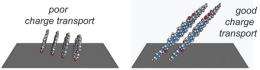
Illustrations of PTCBI films with two different orientations. Researchers found that those laying down (left) exhibit slower transport than those that stand up (right).

(PhysOrg.com) -- E-readers that can be bent and folded, "smart" bandages that signal when they need changing based on oxygen levels, and biodegradable radio frequency identification tags that help companies track and manage stock - these are all real possibilities in the field of organic electronics, which uses carbon-based materials that are intrinsically semiconductors. Recently, using the NSLS, a group of researchers from the National Institute of Standards and Technology (NIST), Arizona State University, and the University of Oulu, Finland, analyzed one promising organic semiconducting material in an effort to bring these technologies, and many more, to the marketplace.

As opposed to conventional electronics, which feature inorganic metal conductors such as silicon or copper, - also known as plastic electronics - can be manufactured using technology as common as an ink jet printer.

This makes possible the production of lightweight, flexible, and robust electronics at low cost. Plastic electronics don't replace silicon technologies, and they aren't likely to fuel the mainstream electronic industry's overall drive to produce ever-smaller and ever-faster devices. Instead, organic electronics offer the possibility of brand new, complementary markets, that is, if industries are able to easily create reliable products.

"With organic materials, reproducibility and reliability are hard to achieve because the ink dries differently almost every time," said NIST researcher Dean DeLongchamp. "You never know exactly what you're going to get."

In this study, the researchers analyzed the structure of dried films made from a particular organic semiconductor often used in , PTCBI. Classified as an "n-type" semiconductor, PTCBI is one of the rare commercially available organic-electronic materials that actually transports electrons. The other kind of organic semiconductors, known as p-type, transmit positive charges - called "holes" because the moving areas of positive charge are places where an electron is missing. In order to work, a complementary organic circuit needs both p- and n-type semiconductors.

At NSLS beamline U7A, the researchers used near-edge x-ray absorption spectroscopy and grazing-incidence x-ray diffraction to determine the orientation and order of PTCBI as it was formed on different surfaces. Their results, which are published in the August 3, 2009, edition of Advanced Functional Materials, are surprising.

"We found that the contact face of PTCBI depends on what type of surface it was deposited upon, which is very unusual," DeLongchamp said. "Typically, we find that an organic semiconductor's crystals change size with the dielectric substrate it is deposited on. But here, the crystals are actually oriented differently on different dielectrics."

The researchers then linked the orientation of the PTCBI crystals to performance: In general, substrates that allow the crystal's individual molecules to stand up straight — and therefore have a large amount of electronic overlap — exhibit the fastest transport. But substrates that force the molecules to lay down flat exhibit poorer performance.

"These fundamental relationships provide practical rules for the synthesis and processing of organic electronics," DeLongchamp said. "The many potential opportunities for performance enhancement indicate a promising future ahead for organic electronics."

Provided by Brookhaven National Laboratory (news : web)

4.7 /5 (7 votes)  

Rank 4.7 /5 (7 votes)
Relevant PhysicsForums posts
  • Doubts about surface plasmons
    created1 hour ago
  • excited U-236 decay time in the U235 fission chain
    createdFeb 09, 2012
  • Polar catastrophe?
    createdFeb 09, 2012
  • Large scale field sonication
    createdFeb 09, 2012
  • states and energy of paired electrons in BCS
    createdFeb 08, 2012
  • difference between longitudinal and transverse refractive indices
    createdFeb 08, 2012
  • More from Physics Forums - Atomic, Solid State, Comp. Physics

More news stories

Putting the squeeze on planets outside our solar system

(PhysOrg.com) -- Using high-powered lasers, scientists at Lawrence Livermore National Laboratory and collaborators discovered that molten magnesium silicate undergoes a phase change in the liquid state, abruptly ...

Physics / Condensed Matter

created 15 hours ago | popularity 4.3 / 5 (7) | comments 0 | with audio podcast

Hovering not hard if you're top-heavy, researchers find

Top-heavy structures are more likely to maintain their balance while hovering in the air than are those that bear a lower center of gravity, researchers at New York University's Courant Institute of Mathematical Sciences ...

Physics / General Physics

created 16 hours ago | popularity 5 / 5 (2) | comments 1 | with audio podcast

SLAC, Stanford team focuses on high-energy electrons to treat cancer

Accelerator physicists at SLAC and cancer specialists from Stanford are working on a new technology that could dramatically reduce the time needed for cancer radiation treatments. The team ran an initial experiment ...

Physics / General Physics

created 19 hours ago | popularity 5 / 5 (2) | comments 0

Measurements from high-energy collisions lead to better understanding of why meson particles disappear

For several years, physicists at the Relativistic Heavy Ion Collider (RHIC) at Brookhaven National Laboratory (BNL), USA, have studied an unusual state of matter called the quark–gluon plasma, which they ...

Physics / General Physics

created 20 hours ago | popularity 4.5 / 5 (4) | comments 0

Explained: Sigma

It's a question that arises with virtually every major new finding in science or medicine: What makes a result reliable enough to be taken seriously? The answer has to do with statistical significance -- but ...

Physics / General Physics

created Feb 09, 2012 | popularity 5 / 5 (16) | comments 53


Anonymous knocks CIA website offline (Update)

The website of the Central Intelligence Agency was inaccessible on Friday after the hacker group Anonymous claimed to have knocked it offline.

New error-correcting codes guarantee the fastest possible rate of data transmission

Error-correcting codes are one of the triumphs of the digital age. They’re a way of encoding information so that it can be transmitted across a communication channel — such as an optical fiber o ...

Humans may have helped the decline of African rainforests 3000 years ago

(PhysOrg.com) -- Large areas of rainforests in Central Africa mysteriously disappeared over three thousand years ago, to be replaced by savannas. The prevailing theory has been that the cause was a change ...

Small modular reactor design could be a 'SUPERSTAR'

(PhysOrg.com) -- Though most of today's nuclear reactors are cooled by water, we've long known that there are alternatives; in fact, the world's first nuclear-powered electricity in 1951 came from a reactor ...

New power source discovered

(PhysOrg.com) -- Researchers at the Massachusetts Institute of Technology (MIT) and RMIT University have made a breakthrough in energy storage and power generation.

The power of estrogen -- male snakes attract other males

A new study has shown that boosting the estrogen levels of male garter snakes causes them to secrete the same pheromones that females use to attract suitors, and turned the males into just about the sexiest ...