Vehicle shock absorber recovers energy from bumps in the road
March 17, 2010 By Lisa Zyga
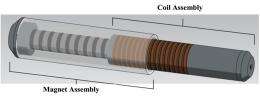
In the regenerative shock absorber, a smaller magnetic tube slides inside a larger, hollow coil tube, producing a magnetic flux. The researchers estimate that, for typical driving conditions, the system can improve fuel efficiency by 2-10%. Image credit: Zuo, et al.
(PhysOrg.com) -- In the past decade, regenerative braking systems have become increasingly popular, recovering energy that would otherwise be lost through braking. However, another energy recovery mechanism that is still in the research stages is regenerative suspension systems. This technology has the ability to continuously recover a vehicle's vibrational energy dissipation that occurs due to road irregularities, vehicle acceleration, and braking, and use the energy to reduce fuel consumption.
In a recent study, Professor Lei Zuo, Brian Scully, Jurgen Shestani, and Yu Zhou, all mechanical engineers from the State University of New York at Stony Brook, have designed and tested a retrofit regenerative shock absorber that recovers a vehicle's vibrational energy. The researchers built a 1:2 scale prototype of the regenerative shock absorber, and demonstrated its ability to harvest 2-8 watts of power during typical driving conditions at a speed of about 45 mph. They predict that a full-scale system on a four-wheel car should be able to recover up to 256 watts under these driving conditions.
“For typical driving conditions, we are predicting the ability to harvest approximately 64 watts per wheel, for a total of approximately 256 watts,” Zuo told PhysOrg.com. “This value increases considerably when the system is used on irregular roads.”
The purpose of the shock absorber in a vehicle's suspension system is to reduce the vehicle’s vibration by dissipating the vibrational energy. About 10 years ago, researchers began looking into recovering the vibrational energy using various magnetic devices. In general, these systems work by first absorbing the kinetic energy of suspension vibration between the wheel and a sprung mass, and then converting that energy into useful electric power.
Zuo and his team’s shock absorber consists of two tube-like components: a smaller magnetic tube slides inside a larger, hollow coil tube. The coil component is made of copper coils wound around a plastic delrin tube, while the magnetic component is made of ring-shaped magnets separated by ring-shaped magnetically permeable spacers. The magnets are aligned with like-poles facing each other to produce a radially emitted magnetic flux. The magnetic tube is also surrounded by a high magnetically permeable material in order to further “pull” the magnetic flux outward. As Zuo explained, having a high magnetic flux is key to the design.
“The power we regenerate is proportional to the square of the magnetic flux across the coils,” he said. “Therefore, if we increase the flux by two times, the peak power output will increase by four times.”
When placed in the vehicle suspension, vibrations in the suspension cause the coil tube to move relative to the magnetic tube. As the copper coils move inside this magnetic field, a voltage is generated. The electricity can then be used to recharge the vehicle’s battery.
By recovering the vehicle’s vibrational energy and using it to drive the vehicle, the researchers hope that regenerative suspension system technology will be able to increase fuel efficiency and cut down on pollution. They note that, in the US, automobiles are a major source of several pollutants in the atmosphere, including 70% of the carbon monoxide, 45% of the nitrogen oxide, and 34% of the hydrocarbons. Further, fuel efficiency has lots of room for improvement: currently, only 10-16% of a vehicle’s fuel energy is used to drive the vehicle, i.e. to overcome the resistance from road friction and air drag. The rest is lost due to braking, vibrational energy dissipation, and other forms of loss.
“Regenerative braking harvests large amount of power in a very short time, in an intermittent manner,” Zuo said. “However, the regenerative shock absorbers can harvest the power in a continuous way. On the smooth highway road, the regenerative shock absorbers can improve the fuel efficiency by 2%, and on bumpy roads up to 10% increase can be expected.”
In the future, the researchers plan to increase the energy density and efficiency of the system by further increasing the magnetic field intensity and improving the harvesting electrical circuit. The New York State Energy Research and Development Authority (NYSERDA) will provide funding to support Zuo on this research and development work.
“We believe there is still room for improvement in the overall design of the regenerative system, and we are working on such improvement under funding support from NYSERDA,” Zuo said.
More information: Lei Zuo, Brian Scully, Jurgen Shestani, and Yu Zhou. “Design and characterization of an electromagnetic energy harvester for vehicles suspensions.” Smart Mater. Struct. 19 (2010) 045003 (10pp). Doi:10.1088/0964-1726/19/4/045003
Copyright 2010 PhysOrg.com.
All rights reserved. This material may not be published, broadcast, rewritten or redistributed in whole or part without the express written permission of PhysOrg.com.
-
More power from bumps in the road: Energy-harvesting shock absorbers
Feb 10, 2009 |
not rated yet |
0
-
Hybrid Bus in the City: A Prototype with a Future
Aug 20, 2007 |
not rated yet |
0
-
Waves of Power
May 17, 2005 |
not rated yet |
0
-
Software eases flow to fluid power trucks
Dec 24, 2008 |
not rated yet |
0
-
Army Looks at Improving Vehicles' Performance With MR Fluid Technology From Lord Corporation
Jul 20, 2004 |
not rated yet |
0
-
Engineers build first sub-10-nm carbon nanotube transistor
Feb 01, 2012 |
4.9 / 5 (31) |
30
-
Something old, something new: Evolution and the structural divergence of duplicate genes
Jan 31, 2012 |
4.6 / 5 (7) |
1
-
The hidden nanoworld of ice crystals: Revealing the dynamic behavior of quasi-liquid layers
Jan 30, 2012 |
5 / 5 (3) |
1
-
Stock market network reveals investor clustering
Jan 27, 2012 |
3.9 / 5 (23) |
8
-
Of microchemistry and molecules: Electronic microfluidic device synthesizes biocompatible probes
Jan 26, 2012 |
5 / 5 (1) |
0
-
Calling function with no input argument
9 hours ago
-
Force free body diagram problem on gym equipment
10 hours ago
-
Empirical data regarding shower heads and water
18 hours ago
-
feed hold button on CNC lathe
Feb 09, 2012
-
RFAC in Fortran
Feb 09, 2012
-
dynamics 2/32
Feb 08, 2012
- More from Physics Forums - General Engineering
More news stories
Google users warned of threat to smartphone wallets
Users of Google smartphone wallets were being warned on Friday that there is a way to crack pass codes intended to thwart thieves from going on illicit shopping sprees.
2 hours ago |
5 / 5 (1) |
0
Anonymous knocks CIA website offline (Update)
The website of the Central Intelligence Agency was inaccessible on Friday after the hacker group Anonymous claimed to have knocked it offline.
4 hours ago |
5 / 5 (6) |
10
New error-correcting codes guarantee the fastest possible rate of data transmission
Error-correcting codes are one of the triumphs of the digital age. Theyre a way of encoding information so that it can be transmitted across a communication channel such as an optical fiber o ...
Technology / Computer Sciences
12 hours ago |
5 / 5 (4) |
5
|
New power source discovered
(PhysOrg.com) -- Researchers at the Massachusetts Institute of Technology (MIT) and RMIT University have made a breakthrough in energy storage and power generation.
Technology / Energy & Green Tech
11 hours ago |
4.8 / 5 (19) |
7
|
Small modular reactor design could be a 'SUPERSTAR'
(PhysOrg.com) -- Though most of today's nuclear reactors are cooled by water, we've long known that there are alternatives; in fact, the world's first nuclear-powered electricity in 1951 came from a reactor ...
Technology / Energy & Green Tech
12 hours ago |
4.2 / 5 (10) |
20
|
Complex wiring of the nervous system may rely on a just a handful of genes and proteins
Researchers at the Salk Institute have discovered a startling feature of early brain development that helps to explain how complex neuron wiring patterns are programmed using just a handful of critical genes. ...
Putting the squeeze on planets outside our solar system
(PhysOrg.com) -- Using high-powered lasers, scientists at Lawrence Livermore National Laboratory and collaborators discovered that molten magnesium silicate undergoes a phase change in the liquid state, abruptly ...
NASA sees wide-eyed cyclone Jasmine
Cyclone Jasmine's eye has opened wider on NASA satellite imagery, as it moves through the Southern Pacific Ocean.
The power of estrogen -- male snakes attract other males
A new study has shown that boosting the estrogen levels of male garter snakes causes them to secrete the same pheromones that females use to attract suitors, and turned the males into just about the sexiest ...
NASA sees Giovanna reach cyclone strength, threaten Madagascar
Tropical Storm 12S built up steam and became a cyclone on February 10, 2012 as NASA's Terra satellite passed overhead. Residents of east-central Madagascar should prepare for this cyclone to make landfall ...
Humans may have helped the decline of African rainforests 3000 years ago
(PhysOrg.com) -- Large areas of rainforests in Central Africa mysteriously disappeared over three thousand years ago, to be replaced by savannas. The prevailing theory has been that the cause was a change ...
Mar 17, 2010
Rank: not rated yet
Mar 17, 2010
Rank: not rated yet
Mar 17, 2010
Rank: 1 / 5 (1)
Mar 17, 2010
Rank: 5 / 5 (5)
Mar 17, 2010
Rank: not rated yet
http://www.treehu...rber.php
The one in the article sounds simpler. They want to eliminate the alternator load on the engine.
Mar 18, 2010
Rank: not rated yet
Mar 18, 2010
Rank: 5 / 5 (2)
There's a lot of potential energy that's being ignored.
Mar 18, 2010
Rank: 5 / 5 (1)
Mar 18, 2010
Rank: 4 / 5 (1)
maybe the high frequency pressure variations [sound] coming from interaction of the tyre with the road surface could be absorbed by piezoelectric crystals arrayed on the surfaces of the wheel which face into the tyre cavity. I suppose this would require some very robust transistors or whatever to rectify the outputs from the crystals.
For "Heat and light on the roof" I think robust photoelectric cells on the top surface should be standard features of all cars right now. In Australia this would allow us to power small extractor fans to take out the hot air which accumulates when cars stand locked and closed up in open air car parks.
For "the HUGE amount of energy wasted ....heat .." I have read recently that at least one car manufacturer is experimenting with the use of a Stirling engine connected to an alternator to do just that: using the 'hot' side of the S. engine as a heat sink for the exhaust pipe.
Mar 19, 2010
Rank: not rated yet
Mar 19, 2010
Rank: not rated yet
The amount of sound energy you could harness is negligible and certainly not worth the added weight of a conversion system.
This makes no sense. look up 'solar constant' and do the math. If you plastered an entire car with 100% efficient solar cells you'd still get only a pittance of power at high noon on a cloudless day in summer compared to what a car needs to run.
Mar 20, 2010
Rank: not rated yet
The 10% for cross country and bumpy roads might make it worth while for military vehicles and off-roaders, but it might be counteracted by more difficult maintenance.
Mar 22, 2010
Rank: not rated yet
Of course the big issue that many pie-in-the-sky types don't think enough about is cost: bang for the buck. If it can make any economic sense, it will very likely get done sooner or later. If it doesn't, it fails.
Always remember the engineer's mantra: "better, faster, cheaper".