Layered graphene sheets could solve hydrogen storage issues
March 17, 2010
Layered graphene sheets could solve hydrogen storage issues

Enlarge

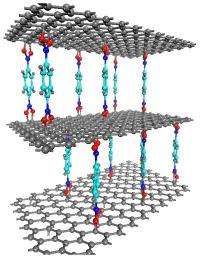
A graphene-oxide framework (GOF) is formed of layers of graphene connected by boron-carboxylic “pillars.” GOFs such as this one are just beginning to be explored as a potential storage medium for hydrogen and other gases. Credit: NIST

Graphene -- carbon formed into sheets a single atom thick -- now appears to be a promising base material for capturing hydrogen, according to recent research* at the National Institute of Standards and Technology and the University of Pennsylvania. The findings suggest stacks of graphene layers could potentially store hydrogen safely for use in fuel cells and other applications.

Graphene has become something of a celebrity material in recent years due to its conductive, thermal and , which could make it useful in a range of sensors and semiconductor devices. The material does not store hydrogen well in its original form, according to a team of scientists studying it at the NIST Center for Neutron Research. But if oxidized graphene sheets are stacked atop one another like the decks of a multilevel parking lot, connected by molecules that both link the layers to one another and maintain space between them, the resulting graphene-oxide framework (GOF) can accumulate hydrogen in greater quantities.

Inspired to create GOFs by the metal-organic frameworks that are also under scrutiny for , the team is just beginning to uncover the new structures' properties. "No one else has ever made GOFs, to the best of our knowledge," says NIST theorist Taner Yildirim. "What we have found so far, though, indicates GOFs can hold at least a hundred times more than ordinary graphene oxide does. The easy synthesis, low cost and non-toxicity of graphene make this material a promising candidate for gas storage applications."

The GOFs can retain 1 percent of their weight in hydrogen at a temperature of 77 degrees Kelvin and ordinary atmospheric pressure—roughly comparable to the 1.2 percent that some well-studied metal-organic frameworks can hold, Yildirim says.

Another of the team's potentially useful discoveries is the unusual relationship that GOFs exhibit between temperature and hydrogen absorption. In most storage materials, the lower the temperature, the more hydrogen uptake normally occurs. However, the team discovered that GOFs behave quite differently. Although a GOF can absorb hydrogen, it does not take in significant amounts at below 50 Kelvin (-223 degrees Celsius). Moreover, it does not release any hydrogen below this "blocking temperature"—suggesting that, with further research, GOFs might be used both to store hydrogen and to release it when it is needed, a fundamental requirement in applications.

Some of the GOFs' capabilities are due to the linking molecules themselves. The molecules the team used are all benzene-boronic acids that interact strongly with hydrogen in their own right. But by keeping several angstroms of space between the layers—akin to the way pillars hold up a ceiling—they also increase the available surface area of each layer, giving it more spots for the to latch on.

According to the team, GOFs will likely perform even better once the team explores their parameters in more detail. "We are going to try to optimize the performance of the GOFs and explore other linking molecules as well," says Jacob Burress, also of NIST. "We want to explore the unusual temperature dependence of absorption kinetics, as well as whether they might be useful for capturing greenhouse gases such as carbon dioxide and toxins like ammonia."

More information: * J. Burress, J. Simmons, J. Ford and T.Yildirim. "Gas adsorption properties of graphene-oxide-frameworks and nanoporous benzene-boronic acid polymers." To be presented at the March meeting of the American Physical Society (APS) in Portland, Ore., March 18, 2010. An abstract is available at http://meetings.ap … Event/122133

Provided by National Institute of Standards and Technology (NIST)

4.7 /5 (23 votes)  

Filter


Move the slider to adjust rank threshold, so that you can hide some of the comments.


Display comments: newest first

deatopmg
Mar 17, 2010

Rank: 3 / 5 (2)
There is a much more efficient way to capture hydrogen with carbon - it's called natural gas, i.e. methane. We've many 100's of years supply. It's abundant, inexpensive to recover, and found almost everywhere.
Glyndwr
Mar 17, 2010

Rank: 1.5 / 5 (2)
why are you stuck in the old industrial finite resources state of mind....its like you want to live your life in scarcity?
NeilFarbstein
Mar 18, 2010

Rank: 1 / 5 (2)
There is a much more efficient way to capture hydrogen with carbon - it's called natural gas, i.e. methane. We've many 100's of years supply. It's abundant, inexpensive to recover, and found almost everywhere.

somebody should find a way to split the carbon off the methane molecule yielding H2 that wont exacerbate
the greenhouse effect.
Tripping
Mar 18, 2010

Rank: not rated yet
What about this?
http://physicswor...ws/22689
Were they predict exactly?
ZeroDelta
Mar 18, 2010

Rank: not rated yet
A fellow studen at RPI recently won $30,000 for VERY similar work. Check it: http://news.rpi.e...key=2690
SongDog
Mar 18, 2010

Rank: not rated yet
Yeah, great. It only needs a lightweight, crashproof 100 atmosphere tank.
ChazzMann
Mar 24, 2010

Rank: not rated yet
There is a much more efficient way to capture hydrogen with carbon - it's called natural gas, i.e. methane. We've many 100's of years supply. It's abundant, inexpensive to recover, and found almost everywhere.


As far as "much more efficient" we haven't scratched the surface of how we might make hydrogen, so efficiency comparisons are premature.

Burning hydrogen pulls oxygen from the atmosphere, but making it by electrolysis puts it back. Burning methane removes oxygen; it's not replaced.

The products of hydrogen combustion? Energy and water. The products of methane combustion? Energy and poison.

Water or poison. Pick one. Choose wisely, because your grandchildren's grandchildren will inherit the impacts of your decision.

Haliburton and Exxon love your theories; I'm sure they can buy a scientist who will prove them. Besides, grandchildren are overrated.
Rank 4.7 /5 (23 votes)
Related Stories
Relevant PhysicsForums posts
  • polymer nanocomposites
    createdFeb 10, 2012
  • Corrosion Tests on Magnesium
    createdFeb 09, 2012
  • polyethylene copper nanocomposite
    createdFeb 09, 2012
  • Output of xrd analysis
    createdFeb 08, 2012
  • Transport phenomena problem based on problems 18.B11 and 19B.6 from Bird, stewart, lw
    createdFeb 06, 2012
  • Help with material selection - Car Piston
    createdFeb 05, 2012
  • More from Physics Forums - Materials & Chemical Engineering

More news stories

What lies beneath: Mapping hidden nanostructures

The ability to diagnose and predict the properties of materials is vital, particularly in the expanding field of nanotechnology. Electron and atom-probe microscopy can categorize atoms in thin sheets of material, ...

Nanotechnology / Nanophysics

created 19 hours ago | popularity 5 / 5 (3) | comments 1

New kind of solar cell could capture significantly more energy than current cells

New solar cells could increase the maximum efficiency of solar panels by over 25%, according to scientists from the University of Cambridge.

Nanotechnology / Nanophysics

created Feb 08, 2012 | popularity 4.5 / 5 (12) | comments 14 | with audio podcast

Nanoshell whispering galleries improve thin solar panels

Visitors to Statuary Hall in the U.S. Capitol Building may have experienced a curious acoustic feature that allows a person to whisper softly at one side of the cavernous, half-domed room and for another on ...

Nanotechnology / Nanomaterials

created Feb 07, 2012 | popularity 4.3 / 5 (6) | comments 6 | with audio podcast

'Dark plasmons' transmit energy

Microscopic channels of gold nanoparticles have the ability to transmit electromagnetic energy that starts as light and propagates via "dark plasmons," according to researchers at Rice University.

Nanotechnology / Nanophysics

created Feb 09, 2012 | popularity 4.8 / 5 (9) | comments 1 | with audio podcast

Revealing how a battery material works

Since its discovery 15 years ago, lithium iron phosphate (LiFePO4) has become one of the most promising materials for rechargeable batteries because of its stability, durability, safety and ability to deliver ...

Nanotechnology / Nanomaterials

created Feb 08, 2012 | popularity 5 / 5 (5) | comments 0 | with audio podcast


Anonymous knocks CIA website offline (Update)

The website of the Central Intelligence Agency was inaccessible on Friday after the hacker group Anonymous claimed to have knocked it offline.

New error-correcting codes guarantee the fastest possible rate of data transmission

Error-correcting codes are one of the triumphs of the digital age. They’re a way of encoding information so that it can be transmitted across a communication channel — such as an optical fiber o ...

Humans may have helped the decline of African rainforests 3000 years ago

(PhysOrg.com) -- Large areas of rainforests in Central Africa mysteriously disappeared over three thousand years ago, to be replaced by savannas. The prevailing theory has been that the cause was a change ...

Small modular reactor design could be a 'SUPERSTAR'

(PhysOrg.com) -- Though most of today's nuclear reactors are cooled by water, we've long known that there are alternatives; in fact, the world's first nuclear-powered electricity in 1951 came from a reactor ...

New power source discovered

(PhysOrg.com) -- Researchers at the Massachusetts Institute of Technology (MIT) and RMIT University have made a breakthrough in energy storage and power generation.

The power of estrogen -- male snakes attract other males

A new study has shown that boosting the estrogen levels of male garter snakes causes them to secrete the same pheromones that females use to attract suitors, and turned the males into just about the sexiest ...