Chemists influence stem-cell development with geometry (w/ Video)
March 17, 2010
Chemists influence stem-cell development with geometry (w/ Video)

Enlarge

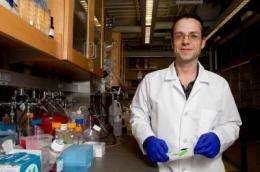
Kristopher Kilian, National Institutes of Health Postdoctoral Fellow at the University of Chicago, and his associates are using shape to control stem-cell development. Their article on the method appears in the March 1 Early Edition of the Proceedings of the National Academy of Sciences. Credit: Jason Smith

University of Chicago scientists have successfully used geometrically patterned surfaces to influence the development of stem cells. The new approach is a departure from that of many stem-cell biologists, who focus instead on uncovering the role of proteins in controlling the fate of stem cells.

"The cells are seeing the same soluble proteins. In both cases it's the shape alone that's dictating whether they turn into fat or bone, and that hasn't been appreciated before," said Milan Mrksich, Professor in Chemistry and a Howard Hughes Medical Institute Investigator, who led the study. "That's exciting because stem-cell therapies are of enormous interest right now, and a significant effort is ongoing to identify the laboratory conditions that can take a stem cell and push it into a specific lineage."

The UChicago team found that making cells assume a star shape promotes a tense cytoskeleton, which provides structural support for cells, while a flower shape promotes a looser . "On a flower shape you get the majority of cells turning to fat, and on a star shape you've got the majority of cells turning into bone," said Kris Kilian, a National Institutes of Health Fellow in Mrksich's research group. The UChicago team published its findings in the March 1 Early Edition of the .

This video is not supported by your browser at this time.

Milan Mrksich, University of Chicago Professor in Chemistry and Howard Hughes Medical Institute Investigator, discusses the geometry of stem cell development in this video. Credit: Steve Koppes with Jason Smith photos

Mrksich cautioned that the method is far from ready for use in the harvest of for therapeutic use, but it does signal a potentially promising direction for further study.

Mrksich's research group has a long history of developing methods for patterning surfaces with chemistry to control the positions, sizes and shapes of cells in culture, and applying those patterned cells to drug-discovery assays, and studies of and cell adhesion.

More information: "Geometric cues for directing the differentiation of mesenchymal stem cells," Proceedings of the National Academy of Sciences, March 1 Early Edition, by Kristopher A. Kilian, Branimir Bugarija, Bruce T. Lahn and Milan Mrksich.

Provided by University of Chicago (news : web)

3.8 /5 (4 votes)  

Rank 3.8 /5 (4 votes)
Relevant PhysicsForums posts
  • Mitosis
    created2 hours ago
  • Stem cell question.
    created4 hours ago
  • Protease cleavage
    created10 hours ago
  • Pertubance in a model
    created16 hours ago
  • Cancer drugs and Alzheimer's, Oh my!
    createdFeb 09, 2012
  • Squishing cells
    createdFeb 09, 2012
  • More from Physics Forums - Biology

More news stories

The power of estrogen -- male snakes attract other males

A new study has shown that boosting the estrogen levels of male garter snakes causes them to secrete the same pheromones that females use to attract suitors, and turned the males into just about the sexiest ...

Biology / Plants & Animals

created 15 hours ago | popularity 4.8 / 5 (6) | comments 1 | with audio podcast

Grass to gas: Researchers' genome map speeds biofuel development

Researchers at the University of Georgia have taken a major step in the ongoing effort to find sources of cleaner, renewable energy by mapping the genomes of two originator cells of Miscanthus x giganteus, a large perenn ...

Biology / Biotechnology

created 12 hours ago | popularity 3.8 / 5 (5) | comments 0 | with audio podcast

Experts reveal how plants don't get sunburn

(PhysOrg.com) -- Experts at the University of Glasgow have discovered how plants survive the harmful rays of the sun.

Biology / Cell & Microbiology

created 15 hours ago | popularity 4.8 / 5 (5) | comments 0 | with audio podcast

Miami battling invasion of giant African snails

No one knows how they got there. But an invasion of African giant snails has southern Florida in a panic over potential crop damage, disease and general yuckiness surrounding the slimy gastropods.

Biology / Ecology

created 19 hours ago | popularity 4 / 5 (1) | comments 4

Protein libraries in a snap

(PhysOrg.com) -- A Rice University undergraduate will depart with not only a degree but also a possible patent for his invention of an efficient way to create protein libraries, an important component of biomolecular ...

Biology / Cell & Microbiology

created 18 hours ago | popularity 4.8 / 5 (4) | comments 1 | with audio podcast


Google users warned of threat to smartphone wallets

Users of Google smartphone wallets were being warned on Friday that there is a way to crack pass codes intended to thwart thieves from going on illicit shopping sprees.

Anonymous knocks CIA website offline (Update)

The website of the Central Intelligence Agency was inaccessible on Friday after the hacker group Anonymous claimed to have knocked it offline.

New error-correcting codes guarantee the fastest possible rate of data transmission

Error-correcting codes are one of the triumphs of the digital age. They’re a way of encoding information so that it can be transmitted across a communication channel — such as an optical fiber o ...

Humans may have helped the decline of African rainforests 3000 years ago

(PhysOrg.com) -- Large areas of rainforests in Central Africa mysteriously disappeared over three thousand years ago, to be replaced by savannas. The prevailing theory has been that the cause was a change ...

New power source discovered

(PhysOrg.com) -- Researchers at the Massachusetts Institute of Technology (MIT) and RMIT University have made a breakthrough in energy storage and power generation.

Complex wiring of the nervous system may rely on a just a handful of genes and proteins

Researchers at the Salk Institute have discovered a startling feature of early brain development that helps to explain how complex neuron wiring patterns are programmed using just a handful of critical genes. ...