Researchers develop molecular 'LEGO kit' to create nano-cubes
March 17, 2010
Researchers develop molecular 'LEGO kit' to create nano-cubes

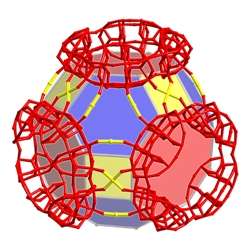
A representation of the POM framework.

(PhysOrg.com) -- Scientists at the University of Glasgow have devised a molecular 'LEGO toolkit' which can be used to assemble a vast number of new and functional chemical compounds.

Using molecules as building blocks they have been able to construct a molecular scaffold based on tiny (nano-scale) storage cubes. This new ‘designer route’ opens the door to many new compounds that, potentially, are able to act as the ion sensors, storage devices, and catalysts of the future.

Researchers within the Department of Chemistry created hollow cube-based frameworks from polyoxometalates (POMs) - complex compounds made from metal and oxygen atoms - which stick together like LEGO bricks meaning a whole range of well-defined architectures can be developed with great ease.

The researchers chose a ‘wheel-shaped’ polyoxometalate molecule, containing a 1-nanometre wide hole, which acts like a ‘window’ to the molecule. The cyclic compounds self-assemble in water to form beautiful cubic single crystals.

The ‘windows’ of the ring-shaped building blocks lead to very large internal pores meaning that these new compounds can effectively act like storage boxes for ions and small molecules.

Well-defined chemical architectures are essential for many functional materials; therefore very large POM frameworks could be used as ion fuel cells, batteries, sensors, catalysts and other new nanotechnologies.

Professor Lee Cronin, Gardiner Chair of Chemistry, who led the study, said: “The ability to build highly-robust inorganic structures in a LEGO-like fashion is a huge boon to chemists, presenting many potential applications.”

In the compound reported, manganese ions link the wheel-shaped molecules together into the molecular scaffold. Positively-charged potassium and lithium ions are also incorporated in the framework to balance the negative charge carried by the ions in the POM wheel. The frameworks themselves can also be ‘tuned’ by changing the charge on the ions.

The molecular sensing aspects of this new material are related to the potassium and lithium ions, which sit loosely in cavities in the framework. These can be displaced by other positively charged ions such as transition metals or small organic molecules while at the same time leaving the framework intact.

These characteristics highlight some of the many potential uses and applications of POM frameworks, but their principle application is their use as catalysts - a molecule used to start or speed-up a chemical reaction making it more efficient, cost-effective and environmentally friendly.

Prof Cronin added: “Although catalysts are of huge industrial significance, many of the catalysts used today in industry are still expensive as well as ‘dirty’, creating environmentally harmful waste.”

“Our research focuses on the design and synthesis of functional molecular architectures which can be used as industrial catalysts that are more energy efficient and environmentally friendly than current materials.”

“Extended modular frameworks that incorporate inorganic building blocks such as these represent a new class of tuneable materials with ‘active sites’ designed to respond to guest inclusion.”

“With a huge variety of POM wheel molecules available, further studies are required to build this family of materials based on the general design process that has been established. But moreover we aim to investigate the catalytic, sensing and guest exchange capabilities in more detail.”

The research is reported in the latest edition of the journal Nature Chemistry.

More information: Paper: http://www.nature. … hem.581.html

Provided by University of Glasgow

4.8 /5 (5 votes)  

Filter


Move the slider to adjust rank threshold, so that you can hide some of the comments.


Display comments: newest first

NeilFarbstein
Mar 18, 2010

Rank: 1 / 5 (1)
I've almost finshed writing a patent on a breakthrough energy storage deveice that is more efficient than compressed air storage and it costs 20 times less than flow batteries under research as utitiliy scale energy storage devices. It will save 4% of all the energy in the world when it is connected to smart grid networks.
Contact
Neil Farbstein
President
Vulvox Inc.
protn7@att.net
Rank 4.8 /5 (5 votes)
Relevant PhysicsForums posts
  • polymer nanocomposites
    created23 hours ago
  • Corrosion Tests on Magnesium
    createdFeb 09, 2012
  • polyethylene copper nanocomposite
    createdFeb 09, 2012
  • Output of xrd analysis
    createdFeb 08, 2012
  • Transport phenomena problem based on problems 18.B11 and 19B.6 from Bird, stewart, lw
    createdFeb 06, 2012
  • Help with material selection - Car Piston
    createdFeb 05, 2012
  • More from Physics Forums - Materials & Chemical Engineering

More news stories

What lies beneath: Mapping hidden nanostructures

The ability to diagnose and predict the properties of materials is vital, particularly in the expanding field of nanotechnology. Electron and atom-probe microscopy can categorize atoms in thin sheets of material, ...

Nanotechnology / Nanophysics

created 15 hours ago | popularity 5 / 5 (3) | comments 1

New kind of solar cell could capture significantly more energy than current cells

New solar cells could increase the maximum efficiency of solar panels by over 25%, according to scientists from the University of Cambridge.

Nanotechnology / Nanophysics

created Feb 08, 2012 | popularity 4.5 / 5 (12) | comments 14 | with audio podcast

Nanoshell whispering galleries improve thin solar panels

Visitors to Statuary Hall in the U.S. Capitol Building may have experienced a curious acoustic feature that allows a person to whisper softly at one side of the cavernous, half-domed room and for another on ...

Nanotechnology / Nanomaterials

created Feb 07, 2012 | popularity 4.3 / 5 (6) | comments 6 | with audio podcast

'Dark plasmons' transmit energy

Microscopic channels of gold nanoparticles have the ability to transmit electromagnetic energy that starts as light and propagates via "dark plasmons," according to researchers at Rice University.

Nanotechnology / Nanophysics

created Feb 09, 2012 | popularity 4.8 / 5 (8) | comments 1 | with audio podcast

Revealing how a battery material works

Since its discovery 15 years ago, lithium iron phosphate (LiFePO4) has become one of the most promising materials for rechargeable batteries because of its stability, durability, safety and ability to deliver ...

Nanotechnology / Nanomaterials

created Feb 08, 2012 | popularity 5 / 5 (5) | comments 0 | with audio podcast


Anonymous knocks CIA website offline (Update)

The website of the Central Intelligence Agency was inaccessible on Friday after the hacker group Anonymous claimed to have knocked it offline.

Google users warned of threat to smartphone wallets

Users of Google smartphone wallets were being warned on Friday that there is a way to crack pass codes intended to thwart thieves from going on illicit shopping sprees.

New error-correcting codes guarantee the fastest possible rate of data transmission

Error-correcting codes are one of the triumphs of the digital age. They’re a way of encoding information so that it can be transmitted across a communication channel — such as an optical fiber o ...

Humans may have helped the decline of African rainforests 3000 years ago

(PhysOrg.com) -- Large areas of rainforests in Central Africa mysteriously disappeared over three thousand years ago, to be replaced by savannas. The prevailing theory has been that the cause was a change ...

New power source discovered

(PhysOrg.com) -- Researchers at the Massachusetts Institute of Technology (MIT) and RMIT University have made a breakthrough in energy storage and power generation.

The power of estrogen -- male snakes attract other males

A new study has shown that boosting the estrogen levels of male garter snakes causes them to secrete the same pheromones that females use to attract suitors, and turned the males into just about the sexiest ...