Human cells exhibit foraging behavior like bacteria
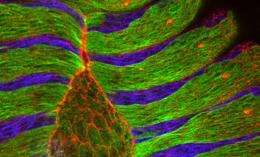
(PhysOrg.com) -- When cells move about in the body, they follow a complex pattern similar to that which amoebae and bacteria use when searching for food, a team of Vanderbilt researchers have found.
The discovery has a practical value for drug development: Incorporating this basic behavior into computer simulations of biological processes that involve cell migration, such as embryo development, bone remodeling, wound healing, infection and tumor growth, should improve the accuracy with which these models can predict the effectiveness of untested therapies for related disorders.
"As far as we can tell, this is the first time this type of behavior has been reported in cells that are part of a larger organism,” says Peter T. Cummings, John R. Hall Professor of Chemical Engineering, who directed the study that is described in the March 10 issue of the Public Library of Science journal PLoS ONE.
The discovery was the unanticipated result of a study the Cummings group conducted to test the hypothesis that the freedom with which different cancer cells move — a concept called motility — could be correlated with their aggressiveness: That is, the faster a given type of cancer cell can move through the body, the more aggressive it is.
"Our results refute that hypothesis—the correlation between motility and aggressiveness that we found among three different types of cancer cells was very weak,” Cummings says. "In the process, however, we began noticing that the cell movements were unexpectedly complicated.”
Then the researchers' interest was piqued by a paper that appeared in the February 2008 issue of the journal Nature titled, "Scaling laws of marine predator search behaviour.” The paper contained an analysis of the movements of a variety of radio-tagged marine predators, including sharks, sea turtles and penguins. The authors found that the predators used a foraging strategy very close to a specialized random walk pattern, called a Lévy walk, an optimal method for searching complex landscapes. At the end of the paper's abstract they wrote, "...Lévy-like behaviour seems to be widespread among diverse organisms, from microbes to humans, as a 'rule' that evolved in response to patchy resource distributions.”
This gave Cummings and his colleagues a new perspective on the cell movements that they were observing in the microscope. They adopted the basic assumption that when mammalian cells migrate they face problems, such as efficiently finding randomly distributed targets like nutrients and growth factors, that are analogous to those faced by single-celled organisms foraging for food.
With this perspective in mind, Alka Potdar, now a post-doctoral fellow at Case Western Reserve University and the Cleveland Clinic, cultured cells from three human mammary epithelial cell lines on two-dimensional plastic plates and tracked the cell motions for two-hour periods in a "random migration” environment free of any directional chemical signals. Epithelial cells are found throughout the body, lining organs and covering external surfaces. They move relatively slowly, at about a micron per minute, which corresponds to two thousandths of an inch per hour.
When Potdar carefully analyzed these cell movements, she found that they all followed the same pattern. However, it was not the Lévy walk that they expected, but a closely related search pattern called a bimodal correlated random walk (BCRW). This is a two-phase movement: a run phase in which the cell travels primarily in one direction, and a re-orientation phase in which it stays in place and reorganizes itself internally to move in a new direction.
In subsequent studies, currently in press, the researchers have found that several other cell types (social amoeba, neutrophils, fibrosarcoma) also follow the same pattern in random migration conditions. They have also found that the cells continue to follow this same basic pattern when a directional chemical signal is added, but the length of their runs are varied and the range of directions they follow are narrowed, giving them a net movement in the direction indicated by the signal.
"For the first time, this gives us a general framework for analyzing the way cells move,” says Potdar.
Provided by Vanderbilt University


