Hubble's successor one step closer to completion
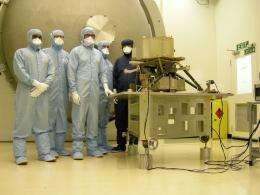
(PhysOrg.com) -- A working replica of MIRI - the pioneering camera and spectrometer for the James Webb Space Telescope - has just been shipped (16th March) from the Science and Technology Facilities Council’s Rutherford Appleton Laboratory to NASA’s Goddard Space Flight Centre, bringing the Webb Telescope one small step closer to embarking on its journey into space where it will produce the sharpest images yet of the farthest depths of the cosmos.
The Webb telescope, a joint collaboration between NASA, the European Space Agency (ESA) and the Canadian Space Agency (CSA), is a large, cold orbiting infrared observatory that will succeed the currently operating Hubble Space Telescope. With the help of MIRI and its three other sophisticated instruments, it will be able to examine the first light in the universe and investigate the evolution of galaxies and the process of star and planet formation - helping to answer some of the fundamental questions about the origin of our Universe.
MIRI (Mid InfraRed Instrument) is an infrared camera and spectrometer that will operate as part of the Webb telescope to observe the Universe at wavelengths that are difficult or impossible to observe from the ground. It is an international project combining the talents of a consortium of European partners, the European Space Agency, and an international science team with those of scientists and engineers at NASA’s Jet Propulsion Laboratory.
The MIRI Structural Thermal Model realistically replicates the thermal, mechanical and optical alignment characteristics of the real flight model MIRI. It was assembled at the Science and Technology Facilities Council’s Rutherford Appleton Laboratory (RAL) from modules built by the University of Leicester, CEA in France, CSL in Belgium, JPL in the USA, Nova-Astron in the Netherlands, STFC’s UK ATC, & the Danish Space Research Centre, with system engineering, product assurance and management provided by Astrium Ltd. It has already been subjected to an extensive series of tests at RAL, and later this year it will be used at NASA’s Goddard Space Flight Centre for pre-integration testing with the Integrated Science Instrument Model (ISIM) - the key element of JWST that holds all four instruments in the correct positions. Meanwhile engineers across Europe and the USA are pressing ahead at full speed to build the flight instrument, which is due for delivery next year.
“The MIRI team is delighted to have reached this important technical milestone after many years of design and development work for the instrument” said the European PI, Gillian Wright of STFC’s UK Astronomy Technology Centre.
George Rieke, MIRI Science Team Lead at University of Arizona, Tucson added, "It is inspirational to see how well the team has worked to make this happen." "It is another big step toward making MIRI a reality."
When launched in 2014, the Webb telescope will have a set of four instruments, including MIRI. MIRI will provide enormous increases in sensitivity, spatial and spectral resolution for three key reasons: Firstly, its location in space will remove the blocking and large background noise effects of the atmosphere which limit ground-based telescopes. Secondly, the telescope is cooled to a very low temperature, reducing its emission and greatly improving its performance. Thirdly, the telescope’s mirror is larger then any other infrared space observatory, giving improved angular resolution and collecting area. This combination makes the Webb telescope a very powerful space observatory which promises to revolutionise our view of the cosmos yet again - just as Hubble did.
The UK is playing a key role in the Webb telescope with the Science and Technology Facilities Council (STFC) leading the European development of the MIRI Optical System. This UK contribution includes leadership by the European PI based at STFC’s UK ATC; Astrium Ltd providing the project management, PA, and system design/engineering; STFC’s Rutherford Appleton Laboratory (RAL) responsible for the Assembly, Verification and Test and the thermal systems work; STFC’s UK ATC designing and building the spectrometer pre-optics module; and the University of Leicester leading the structure and mechanical systems work for MIRI.
Dr David Parker, Director of Space Science and Exploration at the British National Space Centre (BNSC), said, “With the delivery of this sophisticated replica of MIRI, we’ve reached another important milestone in the build of this new window on the ancient Universe. Right now, the UK is involved in many exciting, new space projects. With the upcoming creation of a UK executive space agency we will ensure that the UK continues to play key roles in amazing discovery machines like James Webb Space Telescope.”
Professor Richard Holdaway, Director of Space Science and Technology at the Science and Technology Facilities Council’s Rutherford Appleton Laboratory, added, “The shipping of the MIRI replica to NASA’s Goddard Space Flight Centre, highlights again, the effectiveness of international collaboration on a mission of this size. Each organisation, including Rutherford Appleton Laboratory’s Space Science and Technology Department, contributes their own set of skills and expertise to the project, gradually steering us towards its completion”.
Matt Greenhouse, Project Scientist for the Webb telescope Science Instrument Payload at NASA's Goddard Space Flight Center, Greenbelt, Md. said, "Receipt of the MIRI structural thermal (STM) model represents a major milestone in 8 years of development work by the joint ESA and JPL instrument team. Tests with this prototype model of the MIRI, conducted at Rutherford Appleton Laboratories in the UK, have shown that this science instrument is on track to meet all of its performance requirements. Upon receipt of the STM, GSFC engineers will begin testing it with supporting systems in the Webb telescope Integrated Science Instrument Module to facilitate smooth integration of the flight model."
James Webb Space Telescope
At the heart of the JWST observatory is a large telescope whose primary mirror measures 6.5 metres in diameter (compared to 2.4 metres for Hubble), providing a very large aperture compared to any previous space mission.
The Webb telescope will be operated well outside the Earth’s atmosphere at a point in deep space called ‘second Lagrangian point’ or ‘L2’, located at 1.5 million kilometres in the direction opposite to the sun. The JWST mirror has a diameter of 6.5m and operates at a temperature of <50K, i.e. <-223 C)
Provided by British National Space Centre


