Discovery could pave the way for quantum computing
March 18, 2010
Discovery could pave the way for quantum computing

Enlarge

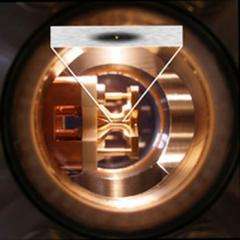
The picture shows the team's experimental apparatus comprising of the ion trap inside the vacuum chamber. The inset shows schematically the single ion (red) in the Bose-Einstein condensate (dark grey).

(PhysOrg.com) -- Two experimental systems at the forefront of modern physics research -- a single trapped ion and a quantum atomic gas -- have been combined for the first time by researchers at Cambridge.

The successful creation of this hybrid system opens the way to new types of experiment, in which the precise controllability of trapped ions can be used to study and manipulate quantum gases with nanometre precision.

In recent years, the ultracold quantum gases known as Bose-Einstein condensates and single ions confined in electromagnetic traps have both been used to explore a wide range of problems in fundamental physics.

Writing in this week's Nature, the team from the Department of Physics at the University of Cambridge describe the immersion of a single trapped ytterbium ion in a Bose-Einstein condensate of neutral atoms.

They showed that they can control the two systems independently, and study their interactions. They also observe 'sympathetic cooling' of the ion by the condensate - an effect that might ultimately prove useful in .

According to Dr Michael Köhl: "We placed a single charged Ytterbium atom into a Bose-Einstein condensate, which at only a few billionths of a degree above is the coldest thing in the universe."

The results could be used to cool quantum computers - devices that, by employing the laws of , can solve certain computational tasks much faster than any existing computer. Basic quantum processors already exist but they are not yet surpassing the fastest normal computers.

"Today's most powerful quantum computers are made from single atoms, like our Ytterbium, trapped in vacuum, but they need to be refrigerated in order to compute correctly. Usually this is done with laser light, which is quite complicated, expensive, and it interrupts the computing process. With our new technique, quantum computers could be cooled continuously in the future which could pave the way to a more widespread application," says Dr Köhl.

Provided by University of Cambridge (news : web)

4.5 /5 (28 votes)  

Rank 4.5 /5 (28 votes)
Relevant PhysicsForums posts
  • Non-Integrable Quadratic Hamiltonian
    created1 hour ago
  • Mysteries in Classical Physics
    created3 hours ago
  • (Conceptual) questions about capacitors, circuits
    created3 hours ago
  • a steel rod and an iron rod is placed inside an ac current soleoid
    created4 hours ago
  • Nature of principal strains
    created4 hours ago
  • Magnet in a AC current solenoid
    created5 hours ago
  • More from Physics Forums - Classical Physics

More news stories

Putting the squeeze on planets outside our solar system

(PhysOrg.com) -- Using high-powered lasers, scientists at Lawrence Livermore National Laboratory and collaborators discovered that molten magnesium silicate undergoes a phase change in the liquid state, abruptly ...

Physics / Condensed Matter

created 14 hours ago | popularity 4.3 / 5 (7) | comments 0 | with audio podcast

Hovering not hard if you're top-heavy, researchers find

Top-heavy structures are more likely to maintain their balance while hovering in the air than are those that bear a lower center of gravity, researchers at New York University's Courant Institute of Mathematical Sciences ...

Physics / General Physics

created 15 hours ago | popularity 5 / 5 (2) | comments 1 | with audio podcast

SLAC, Stanford team focuses on high-energy electrons to treat cancer

Accelerator physicists at SLAC and cancer specialists from Stanford are working on a new technology that could dramatically reduce the time needed for cancer radiation treatments. The team ran an initial experiment ...

Physics / General Physics

created 18 hours ago | popularity 5 / 5 (2) | comments 0

Measurements from high-energy collisions lead to better understanding of why meson particles disappear

For several years, physicists at the Relativistic Heavy Ion Collider (RHIC) at Brookhaven National Laboratory (BNL), USA, have studied an unusual state of matter called the quark–gluon plasma, which they ...

Physics / General Physics

created 19 hours ago | popularity 4.5 / 5 (4) | comments 0

Explained: Sigma

It's a question that arises with virtually every major new finding in science or medicine: What makes a result reliable enough to be taken seriously? The answer has to do with statistical significance -- but ...

Physics / General Physics

created Feb 09, 2012 | popularity 5 / 5 (16) | comments 53


Anonymous knocks CIA website offline (Update)

The website of the Central Intelligence Agency was inaccessible on Friday after the hacker group Anonymous claimed to have knocked it offline.

New error-correcting codes guarantee the fastest possible rate of data transmission

Error-correcting codes are one of the triumphs of the digital age. They’re a way of encoding information so that it can be transmitted across a communication channel — such as an optical fiber o ...

Humans may have helped the decline of African rainforests 3000 years ago

(PhysOrg.com) -- Large areas of rainforests in Central Africa mysteriously disappeared over three thousand years ago, to be replaced by savannas. The prevailing theory has been that the cause was a change ...

New power source discovered

(PhysOrg.com) -- Researchers at the Massachusetts Institute of Technology (MIT) and RMIT University have made a breakthrough in energy storage and power generation.

Small modular reactor design could be a 'SUPERSTAR'

(PhysOrg.com) -- Though most of today's nuclear reactors are cooled by water, we've long known that there are alternatives; in fact, the world's first nuclear-powered electricity in 1951 came from a reactor ...

Google users warned of threat to smartphone wallets

Users of Google smartphone wallets were being warned on Friday that there is a way to crack pass codes intended to thwart thieves from going on illicit shopping sprees.