Rare Hawaiian monk seal brought to Long Marine Lab for study and treatment
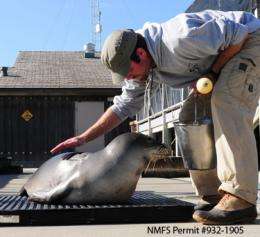
(PhysOrg.com) -- A young Hawaiian monk seal that was removed from the wild last year for treatment and rehabilitation is providing researchers at the University of California, Santa Cruz, with a rare opportunity to study the physiology of this critically endangered species.
Ultimately, the information from these studies can be used to help monk seals in the wild, according to Terrie Williams, a professor of ecology and evolutionary biology at UC Santa Cruz, who is overseeing the research in coordination with the NOAA Fisheries Service's Marine Mammal Health and Stranding Response Program, the Marine Mammal Center in Sausalito, and other researchers.
"No one has ever had the opportunity to conduct these kinds of basic physiological studies with a tropical seal," she said. "The monk seal population is in trouble, and we hope that these studies will help us to better understand their habitat requirements."
The seal--named Hō'ailona and also known by its field identification number, KP2--is currently being evaluated at UCSC's Long Marine Laboratory and may need eye surgery to treat cataracts in both eyes. Hō'ailona was abandoned by his mother a few days after his birth in May 2008. Rescued from a beach on the island of Kauai, he was cared for by scientists from the NOAA Fisheries Service and released back to the wild on the island of Molokai in December 2008.
But Hō'ailona did not adapt well to life in the wild. Habituated to humans, he began hanging out at a popular wharf and interacting with people in the water and on the beach. Hō'ailona soon became a celebrity on Molokai, playing with and being fed by people instead of learning how to live as a wild monk seal. As he grew larger, his interactions with people began to pose a risk to his own welfare as well as to public safety.
To address these concerns, NOAA officials removed Hō'ailona from the wild in November 2009 with the intention of relocating him to a remote area in the Hawaiian Islands where there are numerous seals for him to interact with and very few people. During a veterinary evaluation in preparation for his relocation, however, it was discovered that Hō'ailona had a degenerative eye condition that would seriously hamper his ability to care for himself in the wild. Therefore, NOAA officials decided that it was best for Hō'ailona to be kept under expert care and not released back into the wild.
A team of marine mammal scientists and veterinarians from UCSC and elsewhere are currently evaluating Hō'ailona to assess his overall health and determine the appropriate treatment for his eyes. UCSC's Long Marine Laboratory is one of the leading marine mammal research centers in the world and has the facilities to do surgery on a marine mammal if that proves necessary. Such facilities are not available in Hawaii.
"We've created a little Hawaiian environment here by heating the water and putting a cover over the pool for protection from the wind and the elements," Williams said. "Hō'ailona is doing very well. He was a little thin when he arrived, but he's been rapidly putting on weight and is learning how to participate in our studies."
Williams is particularly interested in conducting basic metabolic studies that will help researchers understand how much energy a monk seal has to expend to find food and thrive in different environments. In the controlled environment at Long Marine Lab, researchers can measure Hō'ailona's oxygen consumption and calculate how much energy he expends per swimming stroke. They can also study his responses to different water temperatures.
This information, when combined with data from electronic tags that record the dives of wild monk seals, will enable researchers to evaluate the suitability of different habitats for wild seals. By counting the number of strokes an animal takes to hunt or dive, researchers can assign an energy "cost" to each of those activities.
"It's a powerful noninvasive tool that we have used to study Antarctic seals. Now we can use it to determine what it costs to be a monk seal living under tropical conditions," Williams said. "The goal is to use this information to guide sound management decisions for the conservation of monk seals based on the best available science."
By studying Hō'ailona's responses to different water temperatures, Williams hopes to learn how sensitive monk seals are to changes in ocean temperature. This is important for understanding how vulnerable the species may be to climate change, she said.
The current population of Hawaiian monk seals is only about 1,100, and their numbers have been declining at a rate of about 4 percent per year. Most of the population is in the Northwestern Hawaiian Islands, while a smaller subpopulation is found in the main Hawaiian Islands.
The long-term plan for Hō'ailona is to return him to Hawaii to be kept at a facility where he can be seen by the public. Currently, Hō'ailona is not on public display at Long Marine Lab, where he is under quarantine to minimize the risk of disease or infection. Plans to return him to Hawaii would be jeopardized if he contracted an illness on the mainland.
In the meantime, this rare Hawaiian monk seal is serving as an important scientific ambassador for his species, Williams said.
"We are thankful for our partnership with UCSC to learn from Hō'ailona and will apply that knowledge to the conservation of monk seals worldwide in Hawaii and in the Mediterranean,” said Dr. Teri Rowles, DVM, the Coordinator of NOAA's Marine Mammal Health and Stranding Response Program, which currently authorizes the research and care of Hō'ailona. "We greatly appreciate the public's concern and support for Hō'ailona in particular and for monk seals in general, and Hō'ailona will teach us a great deal about monk seal biology and health."
Provided by University of California - Santa Cruz


