Life Without Water?

March 18, 2010 by Henry Bortman
Life Without Water?

Enlarge

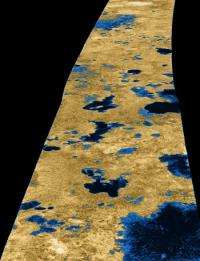
The irregular black shapes in this Cassini radar image of Titan’s northern polar region are believed to be liquid methane-ethane lakes. Credit: NASA/JPL/USGS

On Saturn’s giant moon Titan, it is so cold that water is frozen as hard as granite. And yet there is a complete liquid cycle of methane and ethane. Scientists wonder whether there could also be life.

New discoveries have a way of messing with old definitions. Take, for example, the concept of a habitable world.

The standard definition of a “habitable world” is a world with at its surface; the “” around a star is defined as that Goldilocks region - not too hot, not too cold - where a watery planet or moon can exist.

And then there’s Titan. Saturn’s giant lies about as far from the standard definition of habitable as one can get. The temperature at its surface hovers around 94 degrees Kelvin (minus 179 C, or minus 290 F). At that temperature, water is a rock as hard as granite.

And yet many scientists now believe life may have found a way to take hold on Titan. Water may all be frozen solid, but methane and are liquids. In the past few years, instruments on NASA’s and images captured by ESA’s Huygens probe have revealed an astonishing world with a complete liquid cycle, much like the hydrologic cycle on Earth, but based on methane and ethane rather than on water.

“What Cassini actually found on Titan, from 2004 onwards, was a methane-ethane cycle that very much echoes the kind of hydrologic cycle we see on the Earth,” says Jonathan Lunine, currently at the University of Rome Tor Vergata while on leave from the University of Arizona. Cassini has revealed rivers and lakes of methane-ethane, the lakes evaporating to form clouds, the clouds raining hydrocarbons back down onto the surface, flowing through rivers and collecting in lakes. It is the only world in our solar system other than Earth where a liquid cycle like this takes place. There’s just no water.

But there are plenty of hydrocarbons. Methane and ethane are the simplest molecules. By themselves, they are of limited biological interest. But hydrocarbons are versatile: they can assemble themselves into fantastically complex structures. Indeed, complex hydrocarbons form the basis of what we call life. So one has to wonder: has hydrocarbon chemistry on Titan crossed the threshold from inanimate matter to some form of life?

One thing is for certain: if there is life on Titan, it is not life as we know it. There is no way that terrestrial life could have originated or could survive on Titan. “DNA and RNA,” says Lunine, “form out of compounds that require oxygen and phosphorus, and there’s very little oxygen in the Titan system.” And the very structure of DNA depends on liquid water. “DNA forms a helix because of its water-loving and water-repellant ends.” So life on Titan “would have to find other molecules that carry information.” Moreover, because Titan is so cold, the amount of energy available for building complex biochemical structures is limited. But as Lunine points out, that’s not necessarily a showstopper. “We don’t have a lot of experience with the chemistry that might go on at these temperatures.” We don’t know what’s possible.
Life Without Water?
Enlarge

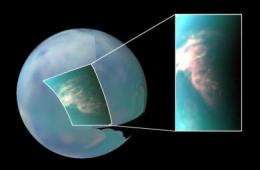
Clouds are clearly visible in this Cassini infrared image of Titan’s southern polar region. Credit: University of Arizona/LPL

The chance to discover a form of life with a different chemical basis than life on Earth has led some researchers to consider Titan the most important world on which to search for extraterrestrial life. In a recent paper in the journal Astrobiology, Robert Shapiro, a professor of chemistry at New York University, and Dirk Shulze-Makuch of Washington State University rated Titan a higher-priority target for investigation than even Mars.

On Mars, and on Jupiter’s moon Europa and Saturn’s moon Enceladus as well, astrobiological efforts center on the hunt for water-based life. But such life, even if it is found, could have shared a single origin with life on Earth, getting started on one world and being transferred by meteorites to others. Not so for Titan. If there is life on Titan, it arose separately from life on Earth.

Not everyone agrees that Titan is the priority, though. NASA and ESA recently gave the nod to a Jupiter-system mission that will explore Europa as the next flagship mission to the outer solar system. It may be decades before another major mission flies to Saturn and Titan.

But a smaller-scale and less-expensive lander known as the Titan Mare Explorer (TiME) could launch as early as 2015, arriving in 2022 or 2023. Ellen Stofan of Proxemy Research in Rectortown, Va., the principal investigator for the TiME mission, described the lander as a buoy-shaped capsule that would splash down in one of Titan’s northern lakes and float across its surface for a minimum of two Titan days (sixteen Earth days).

“We have a number of instruments on board. The most important from a pure scientific point of view is a mass spectrometer,” Stofan said. “We’ll take basically a sip of [the lake] liquids, several times, and analyze them to really nail down their chemical compositions. We know there’s , we know there’s ethane,” but TiME would inventory more complex organic (hydrocarbon) compounds, as well.
Life Without Water?
Enlarge

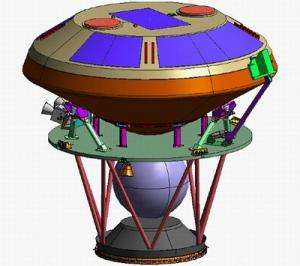
An engineering drawing of the proposed Titan Mare Explorer (TiME), sitting atop its carrier spacecraft. TiME would land in one of Titan’s northern lakes and drift across its surface, taking photographs and analyzing the lake’s chemistry. Credit: Lockheed Martin

If there is life on Titan, it may be difficult to detect. “I don’t expect you to go to these lakes and see beautiful filamentary structures made of cells that are macroscopic in size or easily seen,” says Lunine, who is a co-investigator on the proposed TiME mission. The clues could be subtle. “We would have to look for particular peculiarities in composition, hydrocarbons that are lacking that should be there, others that are more abundant” than expected.

No-one knows “what happens to organic chemistry in [Titan’s] environment,” Lunine adds. “Does it go to a kind of a chemistry that we can call life but works in liquid hydrocarbons? We don’t know the answer to that. But the answer is profound.” Because if the answer is yes, it means that the origin of life has taken place more than once. “If the answer is yes, then it says that life … must be a common outcome of planetary processes in the cosmos.”

If the answer is yes, it means we are not alone.

Source: Astrobio.net

4.8 /5 (21 votes)  

Filter


Move the slider to adjust rank threshold, so that you can hide some of the comments.


Display comments: newest first

gwrede
Mar 18, 2010

Rank: 2.4 / 5 (5)
It's a shame that people don't really understand time.

With the hydrocarbons on Titan, it's "only a matter of time" before life evolves. Now, that /time/ may be about the same as what it took on Eart, or it may be three orders of magnitude more (in which case there'd only be very primitive single-cell organisms), allowing for the colder climate.

One fact is for sure, given enough time, life would develop on Titan.
danman5000
Mar 18, 2010

Rank: 5 / 5 (2)
I always thought the "as we know it" part of "life as we know it" should be more stressed. We only know of one type of life, so can say what else is out there. It's certainly possible that life could arise from other chemical processes than our own. No matter where we find it though, if we do find life somewhere in the solar system then the implications are profound indeed. If more than one planet in our own neighborhood has life, then there has to be more out there in the millions of other star systems in the galaxy. And I'd bet that a few of them are intelligent.
PinkElephant
Mar 18, 2010

Rank: 5 / 5 (3)
“We have a number of instruments on board. The most important from a pure scientific point of view is a mass spectrometer,” Stofan said.
Er.. Why not a simple optical microscope? If you're going to "sip" lake fluid, why not put some of it between a few pairs of glass slides, and see if there's any funny shapes or movements in the fluid?

On Earth, bacteria and protozoa are so wide-spread, a droplet from any random puddle will yield at least a few critters under a microscope.

If there's expectation of microscopic life on Titan, I'd think a microscope would be the most important instrument to carry!
paulthebassguy
Mar 18, 2010

Rank: 3.5 / 5 (2)
It would be so cool if there is "life" discovered on Titan. It's certainly possible.

I don't think we should assume that it is a mathematical certainty though given enough time. We don't know at this stage - the chemicals and energy that exist there might just simply not be enough for anything as complex as life to ever emerge.
Graeme
Mar 18, 2010

Rank: 5 / 5 (1)
As well as the microscope it should have a net and sonar (possibly radar) to explore the depths of the lake. It would be a pity to miss any fish!
NickFun
Mar 18, 2010

Rank: 3 / 5 (2)
It would not surprise me at all if there was life on Titan. Or Enceladus or other moons as well. Perhaps the creatures from other worlds have written us off as being lifeless because methane does not exist as a liquid on our world thus making our planet inhospitable to life.
scidog
Mar 18, 2010

Rank: 5 / 5 (3)
how about a Titan in a bottle experiment?same as the one done years ago with the early Earth gas's and the electric sparks.
PinkElephant
Mar 19, 2010

Rank: not rated yet
how about a Titan in a bottle experiment?same as the one done years ago with the early Earth gas's and the electric sparks.
But what would you look for? In Miller-Urey, they were specifically looking for amino acid formation, because life on Earth is built from amino acids. If we don't know what life on Titan (if any) might or might not be built from, then we have no null hypothesis to reject...
verkle
Mar 19, 2010

Rank: 1 / 5 (6)
Although I am a scientist, don't count me as one of these "scientists". Life and evolution are so complex that it is impossible they could start on their own. Mathematically impossible. No need to even consider if life could be on Titan.
rogervetruba
Mar 19, 2010

Rank: not rated yet
Humans will only consider science that supports and fits within their value system. Assuming we eventually find "life" elsewhere than earth, it will surely be discounted (condemned?) by those who feel that info challenges their beliefs.

So perhaps a question worth answering is what criteria is required for a formal label of "life".

Then, over time, my own sociological hypothesis is that religion will evolve such that the science doesn't challenge its validity, just as the Catholic church forgave Gallileo.... 500 years later.
panorama
Mar 19, 2010

Rank: not rated yet
@rogervetruba

So true, so true.
Quarl
Mar 19, 2010

Rank: 5 / 5 (1)
I wonder why so many who believe in a design consider this rock to be the only one...
Rank 4.8 /5 (21 votes)
Related Stories
Relevant PhysicsForums posts
  • Titan's lack of impact craters
    createdFeb 09, 2012
  • Real pictures of black hole eating a star?
    createdFeb 08, 2012
  • Hypothetical way to travel faster than light, but not technically exceed lightspeed
    createdFeb 06, 2012
  • How do scientists monitor the Sun's activity?
    createdFeb 05, 2012
  • Search patterns in observational studies
    createdFeb 05, 2012
  • Derivation of Pogson's law
    createdFeb 03, 2012
  • More from Physics Forums - General Astronomy

More news stories

Humans may have helped the decline of African rainforests 3000 years ago

(PhysOrg.com) -- Large areas of rainforests in Central Africa mysteriously disappeared over three thousand years ago, to be replaced by savannas. The prevailing theory has been that the cause was a change ...

Space & Earth / Environment

created 11 hours ago | popularity 5 / 5 (4) | comments 10 | with audio podcast report

Could Venus be shifting gear?

(PhysOrg.com) -- ESA’s Venus Express spacecraft has discovered that our cloud-covered neighbour spins a little slower than previously measured. Peering through the dense atmosphere in the infrared, the ...

Space & Earth / Space Exploration

created 7 hours ago | popularity 5 / 5 (5) | comments 7 | with audio podcast

Mars Science Laboratory computer issue resolved

(PhysOrg.com) -- Engineers have found the root cause of a computer reset that occurred two months ago on NASA's Mars Science Laboratory and have determined how to correct it.

Space & Earth / Space Exploration

created 8 hours ago | popularity 5 / 5 (5) | comments 3 | with audio podcast

Clam fields found at deep, low-temperature Mariana vents

(PhysOrg.com) -- Scientists have marveled at the unusual life forms thriving at high temperature hydrothermal vents of the deep ocean.

Space & Earth / Earth Sciences

created 7 hours ago | popularity not rated yet | comments 0 | with audio podcast

Two new moons for Jupiter

Advances in technology have lead to the discovery of new planets outside of our Solar System, and now even new moons in our own backyard.

Space & Earth / Space Exploration

created 7 hours ago | popularity not rated yet | comments 5


Complex wiring of the nervous system may rely on a just a handful of genes and proteins

Researchers at the Salk Institute have discovered a startling feature of early brain development that helps to explain how complex neuron wiring patterns are programmed using just a handful of critical genes. ...

CIA website offline, Anonymous takes credit

The website of the Central Intelligence Agency was unresponsive on Friday after the hacker group Anonymous claimed to have knocked it offline.

Q&A: Obama and the birth control controversy

(AP) -- What birth control debate? A half-century after the introduction of the pill, acceptance of birth control by American women is virtually universal.

The power of estrogen -- male snakes attract other males

A new study has shown that boosting the estrogen levels of male garter snakes causes them to secrete the same pheromones that females use to attract suitors, and turned the males into just about the sexiest ...

New error-correcting codes guarantee the fastest possible rate of data transmission

Error-correcting codes are one of the triumphs of the digital age. They’re a way of encoding information so that it can be transmitted across a communication channel — such as an optical fiber o ...

Both maternal and paternal age linked to autism

Older maternal and paternal age are jointly associated with having a child with autism, according to a recently published study led by researchers at The University of Texas Health Science Center at Houston (UTHealth).