The Multiplying Mystery of Moonwater
March 18, 2010 by Dauna Coulter
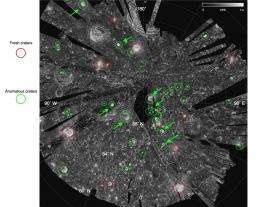
A Mini-SAR radar map of the lunar north pole. Craters circled in green are believed to contain significant deposits of frozen water.
Moonwater. Look it up. You won't find it. It's not in the dictionary.
That's because we thought, until recently, that the Moon was just about the driest place in the solar system. Then reports of moonwater started "pouring" in - starting with estimates of scant amounts on the lunar surface, then gallons in a single crater, and now 600 million metric tons distributed among 40 craters near the lunar north pole.
"We thought we understood the Moon, but we don't," says Paul Spudis of the Lunar and Planetary Institute. "It's clear now that water exists up there in a variety of concentrations and geologic settings. And who'd have thought that today we'd be pondering the Moon's hydrosphere?"
Spudis is principal investigator of NASA's Mini-SAR team - the group with the latest and greatest moonwater "strike." Their instrument, a radar probe on India's Chandrayaan-1, found 40 craters each containing water ice at least 2 meters deep.
"If you converted those craters' water into rocket fuel, you'd have enough fuel to launch the equivalent of one space shuttle per day for more than 2000 years. But our observations are just a part of an even more tantalizing story about what's going on up on the Moon."
It's the story of a lunar water cycle, and it's based on the seemingly disparate - but perhaps connectable - results from Mini-SAR and NASA's recent LCROSS mission and Moon Mineralogy Mapper (M3 or "M-cubed") instrument also on Chandrayaan-1.
"So far we've found three types of moonwater," says Spudis. "We have Mini-SAR's thick lenses of nearly pure crater ice, LCROSS's fluffy mix of ice crystals and dirt, and M-cube's thin layer that comes and goes all across the surface of the Moon."
On October 9, 2009, LCROSS, short for Lunar Crater Observation and Sensing Satellite, struck water in a cold, permanently dark crater at the lunar south pole. Since then, the science team has been thoroughly mining their data.
"It looks as though at least two different layers of our crater soil contain water, and they represent two different time epochs," explains Anthony Colaprete, LCROSS principal investigator. "The first layer, ejected in the first 2 seconds from the crater after impact, contains water and hydroxyl bound up in the minerals, and even tiny pieces of pure ice mixed in. This layer is a thin film and may be relatively 'fresh,' perhaps recently replenished."
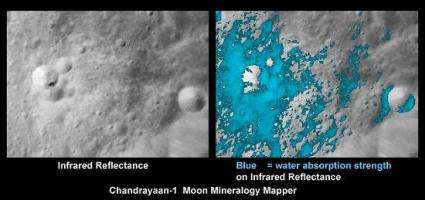
Shown in false-color blue, a thin layer of water-rich minerals cover an expanse of terrain around a young lunar crater. Credit: Chandrayaan-1/Moon Mineralogy Mapper.
According to Colaprete, this brand of moonwater resembles the moonwater M3 discovered last year in scant but widespread amounts, bound to the rocks and dust in the very top millimeters of lunar soil.The second layer is different. "It contains even more water ice plus a treasure chest of other compounds we weren't even looking for," he says. "So far the tally includes sulfur dioxide (SO2), methanol (CH3OH), and the curious organic molecule diacetylene (H2C4). This layer seems to extend below at least 0.5 meters and is probably older than the ice we’re finding on the surface.”
They don't know why some craters contain loads of pure ice while others are dominated by an ice-soil mixture. It's probably a sign that the moonwater comes from more than one source.
"Some of the water may be made right there on the Moon," says Spudis. "Protons in the solar wind can make small amounts of water continuously on the lunar surface by interacting with metal oxides in the rocks. But some of the water is probably deposited on the Moon from other places in the solar system."
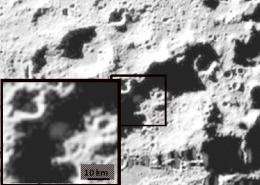
A plume of water-rich vapors billows up from crater Cabeus on Oct. 9, 2009, after LCROSS's Centaur booster hit the crater floor.
The Moon is constantly bombarded by impactors that add to the lunar water budget. Asteroids contain hydrated minerals, and comet cores are nearly pure ice.The researchers also think that much of the crater water migrates to the poles from the Moon's warmer, lower latitudes. "All our findings are telling us there's an active water cycle on the Moon," marvels Colaprete.
Think about it. The "driest place in the solar system" has a water cycle.
"It's a different world up there," says Spudis, "and we've barely scratched the surface. Who knows what discoveries lie ahead?"
Moonwater. Add it to the dictionary.
Source: Science@NASA, by Dauna Coulter
-
NASA gets ready for moon water search
Jan 15, 2008 |
not rated yet |
0
-
Moon's polar craters could be the place to find lunar ice, scientists report
Dec 18, 2008 |
not rated yet |
0
-
Radar Finds Ice Deposits at Moon's North Pole
Mar 02, 2010 |
not rated yet |
0
-
Microwaving Water from Moondust (w/ Video)
Oct 08, 2009 |
not rated yet |
0
-
SMART-1: Travel maps of the lunar north pole
Dec 05, 2007 |
not rated yet |
0
-
Engineers build first sub-10-nm carbon nanotube transistor
Feb 01, 2012 |
4.9 / 5 (30) |
30
-
Something old, something new: Evolution and the structural divergence of duplicate genes
Jan 31, 2012 |
4.6 / 5 (7) |
1
-
The hidden nanoworld of ice crystals: Revealing the dynamic behavior of quasi-liquid layers
Jan 30, 2012 |
5 / 5 (3) |
1
-
Stock market network reveals investor clustering
Jan 27, 2012 |
3.9 / 5 (23) |
8
-
Of microchemistry and molecules: Electronic microfluidic device synthesizes biocompatible probes
Jan 26, 2012 |
5 / 5 (1) |
0
-
Titan's lack of impact craters
Feb 09, 2012
-
Real pictures of black hole eating a star?
Feb 08, 2012
-
Hypothetical way to travel faster than light, but not technically exceed lightspeed
Feb 06, 2012
-
How do scientists monitor the Sun's activity?
Feb 05, 2012
-
Search patterns in observational studies
Feb 05, 2012
-
Derivation of Pogson's law
Feb 03, 2012
- More from Physics Forums - General Astronomy
More news stories
Could Venus be shifting gear?
(PhysOrg.com) -- ESAs Venus Express spacecraft has discovered that our cloud-covered neighbour spins a little slower than previously measured. Peering through the dense atmosphere in the infrared, the ...
Space & Earth / Space Exploration
3 hours ago |
5 / 5 (4) |
4
|
Humans may have helped the decline of African rainforests 3000 years ago
(PhysOrg.com) -- Large areas of rainforests in Central Africa mysteriously disappeared over three thousand years ago, to be replaced by savannas. The prevailing theory has been that the cause was a change ...
Clam fields found at deep, low-temperature Mariana vents
(PhysOrg.com) -- Scientists have marveled at the unusual life forms thriving at high temperature hydrothermal vents of the deep ocean.
Space & Earth / Earth Sciences
4 hours ago |
not rated yet |
0
|
Mars Science Laboratory computer issue resolved
(PhysOrg.com) -- Engineers have found the root cause of a computer reset that occurred two months ago on NASA's Mars Science Laboratory and have determined how to correct it.
Space & Earth / Space Exploration
4 hours ago |
5 / 5 (5) |
2
|
Two new moons for Jupiter
Advances in technology have lead to the discovery of new planets outside of our Solar System, and now even new moons in our own backyard.
Space & Earth / Space Exploration
3 hours ago |
not rated yet |
2
New understanding of DNA repair could eventually lead to cancer therapy
A research group in the Faculty of Medicine & Dentistry at the University of Alberta is hoping its latest discovery could one day be used to develop new therapies that target certain types of cancers.
Hovering not hard if you're top-heavy, researchers find
Top-heavy structures are more likely to maintain their balance while hovering in the air than are those that bear a lower center of gravity, researchers at New York University's Courant Institute of Mathematical Sciences ...
Grass to gas: Researchers' genome map speeds biofuel development
Researchers at the University of Georgia have taken a major step in the ongoing effort to find sources of cleaner, renewable energy by mapping the genomes of two originator cells of Miscanthus x giganteus, a large perenn ...
Night, weekend delivery OK for babies with birth defects
Weekday delivery is no better than night or weekend delivery for infants with birth defects, according to a new study presented today at The Pregnancy Meeting, the Society for Maternal-Fetal Medicine's annual conference. ...
Sonic Cradle lands spot in TED exhibition
A Simon Fraser University graduate student project that melds music, meditation and modern technology has landed a rare spot as an exhibit at TEDActive 2012 in Palm Springs, California this month.
Drug halts organ damage in inflammatory genetic disorder
A new study shows that Kineret (anakinra), a medication approved for the treatment of rheumatoid arthritis, is effective in stopping the progression of organ damage in people with neonatal-onset multisystem inflammatory disease ...


Mar 18, 2010
Rank: 4.8 / 5 (4)
Mar 18, 2010
Rank: 2.8 / 5 (6)
Have I heard it before, or what?
Whaddaya know, every /single/ generation keeps repeating that phrase. When I went to school it was KNOWN that Jupiter had 12 moons. That was The Truth, and God's Wrath upon the one heretic (me) who had the audacity to claim it is only a passing figure.
Mar 18, 2010
Rank: 5 / 5 (2)
Mar 18, 2010
Rank: not rated yet
Mar 18, 2010
Rank: not rated yet
...
Or perhaps not. I've noticed a lot of articles here have puns in them. I've managed to refrain from scraping my eyes out so far but I'm not sure how much longer I can handle it.
Mar 19, 2010
Rank: 1 / 5 (9)
Mar 19, 2010
Rank: 4.2 / 5 (6)
I can respect your beliefs however I would ask that your conclusions based on those beliefs have no place on a site based on the scientific method. Your beliefs can not be tested so they have no place in this discussion.
I will not come to your place of worship and challenge your beliefs by having the audacity to present evidence or facts so please don't come here with your untestable theory of everything.
Mar 19, 2010
Rank: not rated yet
Mar 19, 2010
Rank: not rated yet
Mar 19, 2010
Rank: 5 / 5 (2)
Mar 19, 2010
Rank: not rated yet
Mar 19, 2010
Rank: 1 / 5 (1)
Still, this is a lot more water than anyone has previously mentioned. This is enough water that with hybrid solar, nuclear, and chemical technologies they could sustain a colony's water, oxygen, and energy needs far easier than we have previously imagined, at least, given a suitable landing site.
Amazing really. Just a few years ago, and really even a few months ago, nobody was really suggesting that there might be frozen lakes or glaciers? on the moon.
What were those Apollo astronauts doing anyway? How could NASA be this incompetent that nobody bothered to check a few craters for frozen water?
Man, I know I won't be able to see it, but this makes me want to pull out my telescope and check out the moon some more. Water, who knew?
Mar 19, 2010
Rank: not rated yet
Mar 19, 2010
Rank: not rated yet
Has "Moonwater" been trademarked yet?
Rgds
James
Mar 19, 2010
Rank: not rated yet
@probes: Did you lose a drinking bet which forces you to mention VASMIR in every single post you make? Don't get me wrong, I think it's a very promising technology but if you want to get to Mars in 3.9 seconds you don't need VASMIR, you need warp drive.
Mar 19, 2010
Rank: not rated yet
Mar 19, 2010
Rank: not rated yet
Earthwater. I like to swim in Earthwater.
Mar 20, 2010
Rank: not rated yet
Mar 22, 2010
Rank: not rated yet
Mar 22, 2010
Rank: not rated yet
Mar 22, 2010
Rank: not rated yet
Well, if we were to go by who was first to visit the moon then Russia would win the prize wouldn't they...hands down.
Mar 23, 2010
Rank: not rated yet
Any "war" *on* the Moon will probably be fought with robots and "avatar" units, and will be directed from Earth.
Mar 24, 2010
Rank: not rated yet
I understand (and this article did not mention that) all the water is found on the dark side of the moon where solar radiation does not reach and therefore, cannot evaporate it.
Landing sites for these missions are predetirmined well before the rocket launch by NASA. A lot of considerations go into this decision. The most important one being survivability.