Researchers to test renewable-energy system at local treatment plant
March 18, 2010
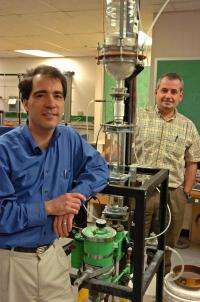
Principle Investigator Chuck Coronella, left, and co-PI Victor Vasquez have developed a patent-pending fluid-bed system to dry wasterwater sludge, which is entering a demonstration-scale phase at a local Reno and Sparks, Nevada water reclamation facility. The low-cost, carbon-neutral system is designed to be onsite, ultimately reducing the trucking and landfill disposal fees as well as provide electrical power for a facility through a gasification and generation process. Credit: Photo by Mike Wolterbeek, University of Nevada, Reno
A successful University of Nevada, Reno renewable energy research project is moving from the lab to the real world in a demonstration-scale system to turn wastewater sludge into electricity.
The new patent-pending, low-cost, energy-efficient technology is scheduled to be set up in the Truckee Meadows Water Reclamation Facility next month following the recent signing of an interlocal agreement with the cities of Reno and Sparks.
"Our plan is to test the unit by about May 15," Chuck Coronella, principle investigator for the research project and an associate professor of chemical engineering, said. "We're designing, building and assembling a continuous-feed system that will ultimately be used to generate electricity. We'll run experiments throughout the summer, creating a usable dried product from the sludge."
The experimental carbon-neutral system will process 20 pounds of sludge per hour, drying it at modest temperatures into solid fuel that will be analyzed for its suitability to be used for fuel through gasification and, in a commercial operation, ultimately converted to electricity. The refrigerator-size demonstration unit will help researchers determine the optimum conditions for a commercial-sized operation.
"The beauty of this process is that it's designed to be all on site, saving trucking costs and disposal fees for the sludge," Victor Vasquez, a University faculty member in chemical engineering said. "It uses waste heat from the process to drive the electrical generation. It also keeps the sludge out of the landfill."
Estimates, which will be further refined through the research, show that a full-scale system could potentially generate 600 kilowatts of electricity a day to help power the relamation facility plant.
The demonstration-scale project is a collaboration with the cities of Reno and Sparks, operators of the wastewater plant. The city councils signed an interlocal agreement recently to allow the research to integrate into their operation, providing space for the experiments, the dewatered sludge and other resources to help make the project a success.
"Economically, this makes sense," Coronella said. "Treatment plants have to get rid of the sludge, and what better way than to process it onsite and use the renewable energy to lower operating costs." Coronella added, "This demonstration gives the University an opportunity to involve students in development of waste-to-energy technology, which ultimately will benefit the community. It's a win-win for everyone involved."
Installation of the system will begin in April, and the system will be tested mid-May. The project will last until fall 2010.
The University's Technology Transfer Office, with assistance from the College of Business, is supporting the project with plans to make the system available to hundreds of communities around the country that operate water treatment plants.
For example, there are approximately 700,000 metric tons of dried sludge produced annually in California municipalities, which would generate as much as a sustainable 400 megawatts of power.
Provided by University of Nevada, Reno
-
Energy efficient sewage plants
Aug 13, 2009 |
not rated yet |
0
-
'If a Package Stinks, It Belongs to Me'
Dec 08, 2006 |
not rated yet |
0
-
Waste could generate up to 7 percent of electricity in Spain
Feb 23, 2010 |
not rated yet |
0
-
NREL, Xcel energy sign wind to hydrogen research agreement
May 08, 2006 |
not rated yet |
0
-
Researcher thinks 'inside the box' to create self-contained wastewater system for soldiers, small towns
Sep 16, 2009 |
not rated yet |
0
-
Engineers build first sub-10-nm carbon nanotube transistor
Feb 01, 2012 |
4.9 / 5 (31) |
30
-
Something old, something new: Evolution and the structural divergence of duplicate genes
Jan 31, 2012 |
4.6 / 5 (7) |
1
-
The hidden nanoworld of ice crystals: Revealing the dynamic behavior of quasi-liquid layers
Jan 30, 2012 |
5 / 5 (3) |
1
-
Stock market network reveals investor clustering
Jan 27, 2012 |
3.9 / 5 (23) |
8
-
Of microchemistry and molecules: Electronic microfluidic device synthesizes biocompatible probes
Jan 26, 2012 |
5 / 5 (1) |
0
-
Calling function with no input argument
10 hours ago
-
Force free body diagram problem on gym equipment
11 hours ago
-
Empirical data regarding shower heads and water
19 hours ago
-
feed hold button on CNC lathe
Feb 09, 2012
-
RFAC in Fortran
Feb 09, 2012
-
dynamics 2/32
Feb 08, 2012
- More from Physics Forums - General Engineering
More news stories
Google users warned of threat to smartphone wallets
Users of Google smartphone wallets were being warned on Friday that there is a way to crack pass codes intended to thwart thieves from going on illicit shopping sprees.
4 hours ago |
5 / 5 (2) |
0
Anonymous knocks CIA website offline (Update)
The website of the Central Intelligence Agency was inaccessible on Friday after the hacker group Anonymous claimed to have knocked it offline.
5 hours ago |
5 / 5 (7) |
11
New error-correcting codes guarantee the fastest possible rate of data transmission
Error-correcting codes are one of the triumphs of the digital age. Theyre a way of encoding information so that it can be transmitted across a communication channel such as an optical fiber o ...
Technology / Computer Sciences
14 hours ago |
4.8 / 5 (6) |
6
|
New power source discovered
(PhysOrg.com) -- Researchers at the Massachusetts Institute of Technology (MIT) and RMIT University have made a breakthrough in energy storage and power generation.
Technology / Energy & Green Tech
13 hours ago |
4.8 / 5 (21) |
7
|
Small modular reactor design could be a 'SUPERSTAR'
(PhysOrg.com) -- Though most of today's nuclear reactors are cooled by water, we've long known that there are alternatives; in fact, the world's first nuclear-powered electricity in 1951 came from a reactor ...
Technology / Energy & Green Tech
13 hours ago |
4.3 / 5 (11) |
20
|
Complex wiring of the nervous system may rely on a just a handful of genes and proteins
Researchers at the Salk Institute have discovered a startling feature of early brain development that helps to explain how complex neuron wiring patterns are programmed using just a handful of critical genes. ...
The power of estrogen -- male snakes attract other males
A new study has shown that boosting the estrogen levels of male garter snakes causes them to secrete the same pheromones that females use to attract suitors, and turned the males into just about the sexiest ...
Putting the squeeze on planets outside our solar system
(PhysOrg.com) -- Using high-powered lasers, scientists at Lawrence Livermore National Laboratory and collaborators discovered that molten magnesium silicate undergoes a phase change in the liquid state, abruptly ...
Humans may have helped the decline of African rainforests 3000 years ago
(PhysOrg.com) -- Large areas of rainforests in Central Africa mysteriously disappeared over three thousand years ago, to be replaced by savannas. The prevailing theory has been that the cause was a change ...
NASA sees wide-eyed cyclone Jasmine
Cyclone Jasmine's eye has opened wider on NASA satellite imagery, as it moves through the Southern Pacific Ocean.
Grass to gas: Researchers' genome map speeds biofuel development
Researchers at the University of Georgia have taken a major step in the ongoing effort to find sources of cleaner, renewable energy by mapping the genomes of two originator cells of Miscanthus x giganteus, a large perenn ...