A molecular brake for the bacterial flagellar nano-motor
March 19, 2010 by Alexandra Weber
A molecular brake for the bacterial flagellar nano-motor

Enlarge

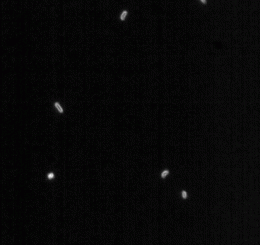
Dark-field microscopic movie of swimming E.Coli bacteria. (Click 'Enlarge').

Researchers at the University of Basel, Switzerland, have discovered that Escherichia coli bacteria harness a sophisticated chemosensory and signal transduction machinery that allows them to accurately control motor rotation, thereby adjusting their swimming velocity in response to changing environments. The research results that were published online in Cell on March 18, 2010, may foster the development of novel strategies to fight persistent infections.

Bacteria can swim through liquids at speeds up to 30 times their body length per second. It has been known for a long time that different swim at different speeds, but it was not known if this is a species specific trait and if can actively adjust their velocity.

The research team from Switzerland and Germany, led by Alex Böhm and Urs Jenal from the Biozentrum has now discovered that E. coli, and probably many other bacteria can actively regulate their swimming velocity.

This behaviour is governed by a molecular motor-brake protein that upon binding of the bacterial second messenger cyclic dimeric GMP interacts with a specific subunit of the flagellar nano-motor and thereby curbs motor output. The intracellular concentration of cyclic dimeric GMP is controlled by a network of signaling proteins.

When bacteria are faced with nutrient depletion this network is actived, produces more cyclic dimeric GMP and triggers motor-brake engagement. Because slow swimming enhances the probability of a bacterial cell to permanently attach to surfaces, this behaviour might prime bacteria to switch into a sessile life style.

Colonization of epithelial surfaces in the human host can lead to the formation of antibiotic tolerant and immune system resistent ‘biofilms’ that are the basis of many chronic bacterial infections. Thus, understanding the molecular basis of surface colonization and formation may foster the development of novel strategies to fight persistent infections. In addition, the discovery of flagellar motor curbing could be exploited for biotechnological applications, for example to engineer nanopumps in microfluidics or to build cell-based microrobots.

More information: Alex Boehm, et al., Second Messenger-Mediated Adjustment of Bacterial Swimming Velocity. Cell (2010); doi:10.1016/j.cell.2010.01.018

Provided by University of Basel


Rank 3 /5 (1 vote)
Relevant PhysicsForums posts
  • Mitosis
    created5 hours ago
  • Stem cell question.
    created6 hours ago
  • Protease cleavage
    created12 hours ago
  • Pertubance in a model
    created19 hours ago
  • Cancer drugs and Alzheimer's, Oh my!
    createdFeb 09, 2012
  • Squishing cells
    createdFeb 09, 2012
  • More from Physics Forums - Biology

More news stories

The power of estrogen -- male snakes attract other males

A new study has shown that boosting the estrogen levels of male garter snakes causes them to secrete the same pheromones that females use to attract suitors, and turned the males into just about the sexiest ...

Biology / Plants & Animals

created 17 hours ago | popularity 4.8 / 5 (6) | comments 2 | with audio podcast

Grass to gas: Researchers' genome map speeds biofuel development

Researchers at the University of Georgia have taken a major step in the ongoing effort to find sources of cleaner, renewable energy by mapping the genomes of two originator cells of Miscanthus x giganteus, a large perenn ...

Biology / Biotechnology

created 14 hours ago | popularity 3.8 / 5 (5) | comments 0 | with audio podcast

Miami battling invasion of giant African snails

No one knows how they got there. But an invasion of African giant snails has southern Florida in a panic over potential crop damage, disease and general yuckiness surrounding the slimy gastropods.

Biology / Ecology

created 21 hours ago | popularity 4 / 5 (1) | comments 4

Experts reveal how plants don't get sunburn

(PhysOrg.com) -- Experts at the University of Glasgow have discovered how plants survive the harmful rays of the sun.

Biology / Cell & Microbiology

created 17 hours ago | popularity 4.8 / 5 (5) | comments 0 | with audio podcast

Protein libraries in a snap

(PhysOrg.com) -- A Rice University undergraduate will depart with not only a degree but also a possible patent for his invention of an efficient way to create protein libraries, an important component of biomolecular ...

Biology / Cell & Microbiology

created 21 hours ago | popularity 4.8 / 5 (4) | comments 1 | with audio podcast


Anonymous knocks CIA website offline (Update)

The website of the Central Intelligence Agency was inaccessible on Friday after the hacker group Anonymous claimed to have knocked it offline.

New error-correcting codes guarantee the fastest possible rate of data transmission

Error-correcting codes are one of the triumphs of the digital age. They’re a way of encoding information so that it can be transmitted across a communication channel — such as an optical fiber o ...

Humans may have helped the decline of African rainforests 3000 years ago

(PhysOrg.com) -- Large areas of rainforests in Central Africa mysteriously disappeared over three thousand years ago, to be replaced by savannas. The prevailing theory has been that the cause was a change ...

Google users warned of threat to smartphone wallets

Users of Google smartphone wallets were being warned on Friday that there is a way to crack pass codes intended to thwart thieves from going on illicit shopping sprees.

New power source discovered

(PhysOrg.com) -- Researchers at the Massachusetts Institute of Technology (MIT) and RMIT University have made a breakthrough in energy storage and power generation.

Small modular reactor design could be a 'SUPERSTAR'

(PhysOrg.com) -- Though most of today's nuclear reactors are cooled by water, we've long known that there are alternatives; in fact, the world's first nuclear-powered electricity in 1951 came from a reactor ...