Silver proves its mettle for nanotech applications
March 19, 2010 by Richard Harth
Silver proves its mettle for nanotech applications

Enlarge

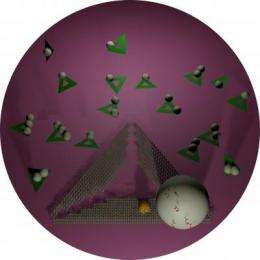
A long single-strand of DNA has been folded into a triangular building platform through a process known as DNA origami. This architectural foundation was then "decorated" with one, two or three silver nanoparticles, which self-assembled at pre-determined locations on the DNA nanostructure. Credit: Hao Yan, Yan Liu, Biodesign Institute at Arizona State University

The self-assembling properties of the DNA molecule have allowed for the construction of an intriguing range of nanoscale forms. Such nanoarchitectures may eventually find their way into a new generation of microelectronics, semiconductors, biological and chemical sensing devices and a host of biomedical applications. Now Hao Yan and Yan Liu, professors at the Biodesign Institute's Center for Single Molecule Biophysics and their collaborators have introduced a new method to deterministically and precisely position silver nanoparticles onto self-assembling DNA scaffolds.

In their latest research, the group used a long single-strand of DNA, which had been folded into a triangular building platform through a process known as DNA origami. This architectural foundation was then 'decorated' with one, two or three , which self-assembled at pre-determined locations on the DNA nanostructure. The group's experimental results, which appear in the advanced online edition of the journal Angewandte Chemie, demonstrate for the first time the viability of using silver, rather than the gold nanoparticles traditionally applied to DNA-tile or origami based architectures. The study was co-authored by Suchetan Pal, Zhengtao Deng, Baoquan Ding.

One of many applications for DNA scaffolds studded with nanoparticles is to perform precise sensing operations at the molecular scale. Sensitive detection of single molecules with high specificity is of great scientific interest for chemists, biologists, pharmacologists, medical researchers and those involved in environmental areas where trace analysis is required. The detailed study of human is but one area where improved single-molecule detection could be of enormous benefit.

In their current effort, the group sought to exploit the properties of the silver nanoparticles to increase the resonance—a vibration of electrons that can give researchers clues regarding the molecular nature of the sample they are studying. "Theoretically, people predicted that a local surface plasmon resonance can be much stronger if you use silver particles compared to gold," said Yan. These locally enhanced areas between nanoparticles are referred to as electrical hot spots.

The group however, had to overcome significant obstacles to the use of silver nanoparticles. Silver tends to be much less stable than gold and can easily oxidize in its normal state. To counter this tendency, Yan and Liu's team attached multiple sulfur atoms to the backbone of the DNA strand used to make the platform for the nanoparticles. Each silver nanoparticle is then firmly held in place by nine sulfur atoms, once it is mounted on the DNA origami shape.

The new study paves the way for creating a more functional DNA architecture. "I believe this work will open doors to implement and study distance-dependent plasmonic interaction between noble at the single particle level," Yan said, adding that the first critical steps to creating hierarchically organized silver nanoparticle structures have now been taken.

Provided by Arizona State University (news : web)

4.3 /5 (4 votes)  

Filter


Move the slider to adjust rank threshold, so that you can hide some of the comments.


Display comments: newest first

NeilFarbstein
Mar 19, 2010

Rank: 1 / 5 (1)
Dr. Thomas Netzel, a former Chairman of the American Chemical Society wrote a technical review of Vulvox's DNA transistor concept, and stated that it will likely change the world in innumerable ways when three dimensional chips containing millions of times as many transistors as those in current chips show up in robots and speech translators that really understand English and in self driving and self navigating cars. They will be constructed from DNA and modified DNA made on solid phase synthesizers or by Vulvox's proprietary DNA synthesis process. That process can make DNA for nanoelectronics at a production cost hundreds of times less expensive than current methods. My company Vulvox has been a leader in this field. The same process can be used to manufacture high quality DNA for gene therapy and RNA for silencer RNA gene therapy.

DNA has been used to grow and assemble ZnO nanowires for piezo-electric sensors and to generate electricity from vibrations.
protn7@att.net
Rank 4.3 /5 (4 votes)
Relevant PhysicsForums posts
  • Science behind the bore feeling?
    created6 hours ago
  • Homo Sapien vs. Chimpanzee - Divergence Timeline
    created11 hours ago
  • a single mRNA strand is attached to sevaral ribosomes?
    createdFeb 08, 2012
  • Oestrogen and FSH
    createdFeb 07, 2012
  • Linear Blood Vessel Network Examples in Animals or Plants
    createdFeb 07, 2012
  • Neuroscientists: What is a Principal Cell Layer?
    createdFeb 06, 2012
  • More from Physics Forums - Biology

More news stories

Nanotube therapy takes aim at breast cancer stem cells

Wake Forest Baptist Medical Center researchers have again proven that injecting multiwalled carbon nanotubes (MWCNTs) into tumors and heating them with a quick, 30-second laser treatment can kill them.

Nanotechnology / Bio & Medicine

created 2 minutes ago | popularity not rated yet | comments 0 | with audio podcast

Inspired by steel, nanomanufacturing gets wear-resistant carbide tip

(PhysOrg.com) -- Scientists at the University of Pennsylvania, the University of Wisconsin-Madison and IBM Research - Zurich have fabricated an ultrasharp silicon carbide tip possessing such high strength ...

Nanotechnology / Nanophysics

created 5 hours ago | popularity 5 / 5 (1) | comments 0 | with audio podcast

New technology platform for molecule-based electronics

Researchers at the Nano-Science Center at the University of Copenhagen have developed a new nano-technology platform for the development of molecule-based electronic components using the wonder material graphene. At the same ...

Nanotechnology / Nanomaterials

created 2 hours ago | popularity 5 / 5 (2) | comments 0

Australians risking skin cancer to avoid nanoparticles

More than three in five Australians are concerned enough about the health implications of nanoparticles in sunscreens to want to know more about their impact. And while the initial scientific information released suggests ...

Nanotechnology / Bio & Medicine

created 3 hours ago | popularity 5 / 5 (1) | comments 0

New kind of solar cell could capture significantly more energy than current cells

New solar cells could increase the maximum efficiency of solar panels by over 25%, according to scientists from the University of Cambridge.

Nanotechnology / Nanophysics

created Feb 08, 2012 | popularity 4.3 / 5 (9) | comments 14 | with audio podcast


Secrets of immune response illuminated in new study

When disease-causing invaders like bacteria infect a human host, cells of various types swing into action, coordinating their activities to address the threat.

Touch screens create online shopping experiences at stores

Imagine browsing knife sets in an airport and then ordering one before you board your plane, or going to a department store to look at makeup without having to bounce from counter to counter to check out each brand's selection.

Genetic risks for type 2 diabetes span multiple ethnicities

A recent large and comprehensive analysis of 50,000 genetic variants across 2,000 genes linked to cardiovascular and metabolic function has identified four genes associated with type 2 diabetes (T2D) and six independent disease-associated ...

Digital photos could put kids at risk

A study published in the International Journal of Electronic Security and Digital Forensics this month suggests that parents and carers could be putting children at risk if they upload digital photos that are automatically "geota ...

Fuel from market waste

Mushy tomatoes, brown bananas and overripe cherries -- to date, waste from wholesale markets has ended up on the compost heap at best. In future it will be put to better use: Researchers have developed a new ...

University of Minnesota and start-up to develop antidote to cyanide poisoning

Cyanide poisoning is often fatal and typically affects victims of industrial accidents, terrorist attacks, or structural fires. Based on research conducted at the Center for Drug Design at the University of Minnesota, startup ...