Origins of the Milky Way
March 19, 2010
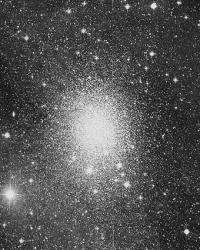
An optical image of the dwarf galaxy in Sculptor. Astronomers have found a very old star in this galaxy, in support of the idea that some of the Milky Way's old stars were once residents of neighboring galaxies.
(PhysOrg.com) -- According to current astronomical models, the Milky Way and other large galaxies formed over billions of years in a process that involved interactions between smaller galaxies, and in particular the gradual capture of many stars from nearby dwarf galaxies (small galaxies with hundreds or thousands of times fewer stars than the Milky Way).
Our current galactic neighborhood hosts one other comparably large galaxy, Andromeda, and several dozen dwarf galaxies of various types, including the so-called Magellanic Clouds and a dwarf galaxy called the Sculptor Dwarf Galaxy. Astronomers piecing together the history of the Milky Way, including its genetic heritage from neighbors, recognize that our story also very likely reflects the cosmic story of how galaxies everywhere are assembled.
The Sculptor Dwarf Galaxy is about 300,000 light-years away, and is notable because among other things it contains many stars that are lacking in heavy elements like iron. Since iron is produced very gradually inside stellar furnaces, a dearth of iron shows that the system (including its stars) is old, and dates from a time before these elements became abundant.
In the case of Sculptor, its stars on average have only a few percent of the heavy elements that we see in the sun. The outer halo of the Milky Way has some much older stars though, some with only one-ten-thousandth of the iron in the sun, or even less.
The problem is this: if the Milky Way did form in part by capturing stars from its neighboring dwarf galaxies, those dwarfs should have stars at least as old as ours, if not older. Why, wondered astronomers, have none been seen?
Writing in the latest issue of Nature, CfA astronomer Anna Frebel and two colleagues describe their discovery of a very old, metal-poor star in Sculptor. The scientists were concerned that previous conclusions were based either on studies of too few stars, or on incomplete diagnostics that used a misleading heavy element. Using a new method, they identified a set of stars in Sculptor that looked like possible old candidates, and then observed them with detailed optical spectroscopy.
They discovered that one of these stars was indeed extremely old - it has an iron abundance less than 0.25% of the sun's, making it a close analog of the old stars in the Milky Way halo and comparable in age to the age of the universe. The results are interesting in themselves, but also because they reinforce the notion that our galaxy has stars that did once belong to our neighbors.
More information: Linking dwarf galaxies to halo building blocks with the most metal-poor star in Sculptor, Nature 464, 72-75 (4 March 2010), doi:10.1038/nature08772
Provided by Harvard-Smithsonian Center for Astrophysics (news : web)
-
Old star is 'missing link' in galactic evolution
Mar 03, 2010 |
not rated yet |
0
-
Dust around a primitive star sheds new light on universe's origins
Jan 15, 2009 |
not rated yet |
0
-
No Place to Hide: Missing Primitive Stars Outside Milky Way Uncovered
Feb 17, 2010 |
not rated yet |
0
-
Alien invaders pack the Milky Way
Feb 23, 2010 |
not rated yet |
0
-
No stars in the clouds
Jan 10, 2006 |
not rated yet |
0
-
Engineers build first sub-10-nm carbon nanotube transistor
Feb 01, 2012 |
4.9 / 5 (31) |
30
-
Something old, something new: Evolution and the structural divergence of duplicate genes
Jan 31, 2012 |
4.6 / 5 (7) |
1
-
The hidden nanoworld of ice crystals: Revealing the dynamic behavior of quasi-liquid layers
Jan 30, 2012 |
5 / 5 (3) |
1
-
Stock market network reveals investor clustering
Jan 27, 2012 |
3.9 / 5 (23) |
8
-
Of microchemistry and molecules: Electronic microfluidic device synthesizes biocompatible probes
Jan 26, 2012 |
5 / 5 (1) |
0
-
Scale of the Universe
2 hours ago
-
Titan's lack of impact craters
Feb 09, 2012
-
Real pictures of black hole eating a star?
Feb 08, 2012
-
Hypothetical way to travel faster than light, but not technically exceed lightspeed
Feb 06, 2012
-
How do scientists monitor the Sun's activity?
Feb 05, 2012
-
Search patterns in observational studies
Feb 05, 2012
- More from Physics Forums - General Astronomy
More news stories
NASA sees wide-eyed cyclone Jasmine
Cyclone Jasmine's eye has opened wider on NASA satellite imagery, as it moves through the Southern Pacific Ocean.
Space & Earth / Earth Sciences
1 hour ago |
not rated yet |
0
NASA sees Giovanna reach cyclone strength, threaten Madagascar
Tropical Storm 12S built up steam and became a cyclone on February 10, 2012 as NASA's Terra satellite passed overhead. Residents of east-central Madagascar should prepare for this cyclone to make landfall ...
Space & Earth / Earth Sciences
1 hour ago |
not rated yet |
0
Humans may have helped the decline of African rainforests 3000 years ago
(PhysOrg.com) -- Large areas of rainforests in Central Africa mysteriously disappeared over three thousand years ago, to be replaced by savannas. The prevailing theory has been that the cause was a change ...
Could Venus be shifting gear?
(PhysOrg.com) -- ESAs Venus Express spacecraft has discovered that our cloud-covered neighbour spins a little slower than previously measured. Peering through the dense atmosphere in the infrared, the ...
Space & Earth / Space Exploration
9 hours ago |
5 / 5 (7) |
7
|
Mars Science Laboratory computer issue resolved
(PhysOrg.com) -- Engineers have found the root cause of a computer reset that occurred two months ago on NASA's Mars Science Laboratory and have determined how to correct it.
Space & Earth / Space Exploration
10 hours ago |
4.7 / 5 (6) |
3
|
Google users warned of threat to smartphone wallets
Users of Google smartphone wallets were being warned on Friday that there is a way to crack pass codes intended to thwart thieves from going on illicit shopping sprees.
Anonymous knocks CIA website offline (Update)
The website of the Central Intelligence Agency was inaccessible on Friday after the hacker group Anonymous claimed to have knocked it offline.
Complex wiring of the nervous system may rely on a just a handful of genes and proteins
Researchers at the Salk Institute have discovered a startling feature of early brain development that helps to explain how complex neuron wiring patterns are programmed using just a handful of critical genes. ...
Putting the squeeze on planets outside our solar system
(PhysOrg.com) -- Using high-powered lasers, scientists at Lawrence Livermore National Laboratory and collaborators discovered that molten magnesium silicate undergoes a phase change in the liquid state, abruptly ...
The power of estrogen -- male snakes attract other males
A new study has shown that boosting the estrogen levels of male garter snakes causes them to secrete the same pheromones that females use to attract suitors, and turned the males into just about the sexiest ...
New error-correcting codes guarantee the fastest possible rate of data transmission
Error-correcting codes are one of the triumphs of the digital age. Theyre a way of encoding information so that it can be transmitted across a communication channel such as an optical fiber o ...
Mar 19, 2010
Rank: not rated yet
Mar 19, 2010
Rank: 3.5 / 5 (4)
Sure! Just throw in some dark matter, some dark energy, a few black holes, and the God particle!!!
Mar 20, 2010
Rank: 4 / 5 (4)
Mar 20, 2010
Rank: 3.4 / 5 (5)
I said the same thing. This is backwards, because the standard claim from astronomers regarding stars is that they fuse lighter elements to heavier and heavier elements. Thus, the older a star is, the MORE iron it should contain....
A very old star SHOULD contain almost entirely iron and heavier elements in it's core....while a very young star should contain little or no iron.
Even if this were a "first generation star" that has somehow managed to keep burning all ths time, it would be composed almost entirely of iron and heavier elements by now, because it clearly would have fused all of it's lighter elements by now.
Mar 20, 2010
Rank: 3.5 / 5 (2)
On the other hand, if this is a "new" first generation star, then it makes sense that it has very little iron...
Again, a second generation star has some iron.
An old first generation star has mostly iron.
A new first generation star, formed in a pure hydrogen and helium environment, has little or no iron. Since this has little or no iron, it must be an all new first generation star, and not an old star at all...
Mar 20, 2010
Rank: not rated yet
We should be prepared for fundamental change of the whole cosmology, because it seems, the origin of many galaxies goes deeper, then the age of most distant parts of Universe.
Mar 20, 2010
Rank: not rated yet
Mar 20, 2010
Rank: 5 / 5 (4)
The article is does not clear make it clear that it is NOT the individual starts that increase gradually in iron content.
It is on a galactic scale that iron content increases gradually. Thus the iron content in the clouds that new stars are formed from increases gradually, as dying stars add iron.
Thus older stars that formed before there was much iron have low iron, and newer stars the formed from gas clouds enriched in iron by dying stars have more iron through out their lives.
Mar 22, 2010
Rank: not rated yet
Mar 24, 2010
Rank: not rated yet
Looking far back into the history of the Universe, the dwarf galaxies that will later go on to merge into ever-larger stellar structures are still gas-rich, tightly bound systems (remember that dwarf galaxies have high mass-to-light ratios [ie dark matter dominated] to hold on to primordial gas, dust & stars). Of course they're metal poor systems, but not until encountering a much larger galaxy (with its' attendant DM halo) are the gas, dust & stellar components of the dwarf galaxy stripped in successive passes. These 'stellar streams' have been seen in our galaxy and several other nearby galaxies, giving more credence to this formation scenario. Also, epochs of star formation in dwarf galaxies can be inferred by careful spectral analysis, to see if periods of star formation coincide with close approaches by the dwarf galaxy.