Gaming - step by step
March 19, 2010 By Ileiren Poon
(PhysOrg.com) -- For one University of Alberta professor, making the move from California to Edmonton turned out to be the first step in becoming involved with an award-winning video game.
Nathan Sturtevant came to the U of A from the University of California, Los Angeles, where his work focused on artificial intelligence programming for multiplayer games like hearts or Chinese checkers. During a conference in Edmonton, he met U of A vice-provost (information technology) Jonathan Shaeffer, whose games work Sturtevant was familiar with
"The U of A is well known for work in games and artificial intelligence," Sturtevant said. "I knew that there are really great people to work with here and I was very happy to come up and be part of the group."
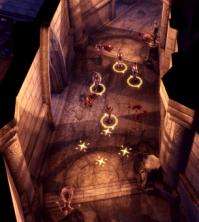
Then, in 2005, Edmonton game developer BioWare approached the U of A computing science department, looking for help with a "pathfinding" challenge in their game Dragon Age: Origins.
Pathfinding is a major element in most modern video games, but not one many gamers think about unless things goes wrong. The ability to click a computer mouse to set digital characters in motion perhaps seems like it should be intuitive in this day of blockbuster games, but getting around or navigating in a complex and crowded game environment can make the journey slow and frustrating, the exact opposite of what video games are expected to deliver. Pathfinding allows the game programming to break the planning process into components, one following the other, so the program doesn't have to tackle all the planning at once.
"If you go back to [earlier] BioWare games you find that essentially what's going on is your character is trying to find an entire path of how to get to their destination before anything else happens," said Sturtevant, a professor in the Department of Computing Science. "There are many cases where that can be really difficult and unnecessarily slow the game down. If you can imagine a [game scenario] with a lot of things going on, or a lot of barriers to get around-in that type of situation the pathfinding program would just fail.
"In the game Dragon Age, BioWare was running exactly into that problem, and they have even more complicated environments than the one I described, and they needed some way for the characters to solve things a little faster," he explains.
Make it faster with fewer resources
So, faced with the challenges of creating pathfinding programming able to navigate complicated environments while minimizing the amount of overhead in terms of memory needed, Sturtevant chose to break the decision-making process into separate levels, leaving the computer to calculate the steps needed by the character.
"In a lot of games when you say 'go do something,' the character sort of sits there for a while as the program is planning and then they take off," he said. "What we did then is you get this very high-level path that says 'You're going this way' and then we can then cut it down into small pieces. You don't need to figure out how to get all the way to your goal, you just need to figure out how to get to the next step along this path."
Sturtevant says he wanted players to be able to trust that a character is going to get where they're going. "One of the things I really wanted to see was that if a character is standing on one side of the game map, would it be possible to mouse click on the farthest point away and watch your character then walk for 10, 20, 30, 40 seconds and get to where you wanted them to go?" he said. That turned out to be the case, which allows players to attend to other characters or decisions within the game as the pathfinding command is being carried out.
Working on Dragon Age was an exciting opportunity, said Sturtevant. "I get to be here in academia at the U of A and work on all these problems, but to be a part of something that millions of people are playing and enjoying, that's pretty thrilling."
-
Degree offered in computer game design
Jul 12, 2006 |
not rated yet |
0
-
Students Launch Audiball, an Xbox Community Game
Jan 16, 2009 |
not rated yet |
0
-
Video games shown to improve vision
Mar 15, 2007 |
not rated yet |
0
-
When computers play games, artificial intelligence is the key to victory
Jun 22, 2005 |
not rated yet |
0
-
Leveling the gaming field
May 13, 2008 |
not rated yet |
0
-
Engineers build first sub-10-nm carbon nanotube transistor
Feb 01, 2012 |
4.9 / 5 (31) |
30
-
Something old, something new: Evolution and the structural divergence of duplicate genes
Jan 31, 2012 |
4.6 / 5 (7) |
1
-
The hidden nanoworld of ice crystals: Revealing the dynamic behavior of quasi-liquid layers
Jan 30, 2012 |
5 / 5 (3) |
1
-
Stock market network reveals investor clustering
Jan 27, 2012 |
3.9 / 5 (23) |
8
-
Of microchemistry and molecules: Electronic microfluidic device synthesizes biocompatible probes
Jan 26, 2012 |
5 / 5 (1) |
0
-
Synergistic relations between computer science and technology.
Feb 06, 2012
-
how do iphone gloves work?
Feb 05, 2012
-
iPhone battery over time
Jan 30, 2012
-
Best alternate Tablet to an iPad for writing math or physics equations?
Jan 26, 2012
-
Sending SMS to a website
Jan 20, 2012
-
Need help with my technical fest!
Jan 19, 2012
- More from Physics Forums - Computing & Technology
More news stories
Google users warned of threat to smartphone wallets
Users of Google smartphone wallets were being warned on Friday that there is a way to crack pass codes intended to thwart thieves from going on illicit shopping sprees.
4 hours ago |
5 / 5 (2) |
0
Anonymous knocks CIA website offline (Update)
The website of the Central Intelligence Agency was inaccessible on Friday after the hacker group Anonymous claimed to have knocked it offline.
6 hours ago |
5 / 5 (7) |
11
New error-correcting codes guarantee the fastest possible rate of data transmission
Error-correcting codes are one of the triumphs of the digital age. Theyre a way of encoding information so that it can be transmitted across a communication channel such as an optical fiber o ...
Technology / Computer Sciences
14 hours ago |
4.8 / 5 (6) |
6
|
New power source discovered
(PhysOrg.com) -- Researchers at the Massachusetts Institute of Technology (MIT) and RMIT University have made a breakthrough in energy storage and power generation.
Technology / Energy & Green Tech
13 hours ago |
4.8 / 5 (21) |
7
|
Small modular reactor design could be a 'SUPERSTAR'
(PhysOrg.com) -- Though most of today's nuclear reactors are cooled by water, we've long known that there are alternatives; in fact, the world's first nuclear-powered electricity in 1951 came from a reactor ...
Technology / Energy & Green Tech
14 hours ago |
4.3 / 5 (11) |
21
|
Complex wiring of the nervous system may rely on a just a handful of genes and proteins
Researchers at the Salk Institute have discovered a startling feature of early brain development that helps to explain how complex neuron wiring patterns are programmed using just a handful of critical genes. ...
The power of estrogen -- male snakes attract other males
A new study has shown that boosting the estrogen levels of male garter snakes causes them to secrete the same pheromones that females use to attract suitors, and turned the males into just about the sexiest ...
Humans may have helped the decline of African rainforests 3000 years ago
(PhysOrg.com) -- Large areas of rainforests in Central Africa mysteriously disappeared over three thousand years ago, to be replaced by savannas. The prevailing theory has been that the cause was a change ...
Putting the squeeze on planets outside our solar system
(PhysOrg.com) -- Using high-powered lasers, scientists at Lawrence Livermore National Laboratory and collaborators discovered that molten magnesium silicate undergoes a phase change in the liquid state, abruptly ...
Could Venus be shifting gear?
(PhysOrg.com) -- ESAs Venus Express spacecraft has discovered that our cloud-covered neighbour spins a little slower than previously measured. Peering through the dense atmosphere in the infrared, the ...
Advanced power-grid model finds low-cost, low-carbon future in West
(PhysOrg.com) -- The least expensive way for the Western U.S. to reduce greenhouse gas emissions enough to help prevent the worst consequences of global warming is to replace coal with renewable and other ...
Mar 20, 2010
Rank: 1 / 5 (1)
Mar 22, 2010
Rank: 1 / 5 (1)
Mar 22, 2010
Rank: not rated yet