Evidence Indicates Humans' Early Tree-dwelling Ancestors Were Also Bipedal
March 20, 2010
Evidence Indicates Humans' Early Tree-dwelling Ancestors Were Also Bipedal

Enlarge

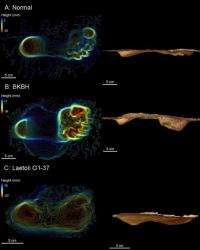
Images show aerial and lateral images of (top to bottom) (A) a human footprint made walking normally with an extended knee and hip gait; (B) a human footprint made walking with bent-knees and hips to mimic a chimpanzee; and (C) a scan of a cast from the Laetoli fossil trackway. Notice that the toe is much deeper than the heel in the middle print and that the Laetoli scan looks more like the human print. (Credit: Randy Haas, University of Arizona)

(PhysOrg.com) -- More than three million years ago, the ancestors of modern humans were still spending a considerable amount of their lives in trees, but something new was happening.

David Raichlen, an assistant professor in the University of Arizona School of Anthropology, and his colleagues at the University at Albany and City University of New York's Lehman College have developed new experimental evidence indicating that these early were walking with a human-like striding gait as long as 3.6 million years ago.

The results of their research appears in Monday's edition of , a journal from the Public Library of Science.

A trackway of footprints preserved in deposited 3.6 million years ago was uncovered in Laetoli, Tanzania, more than 30 years ago. The significance of those prints for has been debated ever since. The most likely individuals to have produced these footprints, which show clear evidence of bipedalism, or walking on two legs, would have been members of the only bipedal species alive in the area at that time, Australopithecus afarensis. That species includes "Lucy," whose are the most complete of any individual A. afarensis found to date.

A number of features in the hips, legs, and back of this group indicate that they would have walked on two legs while on the ground. But the curved fingers and toes as well as an upward-oriented shoulder blade provide solid evidence that Lucy and other members of her species also would have spent significant time climbing in trees.

This morphology differs distinctly from our own genus, Homo, who abandoned arboreal life around 2 million years ago and irrevocably committed to human-like bipedalism. Since the Laetoli tracks were discovered, scientists have debated whether they indicate a modern human-like mode of striding bipedalism, or a less-efficient type of crouched bipedalism more characteristic of chimpanzees whose knees and hips are bent when walking on two legs.

To resolve this, Raichlen and his colleagues devised the first biomechanical experiment explicitly designed to address this question. The team built a sand trackway in Raichlen's motion capture lab at the UA and filmed human subjects walking across the sand. The subjects walked both with normal, erect human gaits and then with crouched, chimpanzee-like gaits. Three-dimensional models of the footprints were collected by biological anthropologist Adam Gordon using equipment brought from his Primate Evolutionary Morphology Laboratory at the University at Albany.

The researchers examined the relative depth of footprints at the heel and toe, and found that depths are about equal when made by a person walking with an erect gait. In contrast, the toe print is much deeper than the heel print when produced by a crouched gait, a product of the timing of weight transfer over the length of the foot.

"Based on previous analyses of the skeletons of Australopithecus afarensis, we expected that the Laetoli footprints would resemble those of someone walking with a bent knee, bent hip gait typical of chimpanzees, and not the striding gait normally used by modern humans," Raichlen said. "But to our surprise, the Laetoli footprints fall completely within the range of normal human footprints."

The fossil footprints at Laetoli preserve a remarkably even depth at the toe and heel, just like those of . "This more human-like form of walking is incredibly energetically efficient, suggesting that reduced energy costs were very important in the evolution of bipedalism prior to the origins of our own genus, Homo," Raichlen said.

If the Laetoli footprints were made by Lucy's species, as most scientists agree to be the case, these experimental results have interesting implications for the timing of evolutionary events.

"What is fascinating about this study is that it suggests that, at a time when our ancestors had an anatomy well-suited to spending a significant amount of time in the trees, they had already developed a highly efficient, modern human-like mode of bipedalism," said Adam Gordon.

"The fossil record indicates that our ancestors did not make a full-time commitment to leaving the trees and walking on the ground until well over a million years after these (Laetoli) prints were made. The fact that partially tree-dwelling animals, like Lucy, had such a remarkably modern gait is a testament to the importance of energetic efficiency in moving around on two legs," Gordon said.

More information: "Laetoli Footprints Preserve Earliest Direct Evidence of Human-like Bipedal Biomechanics" will be published in PLoS ONE on Monday, March 22 and can be accessed online at http://dx.plos.org … pone.0009769

Provided by University of Arizona (news : web)

Filter


Move the slider to adjust rank threshold, so that you can hide some of the comments.


Display comments: newest first

Mstardom
Mar 20, 2010

Rank: not rated yet
This story shows why humans can climb trees so easily. They were made for the trees! Living in trees afforded safety from being eaten because spending a large amount of time on the ground could pose great threat to survival.
dan42day
Mar 21, 2010

Rank: not rated yet
Just how soon after becoming bipedal would we be expected to lose the adaptations that made us efficient at living in trees? What would drive the process? Wouldn't it still be useful to have those abilities even if they are only used rarely in emergencies? What other adaptations can we expect to lose now that we live in a technical society?

Yeah, I know - "Mr Day, you aska lotta questions!"
Loodt
Mar 21, 2010

Rank: 1 / 5 (2)
Dan42day.

Yeah, this evolution business is not as effective as they make out. Just think how handy that tail would have been to drive the mouse on you PC!

Why can't they repeat this test with some chimps?

The foot action of a chimp walking upright must be different to that of a human and these imprints would show that.
Rank 5 /5 (9 votes)
Related Stories
Relevant PhysicsForums posts
  • Mitosis
    created8 hours ago
  • Stem cell question.
    created9 hours ago
  • Protease cleavage
    created15 hours ago
  • Pertubance in a model
    created22 hours ago
  • Cancer drugs and Alzheimer's, Oh my!
    createdFeb 09, 2012
  • Squishing cells
    createdFeb 09, 2012
  • More from Physics Forums - Biology

More news stories

A frank discussion of the power law and linking correlation to causation

(PhysOrg.com) -- Michael Stumpf a mathematics professor at Imperial College in London, and Mason Porter a lecturer at Oxford have teamed together to write and publish a perspective piece in Science regarding the in ...

Other Sciences / Mathematics

created 22 hours ago | popularity 5 / 5 (4) | comments 8 | with audio podcast report

Employers feel no love for unscrupulous practice of 'service sweethearting'

A new study led by two Florida State University marketing professors finds that some frontline service employees who are rewarded for hikes in customer loyalty and satisfaction also may engage in "service ...

Other Sciences / Economics & Business

created 16 hours ago | popularity 4 / 5 (1) | comments 7

The question of life in the ancient world

There’s a general feeling that we don’t get the Greeks – ancient or modern. Many, including heads of state like Angela Merkel, visibly shake their head in exasperation, rightly or wrongly, at ...

Other Sciences / Archaeology & Fossils

created 21 hours ago | popularity 1.3 / 5 (3) | comments 4

Sonic Cradle lands spot in TED exhibition

A Simon Fraser University graduate student project that melds music, meditation and modern technology has landed a rare spot as an exhibit at TEDActive 2012 in Palm Springs, California this month.

Other Sciences / Other

created 18 hours ago | popularity not rated yet | comments 0

US workers are 'giving away the store,' costing firms billions

Nearly 70 percent of the nation's service employees give away free goods and services – from hamburgers to cable TV – costing companies billions of dollars a year, according to a groundbreaking study.

Other Sciences / Economics & Business

created Feb 09, 2012 | popularity 3.3 / 5 (3) | comments 10


Anonymous knocks CIA website offline (Update)

The website of the Central Intelligence Agency was inaccessible on Friday after the hacker group Anonymous claimed to have knocked it offline.

New error-correcting codes guarantee the fastest possible rate of data transmission

Error-correcting codes are one of the triumphs of the digital age. They’re a way of encoding information so that it can be transmitted across a communication channel — such as an optical fiber o ...

Small modular reactor design could be a 'SUPERSTAR'

(PhysOrg.com) -- Though most of today's nuclear reactors are cooled by water, we've long known that there are alternatives; in fact, the world's first nuclear-powered electricity in 1951 came from a reactor ...

New power source discovered

(PhysOrg.com) -- Researchers at the Massachusetts Institute of Technology (MIT) and RMIT University have made a breakthrough in energy storage and power generation.

The power of estrogen -- male snakes attract other males

A new study has shown that boosting the estrogen levels of male garter snakes causes them to secrete the same pheromones that females use to attract suitors, and turned the males into just about the sexiest ...

Advanced power-grid model finds low-cost, low-carbon future in West

(PhysOrg.com) -- The least expensive way for the Western U.S. to reduce greenhouse gas emissions enough to help prevent the worst consequences of global warming is to replace coal with renewable and other ...