Detecting fake wine vintages: It's an (atomic) blast
March 22, 2010
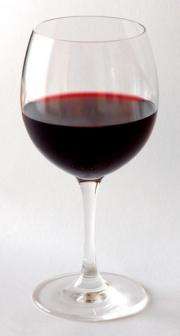
To tell whether a certain wine is a fine vintage or a fake, scientists are using traces of radioactive carbon leftover from atomic bomb tests to estimate the age of the beverage. Credit: Wikimedia Commons
Two decades of atomic bomb testing in the atmosphere are yielding an unexpected bonus for consumers, scientists reported here today at the 239th National Meeting of the American Chemical Society (ACS). It's a new test to determine whether that Bordeaux or burgundy is from a fine vintage year and commands premium price or actually is a counterfeit vin ordinaire or cheap plonk worth much less.
Graham Jones, Ph.D., who headed the research, said that misrepresenting the vintage — the year the wine was made — is an ongoing problem. He is with the University of Adelaide, Australia. Some years bring perfect growing conditions for vineyards in a country or region of a country and the grapes produce exceptional wines that command premium prices. In other years, bad weather, such as heavy late-season rains that bloat grapes with water or long hot, dry spells at harvest, means poor quality wines. Some wine experts estimate that up to 5 percent of the fine wine sold today is fake.
"The problem goes beyond ordinary consumers being overcharged for a bottle of expensive wine of a famous winery with a great year listed on the label," Jones pointed out. "Connoisseurs collect vintage wines and prices have soared with 'investment wines' selling for hundreds of thousands of dollars a case at auction."
Jones said the wine industry is fighting forgeries with special seals and high-tech labels. The method for authentication of a wine's vintage may provide added confidence that the vintage on the label is the vintage in the bottle.
In their leading research, Jones and colleagues found that radioactive carbon dioxide produced from atomic bomb tests in the atmosphere absorbed by grapes can be used to accurately determine wine vintages. The new technique is similar to radio-carbon dating, used for years to estimate the age of prehistoric objects. It works by comparing the amount of carbon-14 (C-14), a less common form of atmospheric carbon, to carbon-12 (C-12), which is more stable and abundant. The ratio of these two carbon forms, or isotopes, has remained constant in the atmosphere for thousands of years.
"Until the late 1940's all carbon-14 in the Earth's biosphere was produced by the interaction between cosmic rays and nitrogen in the upper atmosphere," Jones says. "This changed in the late 1940's up to 1963 when atmospheric atomic explosions significantly increased the amount of C-14 in the atmosphere. When the tests stopped in 1963 a clock was set ticking — that of the dilution of this "bomb-pulse" C-14 by CO2 formed by the burning of fossil fuels."
He explains that traces of radioactive carbon are captured by the grape plants through the absorption of carbon dioxide and eventually transformed into alcohol and other carbon-based components of the wine. The "bomb-pulse" of the atmosphere is eventually absorbed into the wine.
"The year that the grapes were grown fixes the age or vintage of the wine," Jones says.
"The carbon-14 isotope ratio of the wine alcohol can therefore be used to determine the vintage of a wine."
The scientists used a highly-sensitive analytical device called an accelerator mass spectrometer to determine the C-14 levels in the alcohol components of 20 Australian red wines with vintages from 1958 to 1997 and then compared these measurements to the radioactivity levels of known atmospheric samples. They found that the method could reliably determine the vintage of wines to within the vintage year.
In addition to testing alcohol, measuring the age of other wine components, such as tartaric acid and various phenolic substances, can help improve the reliability of the technique for detecting fraud, Jones notes.
Provided by American Chemical Society
-
Red, White Wine, Fish And Science
Oct 29, 2009 |
not rated yet |
0
-
A scientific basis the 'golden rule' of pairing wines and foods
Oct 21, 2009 |
not rated yet |
0
-
Study: Pesticides found in wine
Apr 04, 2008 |
not rated yet |
0
-
Researchers can now determine when a human was born by looking into the eyes of the dead
Jan 30, 2008 |
not rated yet |
0
-
Wine and cheese: serious science
Oct 27, 2005 |
not rated yet |
0
-
Stars containing dark matter should look different from other stars
Feb 20, 2012 |
4.5 / 5 (17) |
11
-
Physicists discover evidence of rare hypernucleus, a component of strange matter
Feb 17, 2012 |
4.7 / 5 (38) |
22
-
Fast photon control brings quantum photonic technologies closer
Feb 13, 2012 |
5 / 5 (8) |
1
-
Engineers build first sub-10-nm carbon nanotube transistor
Feb 01, 2012 |
4.9 / 5 (36) |
32
-
Something old, something new: Evolution and the structural divergence of duplicate genes
Jan 31, 2012 |
4.6 / 5 (7) |
1
-
Cis-trans Selectivity in Wittig Reactions
4 hours ago
-
Chemical Kinetics
4 hours ago
-
heat-driven chemical reaction and thermodynamics
11 hours ago
-
phenol to benzene
15 hours ago
-
TQM, QA and QC
16 hours ago
-
oxidising power
22 hours ago
- More from Physics Forums - Chemistry
More news stories
Flesh-eating bacteria inspire superglue
(PhysOrg.com) -- A bio-inspired superglue has been developed by Oxford University researchers that cant be matched for sticking molecules together and not letting go.
21 hours ago |
5 / 5 (8) |
3
|
Scientists create potent molecules aimed at treating muscular dystrophy
While RNA is an appealing drug target, small molecules that can actually affect its function have rarely been found. But now scientists from the Florida campus of The Scripps Research Institute have for the first time designed ...
10 hours ago |
5 / 5 (4) |
0
|
Researchers discover what cancer cells need to travel
(PhysOrg.com) -- Cancer cells must prepare for travel before invading new tissues, but new Cornell research has found a possible way to stop these cells from ever hitting the road.
20 hours ago |
4.9 / 5 (12) |
0
|
New microfluidic device could be used to diagnose and monitor cancer and other diseases
Separating complex mixtures of cells, such as those found in a blood sample, can offer valuable information for diagnosing and treating disease. However, it may be necessary to search through billions of other ...
Chemistry / Analytical Chemistry
20 hours ago |
5 / 5 (2) |
0
|
New way to tap largest remaining treasure trove of potential new antibiotics
Scientists are reporting use of a new technology for sifting through the world's largest remaining pool of potential antibiotics to discover two new antibiotics that work against deadly resistant microbes, ...
13 hours ago |
5 / 5 (4) |
0
Researchers build first physical 'metatronic' circuit
(PhysOrg.com) -- The technological world of the 21st century owes a tremendous amount to advances in electrical engineering, specifically, the ability to finely control the flow of electrical charges using ...
Spitzer finds solid buckyballs in space
(PhysOrg.com) -- Astronomers using data from NASA's Spitzer Space Telescope have, for the first time, discovered buckyballs in a solid form in space. Prior to this discovery, the microscopic carbon spheres ...
Faster than light neutrinos? More like faulty wiring
You can shelf your designs for a warp drive engine (for now) and put the DeLorean back in the garage; it turns out neutrinos may not have broken any cosmic speed limits after all.
Physicists surprised by disappearing and reappearing superconductivity in iron selenium chalcogenides
Superconductivity is a rare physical state in which matter is able to conduct electricity -- maintain a flow of electrons -- without any resistance. This phenomenon can only be found in certain materials at low temperatures, ...
Stanford research team cracks animated NuCaptcha
(PhysOrg.com) -- The research team from Stanford University, led by Elie Bursztein, that previously had cracked regular CAPTCHAs and then audio CAPTCHAs, now has also successfully cracked the animated version called NuCapt ...
Going up: Japan builder eyes space elevator
A Japanese construction firm claimed Wednesday it could execute an out-of-this-world plan to put tourists in space within 40 years by building an elevator that stretches a quarter of the way to the moon.
Mar 22, 2010
Rank: 5 / 5 (2)
Mar 22, 2010
Rank: not rated yet
There are plenty of awesome wines that you can get for around $20 a bottle if you shop around.
Mar 22, 2010
Rank: not rated yet
Mar 23, 2010
Rank: not rated yet
http://www.lcbo.c...mber=794