New 'smart' roof reads the thermometer, saves energy in hot and cold climates
March 22, 2010
New 'smart' roof reads the thermometer, saves energy in hot and cold climates

Enlarge

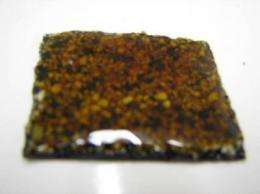
Shingles with a "smart" coating could save energy and lower bills by adjusting to temperature changes. Credit: Ben Wen, Ph.D.

Top a building with a light-colored "cool roof," and it reflects sunlight, cutting air conditioning bills in summer, but increasing winter heating costs. Choose black shingles, and the roof soaks up sunlight to cut winter heating costs but makes the roof bake in the summer sun. One or the other. You can't have it both ways. Until now.

Scientists today reported the development of a "smart" roof coating, made from waste cooking oil from fast food restaurants, that can "read" a . The coating automatically switches roles, reflecting or transmitting solar heat, when the crosses a preset point that can be tuned to the local climate.

They described the coating at the 239th National Meeting of the American Chemical Society (ACS), being held here this week.

Roofs coated with the material would reflect scorching summer sunlight and reduce sticker-shock air-conditioning bills. When chilly weather sets in, the coating would change roles and transmit heat to help warm the interior.

"This is one of the most innovative and practical roofing developed to date," said Ben Wen, Ph.D., leader of the research project. He is the vice-president of United Environment & Energy LLC in Horseheads, N.Y. "This bio-based intelligent roof coating, compared with a traditional cool roof, could reduce both heating and cooling costs as it responds to the external environment. It will help save fuel and electricity and reduce emissions of volatile organic compounds from petroleum-based roofing products. In addition, it will provide a new use for millions of gallons of waste oil after it is used to cook french fries and chicken nuggets."

Scientists already have evidence that "white roofs" — roofs that are painted white to reflect solar heat and help cool buildings during peak summer weather — could significantly reduce global warming by lowering fuel consumption. However, white roofs can have a wintertime heating penalty because they reflect that would help warm the building. So white roofs are a benefit in summer but a detriment in winter.
New 'smart' roof reads the thermometer, saves energy in hot and cold climates
Enlarge

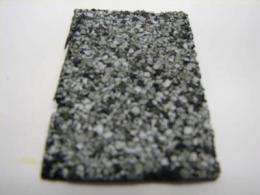
This is a conventional roofing shingle. Credit: Ben Wen, Ph.D.

The new "intelligent" coating may sidestep this quandry. Tests on coated asphalt shingles showed that it could reduce roof temperatures by about 50 - 80 percent in warm weather. In cooler weather, the coating could increase roof temperatures up to 80 percent compared with the traditional cool roof. By changing the coating's composition, Wen and colleagues can tune the substance, so that it changes from reflective to transmitive at a specific environmental temperature.

"Even though the roof temperature is reduced or increased by a few degrees, depending on the outside temperature, this change could make a big difference in your energy bill," Wen noted.

In producing the coating, waste cooking oil is processed into a liquid polymer that hardens into a plastic after application. Unlike raw waste oil, which can smell like French fries or fish, the resulting polymer is virtually odorless. Manufacturers could potentially produce it in any shade, ranging from clear to black, depending on what additives are used, he said. The material is also non-flammable and nontoxic.

Wen cautions against pouring ordinary cooking oil on a roof in an attempt to achieve a similar energy-saving effect. That's because ordinary cooking oil won't turn into a polymer, doesn't contain the key ingredient for controlling infrared light levels, and could well pose a fire hazard for the building.

The coating can be applied to virtually any type of roof. Wen expects that the coating can last many years and can be reapplied when it wears off. If further testing continues to go well, he estimates that the coating could be ready for commercial use in about three years.

Provided by American Chemical Society (news : web)

4.8 /5 (4 votes)  

Filter


Move the slider to adjust rank threshold, so that you can hide some of the comments.


Display comments: newest first

barakn
Mar 22, 2010

Rank: not rated yet
Not enough phases. During winter one would want to have the coating become reflective at night or under heavy cloud conditions to prevent loss of heat. During summer at night one would want to have the coating become transmitive to release heat to the cool night air. Also a layer of insulating snow would render the properties of this tile moot.

I also find fault with the statement "...could reduce roof temperatures by about 50 - 80 percent in warm weather. In cooler weather, the coating could increase roof temperatures up to 80 percent..." Since they haven't stated what temperature scale they are referring to, these numbers are meaningless.
Rank 4.8 /5 (4 votes)
Relevant PhysicsForums posts
  • Stoichiometry
    createdFeb 10, 2012
  • Boiling and melting point of impure substances
    createdFeb 10, 2012
  • Safe nitrogen compound to decompose a 500 deg C in a furnace?
    createdFeb 09, 2012
  • [ask]electron inside drinking water
    createdFeb 08, 2012
  • How to avoid formation of Lithium Chromate ???
    createdFeb 08, 2012
  • how to choose a reduced or oxidated form in a redox
    createdFeb 08, 2012
  • More from Physics Forums - Chemistry

More news stories

Fool's gold may prove an unlikely alternative to overexploited catalytic materials

Catalytic materials, which lower the energy barriers for chemical reactions, are used in everything from the commercial production of chemicals to catalytic converters in car engines. However, with current catalytic materials ...

Chemistry / Materials Science

created 17 hours ago | popularity 4.4 / 5 (8) | comments 6 | with audio podcast

Unpicking HIV’s invisibility cloak

Drug researchers hunting for alternative ways to treat human immunodeficiency virus (HIV) infections may soon have a novel target—its camouflage coat. HIV hides inside a cloak unusually rich in a sugar ...

Chemistry / Biochemistry

created 17 hours ago | popularity 5 / 5 (5) | comments 0

Hydrogen from acidic water: Researchers develop potential low cost alternative to platinum for splitting water

A technique for creating a new molecule that structurally and chemically replicates the active part of the widely used industrial catalyst molybdenite has been developed by researchers with the Lawrence Berkeley ...

Chemistry / Materials Science

created Feb 09, 2012 | popularity 4.8 / 5 (14) | comments 15 | with audio podcast

No entry without protein recycling: Researchers discover new coherence in enzyme transport

The group of Prof. Dr. Ralf Erdmann at the Ruhr-Universität Bochum, Germany, discovered a connection of peroxisomal protein import and receptor export. In the Journal of Biological Chemistry, they disclo ...

Chemistry / Biochemistry

created 17 hours ago | popularity not rated yet | comments 0

Under the microscope #7

In this video Dr Ingrid Graz shows us a thin layer of gold on top of rubber. Cracks in the gold allow it to stretch and we can use this for stretchable electronics.

Chemistry / Other

created 19 hours ago | popularity not rated yet | comments 0


Anonymous knocks CIA website offline (Update)

The website of the Central Intelligence Agency was inaccessible on Friday after the hacker group Anonymous claimed to have knocked it offline.

New error-correcting codes guarantee the fastest possible rate of data transmission

Error-correcting codes are one of the triumphs of the digital age. They’re a way of encoding information so that it can be transmitted across a communication channel — such as an optical fiber o ...

Humans may have helped the decline of African rainforests 3000 years ago

(PhysOrg.com) -- Large areas of rainforests in Central Africa mysteriously disappeared over three thousand years ago, to be replaced by savannas. The prevailing theory has been that the cause was a change ...

New power source discovered

(PhysOrg.com) -- Researchers at the Massachusetts Institute of Technology (MIT) and RMIT University have made a breakthrough in energy storage and power generation.

Google users warned of threat to smartphone wallets

Users of Google smartphone wallets were being warned on Friday that there is a way to crack pass codes intended to thwart thieves from going on illicit shopping sprees.

Small modular reactor design could be a 'SUPERSTAR'

(PhysOrg.com) -- Though most of today's nuclear reactors are cooled by water, we've long known that there are alternatives; in fact, the world's first nuclear-powered electricity in 1951 came from a reactor ...