Supermassive black holes: hinting at the nature of dark matter?
March 22, 2010
Supermassive black holes: hinting at the nature of dark matter?

Enlarge

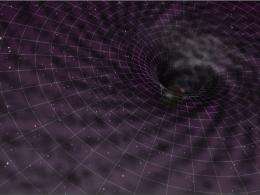
Artist's schematic impression of the distortion of spacetime by a supermassive black hole at the centre of a galaxy. The black hole will swallow dark matter at a rate which depends on its mass and on the amount of dark matter around it. Image: Felipe Esquivel Reed

(PhysOrg.com) -- About 23% of the Universe is made up of mysterious ‘dark matter’, invisible material only detected through its gravitational influence on its surroundings. Now two astronomers based at the National Autonomous University of Mexico (UNAM) have found a hint of the way it behaves near black holes. Their results appear in a letter in the journal Monthly Notices of the Royal Astronomical Society.

In the early Universe clumps of dark matter are thought to have attracted gas, which then coalesced into stars that eventually assembled the we see today. In their efforts to understand and evolution, astronomers have spent a good deal of time attempting to simulate the build up of dark matter in these objects.

The UNAM astronomers, Dr. Xavier Hernandez and Dr. William Lee, calculated the way in which the found at the centre of galaxies absorb dark matter. These black holes have anything between millions and billions of times the mass of the Sun and draw in material at a high rate.

The researchers modelled the way in which the dark matter is absorbed by black holes and found that the rate at which this happens is very sensitive to the amount of dark matter found in the black holes’ vicinity. If this concentration were larger than a critical density of 7 Suns of matter spread over each cubic light year of space, the black hole mass would increase so rapidly, hence engulfing such large amounts of dark matter, that soon the entire galaxy would be altered beyond recognition.

Dr. Hernandez explains, “Over the billions of years since galaxies formed, such runaway absorption of dark matter in black holes would have altered the population of galaxies away from what we actually observe.”

Their work therefore suggests that the density of dark matter in the centres of galaxies tends to a constant value. By comparing their observations to what current models of the evolution of the Universe predict, Hernandez and Lee conclude that it is probably necessary to change some of the assumptions that underpin these models - dark matter may not behave in the way scientists thought it did.

More information: A preprint of the paper can be seen at http://arxiv.org/abs/1002.0553

Provided by Royal Astronomical Society (news : web)

4.3 /5 (21 votes)  

Filter


Move the slider to adjust rank threshold, so that you can hide some of the comments.


Display comments: newest first

ebnv
Mar 22, 2010

Rank: 2.8 / 5 (9)
or -- there is no such thing as dark matter -- just saying
El_Nose
Mar 22, 2010

Rank: 4 / 5 (4)
-- this could explain the Great Void's http://en.wikiped...tes_void that exist. maybe there was a high concentration of dark matter near a large black hole... the size and gravity of the black hole increased significantlly effectively stripping a huge region of space of all matter and thus we now have the great void...
explaining Sloan's Wall http://en.wikiped...eat_Wall might be more difficult
LuckyBrandon
Mar 22, 2010

Rank: 5 / 5 (1)
in regards to the artists rendering...seems like space time would be distorted in such a way to rotate around the black hole, much as a galaxy rotates around its host black hole....
yyz
Mar 22, 2010

Rank: 5 / 5 (1)
El_Nose,

Maybe something along the lines of primordial black holes contributing to the formation of voids in the early universe? An interesting notion, but some (lonely) galaxies within nearby voids have been observed. That's not necessarily a significant problem, but would have to be taken into account.
yyz
Mar 22, 2010

Rank: 5 / 5 (1)
LuckyBrandon,

Check out some of the graphics and animations at "A Black Hole is a Waterfall of Space" ( http://jila.color...all.html ) to see what happens to matter near the event horizon of a black hole. (Actually, check out the 'hole' site for various types of black holes and their characteristics.)
antialias
Mar 22, 2010

Rank: 5 / 5 (3)
this could explain the Great Void....the size and gravity of the black hole increased significantlly effectively stripping a huge region of space of all matter


Unlikely. A black hole with a solar mass still has only the gravitational pull of one solar mass. Even supermassive black holes have a limited range beyond which their gravitational attraction becomes negligible (and stuff rather tends to orbit them than be swallowed up at those distances - much like the galaxy rotates but doesn't get eaten up by the central black hole(s).)

It is only near the event horizon where things get markedly different from a similar mass which is not a black hole. And the radius of the event horizon is 'relatively small'. Even for supermassive black holes is is on the order of only 10 AUs.

The Great Void is too large to have been sucked empty by an (or even many) supermassive black holes.
croghan27
Mar 22, 2010

Rank: not rated yet
"It is only near the event horizon where things get markedly different from a similar mass which is not a black hole. "

If it has a similar mass .... why is it not a black hole too. Given what I have heard of the mass of the holes compaired to the size of the holes - it must be all sorts of huge.
Slotin
Mar 22, 2010

Rank: not rated yet
In my opinion these large black holes virtually creating matter from vacuum fluctuations - we can see Big Bang in live broadcast there.

A Black Hole is a Waterfall of Space
It's rather observational illusion. The ripples at water surface are accellerating their speed from source, but it doesn't mean, true flow of matter occurs here - only dispersion of their energy into extradimensions, represented by underwater.
antialias_physorg
Mar 22, 2010

Rank: 5 / 5 (3)
If it has a similar mass .... why is it not a black hole too.


That was just an example to show that just because a body turns into a black hole it doesn't suddenly have more of a gravitational effect on nearby bodies than it did before it 'turned black'. The mass is the same and therefore so is the gravitational effect.

E.g. if our sun were to turn into a black hole (which it won't because it does not have enough mass) the earth would orbit around it exactly on the same path as it does now.

There are bodies that have masses greater than the Chandrasekar limit (1.44 masses of the sun for nonrotating bodies) which are not black holes (yet). This is because their internal radiation pressure still keeps them from collapsing. When that burns out these stellar bodies will collapse into black holes eventually.
croghan27
Mar 22, 2010

Rank: not rated yet
Thanks for that, antialias .... they are like Scrooge's third ghost ... black holes yet to be.

Slotin .... I have always wondered .... we are in one dimension here - it appears that frequently thing zap off from our dimension into others ..... that brings up the question - do some things ever come TO us from other dimensions?

String theory posits 31 (last time I looked) dimensions ..... that sounds like there is a pretty good chance the occasional bit would make its' way here.

If observed by a physicist that frowns upon the string idea - it would leave him all sorts of dazzled!
CyberRat
Mar 23, 2010

Rank: 2 / 5 (4)
Dark mater, made up all due to the redshift calculations, some objects move faster then light IF redshift can be counted to movement and speed. Worse thing is 'mainstream' scientist just refuse to look at other theories. 99% of visible mater is plasma, plasma means: electric current. Electromagnetic is so much more powerful then gravity!
Rank 4.3 /5 (21 votes)
Relevant PhysicsForums posts
  • Titan's lack of impact craters
    createdFeb 09, 2012
  • Real pictures of black hole eating a star?
    createdFeb 08, 2012
  • Hypothetical way to travel faster than light, but not technically exceed lightspeed
    createdFeb 06, 2012
  • How do scientists monitor the Sun's activity?
    createdFeb 05, 2012
  • Search patterns in observational studies
    createdFeb 05, 2012
  • Derivation of Pogson's law
    createdFeb 03, 2012
  • More from Physics Forums - General Astronomy

More news stories

Humans may have helped the decline of African rainforests 3000 years ago

(PhysOrg.com) -- Large areas of rainforests in Central Africa mysteriously disappeared over three thousand years ago, to be replaced by savannas. The prevailing theory has been that the cause was a change ...

Space & Earth / Environment

created 10 hours ago | popularity 5 / 5 (4) | comments 10 | with audio podcast report

Could Venus be shifting gear?

(PhysOrg.com) -- ESA’s Venus Express spacecraft has discovered that our cloud-covered neighbour spins a little slower than previously measured. Peering through the dense atmosphere in the infrared, the ...

Space & Earth / Space Exploration

created 6 hours ago | popularity 5 / 5 (5) | comments 7 | with audio podcast

Mars Science Laboratory computer issue resolved

(PhysOrg.com) -- Engineers have found the root cause of a computer reset that occurred two months ago on NASA's Mars Science Laboratory and have determined how to correct it.

Space & Earth / Space Exploration

created 7 hours ago | popularity 5 / 5 (5) | comments 3 | with audio podcast

Clam fields found at deep, low-temperature Mariana vents

(PhysOrg.com) -- Scientists have marveled at the unusual life forms thriving at high temperature hydrothermal vents of the deep ocean.

Space & Earth / Earth Sciences

created 7 hours ago | popularity not rated yet | comments 0 | with audio podcast

Two new moons for Jupiter

Advances in technology have lead to the discovery of new planets outside of our Solar System, and now even new moons in our own backyard.

Space & Earth / Space Exploration

created 6 hours ago | popularity not rated yet | comments 4


Complex wiring of the nervous system may rely on a just a handful of genes and proteins

Researchers at the Salk Institute have discovered a startling feature of early brain development that helps to explain how complex neuron wiring patterns are programmed using just a handful of critical genes. ...

The power of estrogen -- male snakes attract other males

A new study has shown that boosting the estrogen levels of male garter snakes causes them to secrete the same pheromones that females use to attract suitors, and turned the males into just about the sexiest ...

Human cognitive performance suffers following natural disasters, researchers find

Not surprisingly, victims of a natural disaster can experience stress and anxiety, but a new study indicates that it might also cause them to make more errors - some serious - in their daily lives. In their upcoming Human Fa ...

New error-correcting codes guarantee the fastest possible rate of data transmission

Error-correcting codes are one of the triumphs of the digital age. They’re a way of encoding information so that it can be transmitted across a communication channel — such as an optical fiber o ...

Both maternal and paternal age linked to autism

Older maternal and paternal age are jointly associated with having a child with autism, according to a recently published study led by researchers at The University of Texas Health Science Center at Houston (UTHealth).

Curry spice component may help slow prostate tumor growth

Curcumin, an active component of the Indian curry spice turmeric, may help slow down tumor growth in castration-resistant prostate cancer patients on androgen deprivation therapy (ADT), a study from researchers ...