Mapping Venus: Extreme makeover or plate tectonics?
March 22, 2010 by Morgan Bettex
Mapping Venus

Enlarge

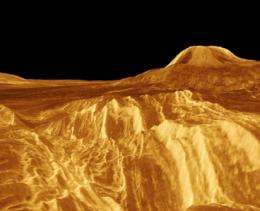
This computer-generated view of the surface of Venus was created from radar images taken during NASA’s Magellan mission during the 1990s. The images suggest that the Venus surface evolves through a periodic resurfacing process, possibly caused by volcanic activity. Image: NASA Jet Propulsion Laboratory

(PhysOrg.com) -- Venus and Earth have long been thought of as sister planets. Given its similar size and proximity to Earth in the inner Solar System, Venus might seem like a promising candidate for having a surface that evolves through a tectonic process similar to what occurs on Earth, where rigid plates slowly shift across the underlying mantle.

But a recent analysis by Peter James, a graduate student in the Department of Earth, Atmospheric and Planetary Sciences, highlights the fact that Earth’s plate tectonics seem to be the exception rather than the rule for rocky planets like , Mars and Mercury.

James provides new evidence that the generation and recycling of the surface on Venus occurs through a process that is actually quite different from what happens on Earth. His finding supports a theory that first arose in the early 1990s, when NASA’s Magellan spacecraft orbited Venus and took radar images of the planet’s surface. Before Magellan, most scientists assumed that the surface of Venus was influenced by some form of or volcanism.

The Magellan images revealed a distribution of craters that suggest that most of Venus’ surface was formed around the same time — about 500 million years ago, which is young considering that the planet’s age is estimated at about 4.6 billion years. As a result of this uniform age of the surface, scientists hypothesized that the Venus surface is not made of moving plates like Earth, nor is it inactive like the moon. Instead it evolves through a periodic resurfacing process, possibly caused by .

Probing the crust

Geologists study features of a planet’s crust, such as its thickness and composition, for clues about that planet’s history. These clues shed light on the physical processes that made the crust, which is usually produced by partial melting of mantle material.

To study Venus’ crust, James used gravity and topography data collected by Magellan between 1990 and 1994. Analyzing these data, James mapped the thickness of the planet’s crust, which he calculated to be about 30 kilometers (Earth’s is about 20 kilometers, on average). He could identify regions where Venus’ convecting mantle is pushing or pulling on its crust as the planet cools.

While these results provide a better picture of the Venus crust, what is most compelling about the analysis, which James presented on March 1 at the Lunar and Planetary Science Conference, is the discovery that there are no large mass concentrations, or “mascons,” buried beneath the surface of Venus.

Existing on Mars and the moon, mascons are gravity anomalies that correspond to large craters and basins created billions of years ago by massive impacts from large meteoroids. These mascons exert a slightly stronger gravitational pull — detected by spacecraft or satellites — than that of a smooth surface. While the process of mascon formation is not well understood, James explained that the extra gravitational pull likely comes from two sources: dense rock in the craters from volcanic flow and the placement of denser mantle material near the surface.

James expected to find remnants of these crustal structures on Venus, given that they are prominent features on Mars and the moon. He believes that the absence of mascons is consistent with the idea that the Venus surface experienced some sort of “catastrophic overturning” at least 500 million years ago. “If the mascons were erased in the event 500 million years ago, that would require a mechanism that more thoroughly reworks the crust,” he explained.

Brown University geologist Marc Parmentier agreed with James that the lack of mascons indicates that some sort of mechanism — perhaps large-scale volcanic activity — periodically creates a new surface on Venus.

He praised the analysis for ensuring that research about Venus remains an active area in planetary science, which is currently heavily focused on Mars and the moon. “His work lets us continue to address one of the questions of Venus, which is how this so-called resurfacing process took place,” he said.

James hopes to address this question in future research by using more finite element modeling to understand how mascons are formed and evolve. He said that NASA’s upcoming GRAIL mission to the moon will gather unprecedented gravity data that will provide some basis for comparing the lunar and Venus crusts.

Provided by Massachusetts Institute of Technology (news : web)

Filter


Move the slider to adjust rank threshold, so that you can hide some of the comments.


Display comments: newest first

Shootist
Mar 22, 2010

Rank: 5 / 5 (1)
No surprise. Of the four rocky worlds only Terra has Luna.
MontgomeryScott
Mar 22, 2010

Rank: not rated yet
Agree, not sure why there is not more study associated with the huge affects the moon has played in the history of the earth, ourselves, and the possibility of life itself.
hylozoic
Mar 23, 2010

Rank: not rated yet
A gravity well spinning around this gravity well seems to be a good candidate for an 'Important Variable' award -- especially when thinking about the factors that contribute to the development of organisms which are effectively physiological expressions of water existing within in a high-density feedback waveform of carbon, et cetera....
Rank 5 /5 (11 votes)
Related Stories
Relevant PhysicsForums posts
  • Scale of the Universe
    created8 hours ago
  • Titan's lack of impact craters
    createdFeb 09, 2012
  • Real pictures of black hole eating a star?
    createdFeb 08, 2012
  • Hypothetical way to travel faster than light, but not technically exceed lightspeed
    createdFeb 06, 2012
  • How do scientists monitor the Sun's activity?
    createdFeb 05, 2012
  • Search patterns in observational studies
    createdFeb 05, 2012
  • More from Physics Forums - General Astronomy

More news stories

Humans may have helped the decline of African rainforests 3000 years ago

(PhysOrg.com) -- Large areas of rainforests in Central Africa mysteriously disappeared over three thousand years ago, to be replaced by savannas. The prevailing theory has been that the cause was a change ...

Space & Earth / Environment

created 19 hours ago | popularity 4.3 / 5 (11) | comments 12 | with audio podcast report

Could Venus be shifting gear?

(PhysOrg.com) -- ESA’s Venus Express spacecraft has discovered that our cloud-covered neighbour spins a little slower than previously measured. Peering through the dense atmosphere in the infrared, the ...

Space & Earth / Space Exploration

created 15 hours ago | popularity 5 / 5 (7) | comments 7 | with audio podcast

NASA budget will axe Mars deal with Europe: scientists

US President Barack Obama's budget proposal to be submitted next week for 2013 will cut NASA's budget by 20 percent and eliminate a major partnership with Europe on Mars exploration, scientists said Thursday.

Space & Earth / Space Exploration

created 18 hours ago | popularity 5 / 5 (2) | comments 18

Mars Science Laboratory computer issue resolved

(PhysOrg.com) -- Engineers have found the root cause of a computer reset that occurred two months ago on NASA's Mars Science Laboratory and have determined how to correct it.

Space & Earth / Space Exploration

created 16 hours ago | popularity 4.7 / 5 (6) | comments 3 | with audio podcast

Two new moons for Jupiter

Advances in technology have lead to the discovery of new planets outside of our Solar System, and now even new moons in our own backyard.

Space & Earth / Space Exploration

created 15 hours ago | popularity 4 / 5 (1) | comments 7


Google users warned of threat to smartphone wallets

Users of Google smartphone wallets were being warned on Friday that there is a way to crack pass codes intended to thwart thieves from going on illicit shopping sprees.

Anonymous knocks CIA website offline (Update)

The website of the Central Intelligence Agency was inaccessible on Friday after the hacker group Anonymous claimed to have knocked it offline.

New error-correcting codes guarantee the fastest possible rate of data transmission

Error-correcting codes are one of the triumphs of the digital age. They’re a way of encoding information so that it can be transmitted across a communication channel — such as an optical fiber o ...

New power source discovered

(PhysOrg.com) -- Researchers at the Massachusetts Institute of Technology (MIT) and RMIT University have made a breakthrough in energy storage and power generation.

Complex wiring of the nervous system may rely on a just a handful of genes and proteins

Researchers at the Salk Institute have discovered a startling feature of early brain development that helps to explain how complex neuron wiring patterns are programmed using just a handful of critical genes. ...

The power of estrogen -- male snakes attract other males

A new study has shown that boosting the estrogen levels of male garter snakes causes them to secrete the same pheromones that females use to attract suitors, and turned the males into just about the sexiest ...