Printable sensors
March 22, 2010
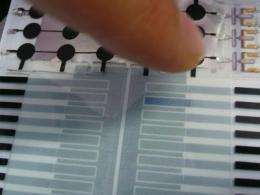
The sensor recognizes the finger's heat signal without being touched. Credit: Joanneum Research Forschungsgesellschaft mbH
In the future every home will have one: electronic devices that you can control just by pointing a finger. To turn this vision into reality the 3Plast research consortium is developing special sensors that can be printed onto plastic film and affixed to objects.
The cellphone is switched off but immediately springs into action at the point of a finger. It is not necessary to touch the display. This touchless control is made possible by a polymer sensor affixed to the cellphone which, like human skin, reacts to the tiniest fluctuations in temperature and differences in pressure and recognizes the finger as it approaches.
The scenario is fictitious at present but could become reality in a few years time thanks to the efforts of the research scientists involved in the EU project 3Plast, which stands for "Printable pyroelectrical and piezoelectrical large area sensor technology". The companies and institutes involved from industry and research have set themselves the goal of mass producing pressure and temperature sensors which can be cheaply printed onto plastic film and flexibly affixed to a wide range of everyday objects, such as electronic equipment. The 2.2 million euro funded project is coordinated by the Fraunhofer Institute for Silicate Research ISC in Würzburg.
"The sensor consists of pyroelectrical and piezoelectrical polymers which can now be processed in high volumes by screen printing, for example. The sensor is combined with an organic transistor, which strengthens the sensor signal. It's strongest where the finger is," explains Gerhard Domann, who is in charge of the project. "The special thing about our sensor is that the transistor can also be printed."
The production of polymer sensors still poses a number of challenges. To produce printable transistors, the insulation materials have to be very thin. The experts at the ISC have, however, succeeded in producing an insulator which is only 100 nanometers thick. The first sensors have already been printed onto film. The research scientists are currently working on optimized transistors which can amplify rapid changes in temperature and pressure.
"By providing everyday objects with information about their environment - for example whether a person is approaching - by means of pressure and temperature sensors, we can create and market new devices that can be controlled just by pointing a finger," enthuses Domann. The research scientist envisions further applications for the technology in the automotive and construction industries as well as in robotics. "The project comes to an end in January 2011, but we think it will take a few more years before sensors can be printed on large surfaces."
-
Printable biofuel cell developed in Finland
Nov 08, 2006 |
not rated yet |
0
-
Sensor of plastic can be produced in a printing press
Feb 08, 2005 |
not rated yet |
0
-
Position sensors: magnets know their place
Feb 25, 2008 |
not rated yet |
0
-
World's Smallest 2.0µm-Pixel MOS Image Sensor
Feb 09, 2005 |
not rated yet |
0
-
Eyeing the future of ubiquitous computing
Dec 05, 2004 |
not rated yet |
0
-
Engineers build first sub-10-nm carbon nanotube transistor
Feb 01, 2012 |
4.9 / 5 (31) |
30
-
Something old, something new: Evolution and the structural divergence of duplicate genes
Jan 31, 2012 |
4.6 / 5 (7) |
1
-
The hidden nanoworld of ice crystals: Revealing the dynamic behavior of quasi-liquid layers
Jan 30, 2012 |
5 / 5 (3) |
1
-
Stock market network reveals investor clustering
Jan 27, 2012 |
3.9 / 5 (23) |
8
-
Of microchemistry and molecules: Electronic microfluidic device synthesizes biocompatible probes
Jan 26, 2012 |
5 / 5 (1) |
0
-
Calling function with no input argument
6 hours ago
-
Force free body diagram problem on gym equipment
7 hours ago
-
Empirical data regarding shower heads and water
15 hours ago
-
feed hold button on CNC lathe
Feb 09, 2012
-
RFAC in Fortran
Feb 09, 2012
-
dynamics 2/32
Feb 08, 2012
- More from Physics Forums - General Engineering
More news stories
CIA website offline, Anonymous takes credit
The website of the Central Intelligence Agency was unresponsive on Friday after the hacker group Anonymous claimed to have knocked it offline.
56 minutes ago |
5 / 5 (1) |
6
New error-correcting codes guarantee the fastest possible rate of data transmission
Error-correcting codes are one of the triumphs of the digital age. Theyre a way of encoding information so that it can be transmitted across a communication channel such as an optical fiber o ...
Technology / Computer Sciences
9 hours ago |
5 / 5 (3) |
5
|
Small modular reactor design could be a 'SUPERSTAR'
(PhysOrg.com) -- Though most of today's nuclear reactors are cooled by water, we've long known that there are alternatives; in fact, the world's first nuclear-powered electricity in 1951 came from a reactor ...
Technology / Energy & Green Tech
8 hours ago |
4.2 / 5 (10) |
18
|
Advanced power-grid model finds low-cost, low-carbon future in West
(PhysOrg.com) -- The least expensive way for the Western U.S. to reduce greenhouse gas emissions enough to help prevent the worst consequences of global warming is to replace coal with renewable and other ...
Technology / Energy & Green Tech
8 hours ago |
3.7 / 5 (3) |
7
|
New power source discovered
(PhysOrg.com) -- Researchers at the Massachusetts Institute of Technology (MIT) and RMIT University have made a breakthrough in energy storage and power generation.
Technology / Energy & Green Tech
8 hours ago |
4.9 / 5 (11) |
3
|
Complex wiring of the nervous system may rely on a just a handful of genes and proteins
Researchers at the Salk Institute have discovered a startling feature of early brain development that helps to explain how complex neuron wiring patterns are programmed using just a handful of critical genes. ...
Q&A: Obama and the birth control controversy
(AP) -- What birth control debate? A half-century after the introduction of the pill, acceptance of birth control by American women is virtually universal.
The power of estrogen -- male snakes attract other males
A new study has shown that boosting the estrogen levels of male garter snakes causes them to secrete the same pheromones that females use to attract suitors, and turned the males into just about the sexiest ...
Humans may have helped the decline of African rainforests 3000 years ago
(PhysOrg.com) -- Large areas of rainforests in Central Africa mysteriously disappeared over three thousand years ago, to be replaced by savannas. The prevailing theory has been that the cause was a change ...
Both maternal and paternal age linked to autism
Older maternal and paternal age are jointly associated with having a child with autism, according to a recently published study led by researchers at The University of Texas Health Science Center at Houston (UTHealth).
Curry spice component may help slow prostate tumor growth
Curcumin, an active component of the Indian curry spice turmeric, may help slow down tumor growth in castration-resistant prostate cancer patients on androgen deprivation therapy (ADT), a study from researchers ...