23,000 year old stone wall found at entrance to cave in Greece
March 22, 2010
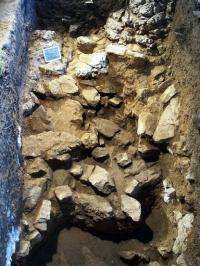
An undated handout photo provided by the Greek Culture Ministry shows an prehistorical stone wall. The ministry said Greek experts discovered the oldest stony wall of the country, blocking the entrance of a cavern for 23,000 years in Thessalia, in the north.
The oldest stone wall in Greece, which has stood at the entrance of a cave in Thessaly for the last 23,000 years, has been discovered by palaeontologists, the ministry of culture said Monday.
The age of the find, determined by an optical dating test, singles it out as "probably one of the oldest in the world", according to a ministry press release.
"The dating matches the coldest period of the most recent ice age, indicating that the cavern's paleolithic inhabitants built it to protect themselves from the cold", said the ministry.
The wall blocked two-thirds of the entrance to the cave, located close to Kalambaka, itself near the popular tourist area and monastic centre of Meteora in central Greece. Greek palaeontologists have been excavating the site for the last 25 years.
(c) 2010 AFP
-
Historic Italian cave may collapse
May 01, 2008 |
not rated yet |
0
-
Fifth century BC objects returned to Greece
May 19, 2009 |
not rated yet |
0
-
Earliest evidence of our cave-dwelling human ancestors
Dec 19, 2008 |
not rated yet |
0
-
World's oldest submerged town dates back 5,000 years (w/ Video)
Oct 16, 2009 |
not rated yet |
0
-
Ancient drawing of mammoth found in Cheddar caves
Aug 15, 2007 |
not rated yet |
0
-
Engineers build first sub-10-nm carbon nanotube transistor
Feb 01, 2012 |
4.9 / 5 (28) |
26
-
Something old, something new: Evolution and the structural divergence of duplicate genes
Jan 31, 2012 |
4.6 / 5 (7) |
1
-
The hidden nanoworld of ice crystals: Revealing the dynamic behavior of quasi-liquid layers
Jan 30, 2012 |
5 / 5 (3) |
1
-
Stock market network reveals investor clustering
Jan 27, 2012 |
4 / 5 (22) |
8
-
Of microchemistry and molecules: Electronic microfluidic device synthesizes biocompatible probes
Jan 26, 2012 |
5 / 5 (1) |
0
-
What are the limits of learning?
6 hours ago
-
Neuroscientists: What is a Principal Cell Layer?
17 hours ago
-
How does slime mould grow?
Feb 04, 2012
-
Why are mosquitoes and bedbugs successful?
Feb 04, 2012
-
Amazon fungi found to eat plastic
Feb 01, 2012
-
Tips Picking up TEM grids?
Feb 01, 2012
- More from Physics Forums - Biology
More news stories
Counties with thriving small businesses have healthier residents, researchers find
Counties and parishes with a greater concentration of small, locally-owned businesses have healthier populations with lower rates of mortality, obesity and diabetes than do those that rely on large companies ...
Other Sciences / Economics & Business
11 minutes ago |
not rated yet |
0
Fossil cricket: Jurassic love song reconstructed
Some 165 million years ago, the world was host to a diversity of sounds. Primitive bushcrickets and croaking amphibians were among the first animals to produce loud sounds by stridulation (rubbing certain body parts together). ...
Other Sciences / Archaeology & Fossils
13 hours ago |
5 / 5 (2) |
1
|
Do we no longer care about the collective good?
The Transformation of Solidarity, a book co-edited by University of Queensland sociologist Dr Mara Yerkes, tackles the subject of globalisation of national economies and societies where we put a high value ...
Other Sciences / Social Sciences
22 hours ago |
3.9 / 5 (8) |
34
East views the world differently to West
Cultural differences between the West and East are well documented, but a study shows that concrete differences also exist in how British and Chinese people recognise people and the world around them. Easterners really do ...
Other Sciences / Social Sciences
18 hours ago |
5 / 5 (5) |
7
Namibia sponge fossils are world's first animals: study
Scientists digging in a Namibian national park have uncovered sponge-like fossils they say are the first animals, a discovery that would push the emergence of animal life back millions of years.
Other Sciences / Archaeology & Fossils
21 hours ago |
4.6 / 5 (10) |
0
Our Amorphophallus is smaller: New plant species from Madagascar smells like roadkill
The famed "corpse flower" plant known for its giant size, rotten-meat odor and phallic shape has a new, smaller relative: A University of Utah botanist discovered a new species of Amorphophallus that i ...
Invasive alien predator causes rapid declines of European ladybirds
A new study provides compelling evidence that the arrival of the invasive non-native harlequin ladybird to mainland Europe and subsequent spread has led to a rapid decline in historically-widespread species ...
New findings highlight the benefit of exercise ECGs just as they are being scrapped
In the UK, the exercise electrocardiogram (ECG) is the most common initial test for the evaluation of stable chest pain and has been used widely for almost half a century. However, recent NICE guidelines recommend that it ...
Looking for work? There may be an app for that
(AP) -- Looking for a promising career in a lousy economy? A new study suggests you're apt to find it in apps - the services and tools built to run on smartphones, computer tablets and Facebook's online social network.
Firm claims Apple infringing trademark in China
A Taiwan-linked company which claims ownership of the iPad trademark in China has filed lawsuits and lodged complaints against Apple for infringement, according to a lawyer.
Long-term study shows epilepsy surgery improves seizure control and quality of life
While epilepsy surgery is a safe and effective intervention for seizure control, medical therapy remains the more prominent treatment option for those with epilepsy. However, a new 26-year study reveals that following epilepsy ...
Mar 22, 2010
Rank: 5 / 5 (1)
Mar 22, 2010
Rank: 4.3 / 5 (3)
But seriously, this link will explain it to you
http://en.wikiped...l_dating
Mar 22, 2010
Rank: 3.3 / 5 (3)
Mar 22, 2010
Rank: 1 / 5 (1)
Mar 23, 2010
Rank: not rated yet
Apr 05, 2010
Rank: not rated yet
Apr 08, 2010
Rank: not rated yet
High-class art had hung on the walls of French caves, for 10,000 years when this wall was built.
The great majority of people would not have a cave available: most lived in open settings, and built structures for shelter and other purposes
But most construction was of organic materials, and did not last.
We probably get some wrong ideas, by placing too much weight on what we find in caves: they were never "representative" living-contexts.