Researchers investigate mysterious stone spheres in Costa Rica
March 22, 2010
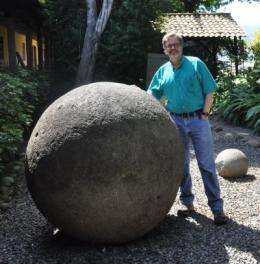
John Hoopes, University of Kansas associate professor of anthropology and director of the Global Indigenous Nations Studies Program, recently returned from a trip to Costa Rica where he and colleagues evaluated ancient stone spheres for UNESCO, the United Nations cultural organization that might grant the spheres World Heritage Status. Credit: Courtesy of John Hoopes
The ancient stone spheres of Costa Rica were made world-famous by the opening sequence of "Raiders of the Lost Ark," when a mockup of one of the mysterious relics nearly crushed Indiana Jones.
So perhaps John Hoopes is the closest thing at the University of Kansas to the movie action hero.
Hoopes, associate professor of anthropology and director of the Global Indigenous Nations Studies Program, recently returned from a trip to Costa Rica where he and colleagues evaluated the stone balls for UNESCO, the United Nations cultural organization that might grant the spheres World Heritage Status.
His report will help determine if sites linked to the massive orbs will be designated for preservation and promotion because of their "outstanding value to humanity."
Hoopes, who researches ancient cultures of Central and South America, is one of the world's foremost experts on the Costa Rican spheres. He explained that although the stone spheres are very old, international interest in them is still growing.
"The earliest reports of the stones come from the late 19th century, but they weren't really reported scientifically until the 1930s — so they're a relatively recent discovery," Hoopes said. "They remained unknown until the United Fruit Company began clearing land for banana plantations in southern Costa Rica."
According to Hoopes, around 300 balls are known to exist, with the largest weighing 16 tons and measuring eight feet in diameter. Many of these are clustered in Costa Rica's Diquis Delta region. Some remain pristine in the original places of discovery, but many others have been relocated or damaged due to erosion, fires and vandalism.
The KU researcher said that scientists believe the stones were first created around 600 A.D., with most dating to after 1,000 A.D. but before the Spanish conquest.
"We date the spheres by pottery styles and radiocarbon dates associated with archeological deposits found with the stone spheres," Hoopes said. "One of the problems with this methodology is that it tells you the latest use of the sphere but it doesn't tell you when it was made. These objects can be used for centuries and are still sitting where they are after a thousand years. So it's very difficult to say exactly when they were made."
Speculation and pseudoscience have plagued general understanding of the stone spheres. For instance, publications have claimed that the balls are associated with the "lost" continent of Atlantis. Others have asserted that the balls are navigational aids or relics related to Stonehenge or the massive heads on Easter Island.
"Myths are really based on a lot of very rampant speculation about imaginary ancient civilizations or visits from extraterrestrials," Hoopes said.
In reality, archaeological excavations in the 1940s found the stone balls to be linked with pottery and materials typical of pre-Columbian cultures of southern Costa Rica.
"We really don't know why they were made," Hoopes said. "The people who made them didn't leave any written records. We're left to archeological data to try to reconstruct the context. The culture of the people who made them became extinct shortly after the Spanish conquest. So, there are no myths or legends or other stories that are told by the indigenous people of Costa Rica about why they made these spheres."
Hoopes has a created a popular Web page to knock down some of the misconceptions about the spheres. He said the stones' creation, while vague, certainly had nothing to do with lost cities or space ships.
"We think the main technique that was used was pecking and grinding and hammering with stones," said Hoopes. "There are some spheres that have been found that still have the marks of the blows on them from hammer stones. We think that that's how they were formed, by hammering on big rocks and sculpting them into a spherical shape."
Provided by University of Kansas
-
Costa Rica tops happiness, 'green living' poll
Jul 04, 2009 |
not rated yet |
0
-
Hollow spheres made of metal
Oct 13, 2009 |
not rated yet |
0
-
Probing Question: How and why was Stonehenge built?
Mar 18, 2010 |
not rated yet |
0
-
What is the risk factor for gastric cancer in a Costa Rican?
Jan 21, 2009 |
not rated yet |
0
-
Scientists 'grow' edible insects in Costa Rica
Feb 03, 2010 |
not rated yet |
0
-
Engineers build first sub-10-nm carbon nanotube transistor
Feb 01, 2012 |
4.9 / 5 (31) |
30
-
Something old, something new: Evolution and the structural divergence of duplicate genes
Jan 31, 2012 |
4.6 / 5 (7) |
1
-
The hidden nanoworld of ice crystals: Revealing the dynamic behavior of quasi-liquid layers
Jan 30, 2012 |
5 / 5 (3) |
1
-
Stock market network reveals investor clustering
Jan 27, 2012 |
3.9 / 5 (23) |
8
-
Of microchemistry and molecules: Electronic microfluidic device synthesizes biocompatible probes
Jan 26, 2012 |
5 / 5 (1) |
0
-
Mitosis
2 hours ago
-
Stem cell question.
3 hours ago
-
Protease cleavage
10 hours ago
-
Pertubance in a model
16 hours ago
-
Cancer drugs and Alzheimer's, Oh my!
Feb 09, 2012
-
Squishing cells
Feb 09, 2012
- More from Physics Forums - Biology
More news stories
A frank discussion of the power law and linking correlation to causation
(PhysOrg.com) -- Michael Stumpf a mathematics professor at Imperial College in London, and Mason Porter a lecturer at Oxford have teamed together to write and publish a perspective piece in Science regarding the in ...
Employers feel no love for unscrupulous practice of 'service sweethearting'
A new study led by two Florida State University marketing professors finds that some frontline service employees who are rewarded for hikes in customer loyalty and satisfaction also may engage in "service ...
Other Sciences / Economics & Business
10 hours ago |
4 / 5 (1) |
4
The question of life in the ancient world
Theres a general feeling that we dont get the Greeks ancient or modern. Many, including heads of state like Angela Merkel, visibly shake their head in exasperation, rightly or wrongly, at ...
Other Sciences / Archaeology & Fossils
16 hours ago |
1.3 / 5 (3) |
4
Sonic Cradle lands spot in TED exhibition
A Simon Fraser University graduate student project that melds music, meditation and modern technology has landed a rare spot as an exhibit at TEDActive 2012 in Palm Springs, California this month.
12 hours ago |
not rated yet |
0
Chilean miners' rescue capsule on show in London
The capsule used to rescue Chilean miners trapped underground for two months goes on display Saturday at the Science Museum in London -- the first time it has been seen in Europe.
15 hours ago |
not rated yet |
0
Google users warned of threat to smartphone wallets
Users of Google smartphone wallets were being warned on Friday that there is a way to crack pass codes intended to thwart thieves from going on illicit shopping sprees.
Anonymous knocks CIA website offline (Update)
The website of the Central Intelligence Agency was inaccessible on Friday after the hacker group Anonymous claimed to have knocked it offline.
New error-correcting codes guarantee the fastest possible rate of data transmission
Error-correcting codes are one of the triumphs of the digital age. Theyre a way of encoding information so that it can be transmitted across a communication channel such as an optical fiber o ...
Humans may have helped the decline of African rainforests 3000 years ago
(PhysOrg.com) -- Large areas of rainforests in Central Africa mysteriously disappeared over three thousand years ago, to be replaced by savannas. The prevailing theory has been that the cause was a change ...
New power source discovered
(PhysOrg.com) -- Researchers at the Massachusetts Institute of Technology (MIT) and RMIT University have made a breakthrough in energy storage and power generation.
Complex wiring of the nervous system may rely on a just a handful of genes and proteins
Researchers at the Salk Institute have discovered a startling feature of early brain development that helps to explain how complex neuron wiring patterns are programmed using just a handful of critical genes. ...
Mar 22, 2010
Rank: 5 / 5 (1)
I would love to see a Mythbusters on that one!!! LOL
How round are they????? That will tell you how sophisticated they were.
Mar 22, 2010
Rank: 1 / 5 (4)
He is giving them an age concurrent with the ages of contextual evidence -potsherds and fire ash associated with the spheres- which actually mean nothing more nor less than that people left some potsherds near them, and had a fire going.
It certainly does not equate to these same people being the "sculptors".
Also, Hoopes, I note, does not source the material, either. Are there large, weathered outcrops of the stone nearby? Evidence of Quarrying? Where are these hammers and "peckers"?
Where are the large firepits needed to produce the coals to repeatedly heat the surface of these "boulders"? What is the "exfoliation habit" of this type of rock ie- is it orthogonal or spherical in terms of the exfoliating process?
Lastly, where are the NUMBERS? What are their size, distribution, deviation from spherical, ET C,?
Mar 23, 2010
Rank: 5 / 5 (2)
http://www.world-...r_12.htm
Brant. I also would definitely like to know how perfect they are. But they haven't been properly measured yet. Drawing a perfect 2D circle is hard enough. But a near perfect sphere would be more of a challenge.
Mar 23, 2010
Rank: 2 / 5 (4)
Thanks for the info- I've looked into this whole fascinating mystery rather extensively over the years, including Dr. Hoopes' explanation- thus my questions regarding the lack of hard, quantified, comprehensive data, and the therefore merely "interpretive" nature of his conclusions.
Mar 23, 2010
Rank: 4 / 5 (1)
Mar 23, 2010
Rank: 2.2 / 5 (6)
Mar 23, 2010
Rank: 3.8 / 5 (4)
Humans seem to have been around for quite a while -- these things only emphasize how interesting a species we appear to be. Man, life is good.
Mar 23, 2010
Rank: 4.2 / 5 (5)
Actually it's the exact opposite which lead to the Salem witch trials. Accepting an idea as plausible or valid when there is absolutely no evidence to support it can lead to things like burning people because they're witches.
The burden of proof is on all claims in science. That is what science is. Identifying what is very clearly mythology doesn't mean that it is not true. However hypotheses founded on mythology which has no basis in fact (or is actually counter-factual) can certainly be called silly.
Science doesn't say these silly ideas are untrue (except where they are demonstrably counter-factual), but don't expect people to spend time looking into completely implausible, silly ideas based on mythology. If there were a kernel of truth in it, science would (or will) eventually take it and run whole hog with it.
Until then, scientists will laugh.
Mar 23, 2010
Rank: 5 / 5 (4)
maybe these are a similar way of saying My Balls are bigger than yours?
Mar 23, 2010
Rank: 3.4 / 5 (5)
I can draw a perfect-to-the-eye circle with a piece of string tied to a pencil, so I don't think it's all that hard.
Mar 23, 2010
Rank: 4 / 5 (1)
Mar 23, 2010
Rank: 4 / 5 (1)
Mar 23, 2010
Rank: 2.5 / 5 (2)
Mar 23, 2010
Rank: 3 / 5 (1)
Mar 23, 2010
Rank: 4 / 5 (2)
Precisely because they are as yet a mystery. Their potential value is enormous, and only until we prove or disprove a particular origin can we derive a more definite value. Are you willing to trash something that may actually have some cultural, historical or scientific value--before you know its true value?
Mar 23, 2010
Rank: 1 / 5 (1)
I get what you are saying and I agree - it's better to err on safe side and research and protect something that may have a huge value.
But the point of the article is not that. The point is to first declare the spheres to have "outstanding value to humanity" and get them World Heritage status under UNESCO - now when we know almost absolutely nothing about them. Now, not after doing research to know for sure (actually, to know anything, according to the interviewed guy).
I guess it might be just politics - the country in UNESCO's program gets some financing.
Mar 24, 2010
Rank: 1 / 5 (1)
An old professor of mine-- I took a 300 level course in archaeology from him a few years back at KU. He's a really great guy. Loved the class.
Mar 28, 2010
Rank: 5 / 5 (1)
I seem to recall seeing pictures in the World Book or National Geographic (as a kid ) which showed large (several feet high) stone wheels sitting outside Cook Islanders raised thatched homes. As I recall, they were a form of money! Possibly the stone spheres served a similar function... fortunately the Cook Islanders were still around to ask I guess.
Mar 31, 2010
Rank: not rated yet